
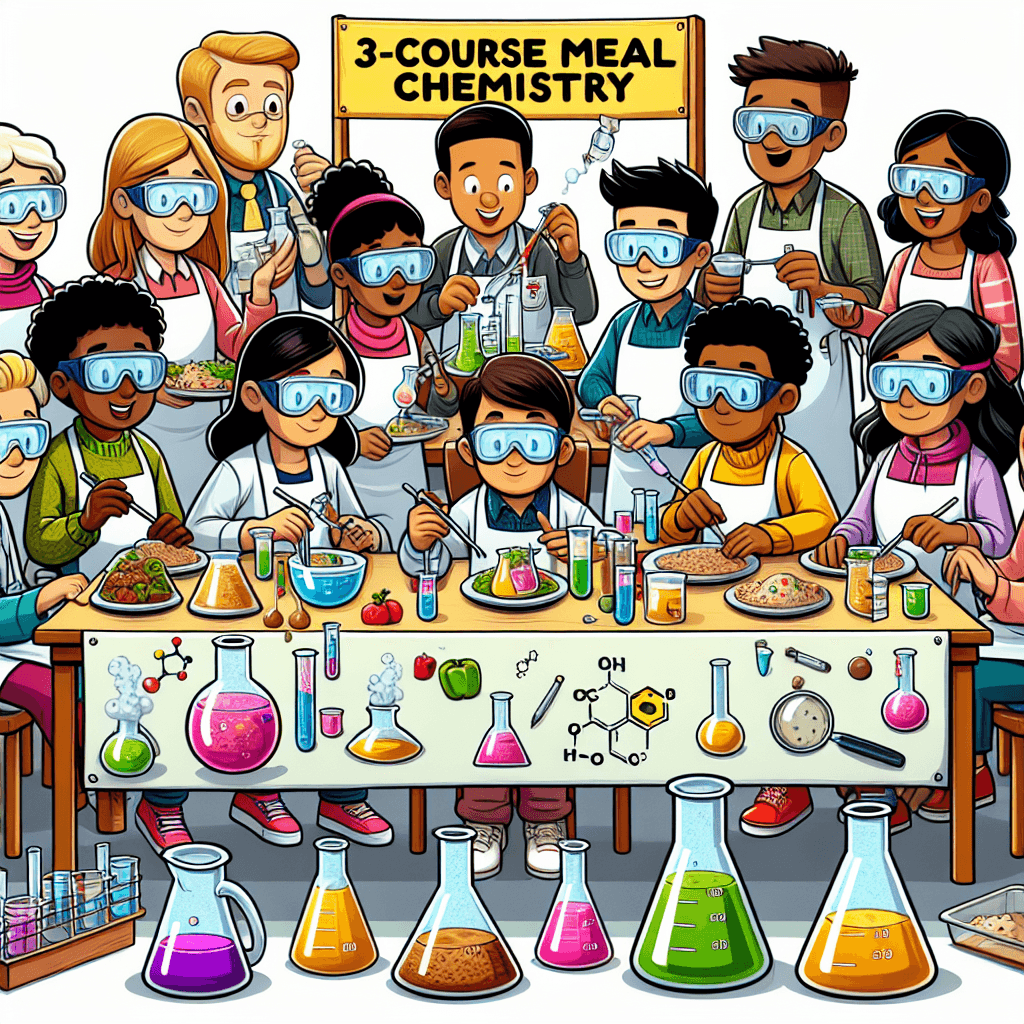
3-Course Meal Chemistry Exploration
Inquiry Framework
Question Framework
Driving Question
The overarching question that guides the entire project.How can we use our understanding of chemical reactions and physical changes to create a 3-course meal that not only satisfies personal taste but also demonstrates the principles of conservation of energy and matter in cooking?Essential Questions
Supporting questions that break down major concepts.- What are the key differences between physical and chemical changes, and how can they be identified in everyday cooking?
- How do chemical reactions in cooking demonstrate the law of conservation of energy and matter?
- In what ways can a recipe be modified to influence the outcome of a dish and cater to personal preferences?
- How does thermal energy affect the state and particle motion of a substance during a chemical reaction in cooking?
- What role does temperature play in both endothermic and exothermic reactions during the cooking process?
- How can understanding chemical reactions and physical changes in cooking lead to innovation and creativity in recipe development?
Standards & Learning Goals
Learning Goals
By the end of this project, students will be able to:- Students will demonstrate the ability to identify chemical and physical changes in cooking through experimentation and analysis of recipes.
- Students will create models to explain chemical reactions and the conservation of mass and energy within the context of cooking.
- Students will test, modify, and innovate cooking recipes to align with personal preferences while understanding underlying chemical principles.
- Students will analyze the impact of temperature on state changes and particle motion in the context of cooking.
- Students will write and interpret chemical equations relevant to the recipes used in their project.
- Students will understand and explain the roles of endothermic and exothermic reactions in the cooking process.
NGSS
Entry Events
Events that will be used to introduce the project to studentsThe Mystery Box Challenge
Introduce the project with a ‘Mystery Box’ that contains strange ingredients and everyday kitchen items. Ask students to identify possible chemical reactions and physical changes that could occur if they were to create a dish with these ingredients, sparking curiosity about how ordinary items can surprise us in a culinary context.Cooking Fail Compilation
Show a compilation of dramatic cooking fails where recipes don’t go as planned. Invite students to pick one scene to hypothetically 'fix', prompting them to consider what chemical reactions or physical changes could be modified to achieve a successful outcome.Portfolio Activities
Portfolio Activities
These activities progressively build towards your learning goals, with each submission contributing to the student's final portfolio.Flavor Formula Explorers
Students will kick-start their culinary chemistry journey by planning a 3-course meal with a focus on identifying potential chemical reactions and physical changes for each dish.Steps
Here is some basic scaffolding to help students complete the activity.Final Product
What students will submit as the final product of the activityA detailed meal plan with identified chemical reactions and physical changes for each course.Alignment
How this activity aligns with the learning objectives & standardsAligns with MS.PS1-2 by encouraging analysis and identification of chemical reactions from properties of dishes.Culinary Change Detectives
Students engage in hands-on experiments to test their 3-course meal recipes, recording observations about chemical and physical changes and analyzing recipe effectiveness.Steps
Here is some basic scaffolding to help students complete the activity.Final Product
What students will submit as the final product of the activityAn experimental report featuring observations, insights on chemical and physical changes, and improved recipe versions.Alignment
How this activity aligns with the learning objectives & standardsSupports MS.PS1-4 by developing models that highlight changes in states and particle motion due to thermal energy changes.Reaction Recipe Investigation
Students will explore each recipe to identify and document a specific chemical reaction by writing a balanced chemical equation, ensuring it demonstrates the conservation of energy and matter.Steps
Here is some basic scaffolding to help students complete the activity.Final Product
What students will submit as the final product of the activityA portfolio of balanced chemical equations for reactions in their meal plan, including illustrative diagrams.Alignment
How this activity aligns with the learning objectives & standardsCovers MS.PS1-5 by developing a model to show the conservation of atoms during reactions.Rubric & Reflection
Portfolio Rubric
Grading criteria for assessing the overall project portfolioCulinary Chemistry Exploration
Identification of Chemical and Physical Changes
Assesses students' ability to identify and correctly distinguish between chemical and physical changes in their chosen recipes.Chemical Change Identification
Ability to accurately identify and describe chemical changes occurring in each dish of the 3-course meal.
Exemplary
4 PointsIdentifies chemical changes with detailed descriptions and accurately explains their significance in cooking.
Proficient
3 PointsCorrectly identifies chemical changes with clear descriptions in each dish.
Developing
2 PointsIdentifies basic chemical changes with incomplete or vague descriptions.
Beginning
1 PointsFails to correctly identify chemical changes, with little to no description.
Physical Change Identification
Ability to accurately identify and describe physical changes occurring in each dish of the 3-course meal.
Exemplary
4 PointsIdentifies physical changes with detailed descriptions and analyses their role in culinary outcomes.
Proficient
3 PointsCorrectly identifies physical changes with clear explanations in each dish.
Developing
2 PointsIdentifies physical changes with basic or incomplete explanations.
Beginning
1 PointsFails to correctly identify physical changes, with inadequate explanation.
Modeling and Analysis
Evaluates students' competency in developing models and analyzing phenomena related to chemical reactions and physical changes in recipes.Model Development
Ability to create models that accurately depict chemical reactions and physical changes in chosen recipes.
Exemplary
4 PointsProduces sophisticated and innovative models that accurately demonstrate chemical and physical processes.
Proficient
3 PointsDevelops clear and accurate models showcasing the processes effectively.
Developing
2 PointsCreates basic models with partial accuracy in depicting processes.
Beginning
1 PointsProduces incomplete or incorrect models with unclear process depiction.
Analysis and Reflection
Capability to analyze cooking processes and reflect on chemical and physical changes observed and documented.
Exemplary
4 PointsPresents comprehensive analyses and insightful reflections on cooking processes and changes.
Proficient
3 PointsProvides clear analyses and thoughtful reflections on changes and processes observed.
Developing
2 PointsOffers basic analyses with limited reflection on observed changes.
Beginning
1 PointsLacks clarity and depth in analysis and reflection, with minimal understanding displayed.
Application and Innovation
Assesses how students apply understanding of chemical reactions and physical changes to innovate and modify recipes.Innovative Recipe Modification
Ability to innovate by modifying recipes to influence chemical processes and enhance outcomes.
Exemplary
4 PointsDemonstrates creativity with highly effective recipe modifications influencing chemical processes.
Proficient
3 PointsSuccessfully modifies recipes, showing clear understanding and application of chemical principles.
Developing
2 PointsAttempts modifications with limited success or inconsistency in influencing outcomes.
Beginning
1 PointsShows little to no modification or unsuccessful attempts without applying principles.
Predictive Skills
Ability to predict outcomes based on understanding of chemical reactions and physical changes, and test hypotheses through practical application.
Exemplary
4 PointsExhibits superior predictive skills, accurately hypothesizes and tests outcomes with insightful consideration of chemical principles.
Proficient
3 PointsShows effective predictive skills, hypothesizes and tests outcomes successfully with clear understanding.
Developing
2 PointsPossesses basic predictive skills, with limited hypotheses testing and accuracy.
Beginning
1 PointsStruggles with prediction, hypothesis testing is inaccurate or absent.