
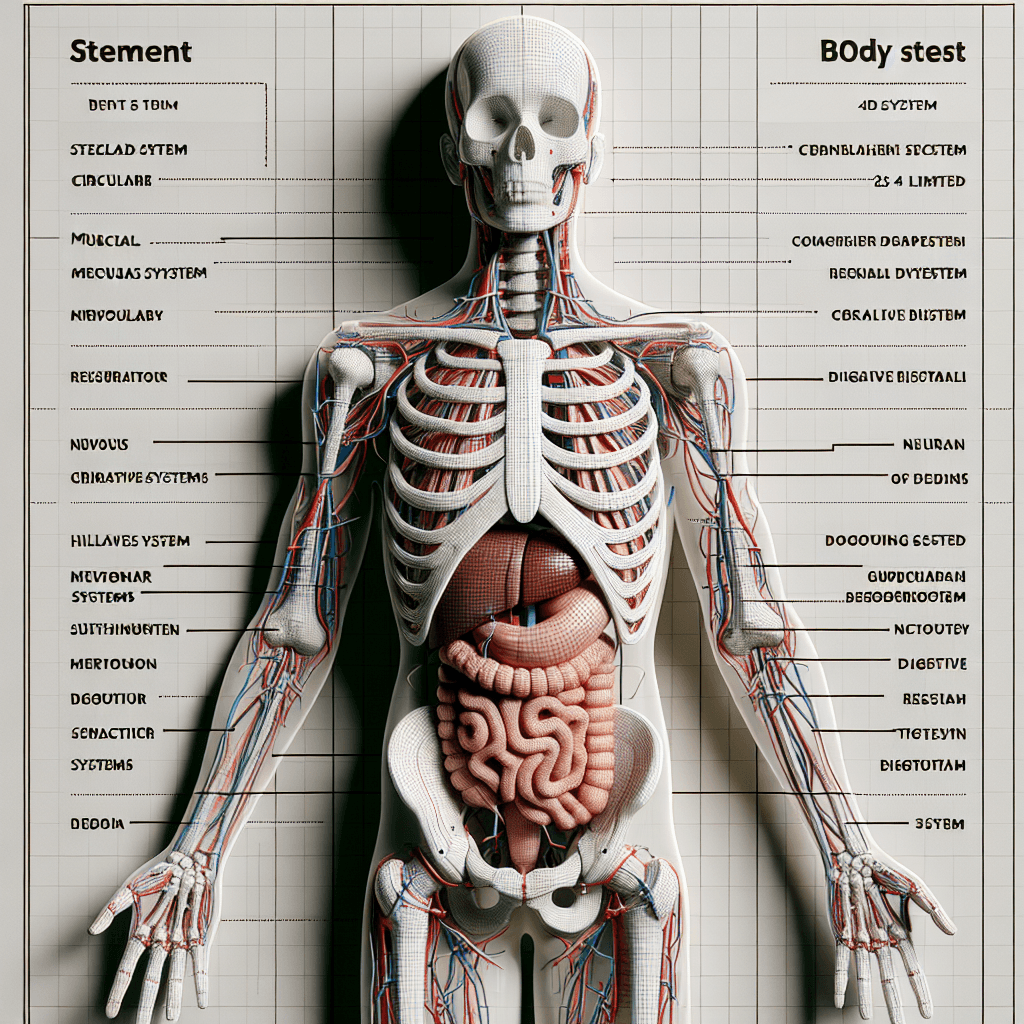
3D/4D Human Body Systems Model Project
Inquiry Framework
Question Framework
Driving Question
The overarching question that guides the entire project.How can we create an interactive 3D or 4D model that illustrates the functions of a specific human body system, the role it plays alongside hormones in maintaining homeostasis, and demonstrates a common disease affecting this system, along with its symptoms and treatments?Essential Questions
Supporting questions that break down major concepts.- How do the different systems of the human body function and work together to maintain homeostasis?
- What role do hormones play in regulating various body systems?
- Why is it essential to understand the structure and function of the human body in healthcare?
- How can diseases impact the normal functioning of the body systems?
- What are some common diseases associated with each body system, and how are they treated?
- How do lifestyle choices and environmental factors affect the health of body systems?
- What advancements in biomedical therapies offer hope for treating and preventing diseases?
Standards & Learning Goals
Learning Goals
By the end of this project, students will be able to:- Develop a comprehensive understanding of the structures and functions of various human body systems such as respiratory, circulatory, sensory, urinary, reproductive, digestive, and musculoskeletal systems.
- Interpret healthcare data through diagrams, and charts related to human body systems and diseases.
- Identify and describe common diseases associated with each body system, including its pathology and recommended treatment.
- Explore the role of hormones in maintaining body homeostasis and their interactions with body systems.
- Demonstrate proficiency in converting between standard and metric units and applying basic medical math relevant to healthcare scenarios.
- Apply research skills to investigate emerging diseases and disorders and understand recent advances in biomedical therapies.
- Create a 3D or 4D model that effectively represents the operation of a chosen body system, highlighting its importance in healthcare.
Foundation 1: Academic Foundations in Healthcare
Entry Events
Events that will be used to introduce the project to studentsHuman Body Science Fair
Students are thrust into an immersive scenario where they must prepare their model for a 'cutting-edge' science fair. Each team is required to showcase not only the anatomical models but also the real-life implications, such as a disease exhibit with interactive symptoms and treatment simulations. Judges (peers and teachers) will evaluate based on creativity, scientific accuracy, and public engagement.Interactive Health Exhibit
The school is hosting an interactive health exhibit open to peers and local community members. In groups, students create 3D/4D models and informational displays that explain bodily functions, diseases, and treatments with creative storytelling and personal narratives from people affected by these conditions.Portfolio Activities
Portfolio Activities
These activities progressively build towards your learning goals, with each submission contributing to the student's final portfolio.Exploration Station: Human Body Systems
Students will embark on an exploratory activity focusing on understanding the structures and functions of various human body systems. Each student or group will select and research one system, creating an informative poster that includes diagrams, charts, and textual explanations.Steps
Here is some basic scaffolding to help students complete the activity.Final Product
What students will submit as the final product of the activityAn informative poster representing the chosen body system with diagrams and accompanying textual analysis.Alignment
How this activity aligns with the learning objectives & standardsAligns with FFC1.4 - Identify the basic levels of organization of the human body and FFC1.6 - Identify basic structures and functions of human body systems.Pathology Pioneers: Disease Investigation
In this activity, students investigate a common disease or disorder affecting a specific body system. They will explore the etiology, pathology, and impact on the body system, as well as outline treatment and potential prevention methods.Steps
Here is some basic scaffolding to help students complete the activity.Final Product
What students will submit as the final product of the activityA comprehensive disease profile report that includes etiology, pathology, symptoms, treatment options, and prevention methods.Alignment
How this activity aligns with the learning objectives & standardsAligns with FFC1.7 - Describe common diseases and disorders of each body system.Hormonal Harmony: Endocrine Engagement
Students will delve into the crucial role of hormones in maintaining homeostasis. They will study how the endocrine system interacts with other body systems and create a dynamic presentation that illustrates these interactions.Steps
Here is some basic scaffolding to help students complete the activity.Final Product
What students will submit as the final product of the activityA dynamic slide presentation showcasing how hormonal interactions facilitate homeostasis within the chosen body system.Alignment
How this activity aligns with the learning objectives & standardsAligns with learning goals on exploring the role of hormones and understanding system interactions.Biomedical Breakthrough: Therapeutic Technologies
Students investigate emerging biomedical technologies and therapies related to the treatment of diseases in their chosen body system. They will present findings on how these advancements offer hope for prevention and treatment.Steps
Here is some basic scaffolding to help students complete the activity.Final Product
What students will submit as the final product of the activityA detailed presentation or report on a biomedical technology or therapy related to the body system and disease treatment.Alignment
How this activity aligns with the learning objectives & standardsAligns with FFC1.9 - Describe biomedical therapies as they relate to the prevention, pathology, and treatment of disease.Model Making Marvels: 3D/4D Creation Challenge
Students will consolidate their learning by creating a 3D or 4D model of the chosen body system, incorporating their knowledge of its functions, disease impacts, hormonal roles, and biomedical advancements.Steps
Here is some basic scaffolding to help students complete the activity.Final Product
What students will submit as the final product of the activityA comprehensive, interactive 3D or 4D model complete with an explanatory guide showcasing the chosen body system and its real-life implications.Alignment
How this activity aligns with the learning objectives & standardsAligns with FFC1.1 - Demonstrating the ability to analyze healthcare data through a tangible model and interpretations.Rubric & Reflection
Portfolio Rubric
Grading criteria for assessing the overall project portfolioComprehensive Human Body System Model Rubric
Anatomical and Functional Accuracy
Evaluation of the accuracy and completeness of anatomical structures and their functions as represented in the model.Structure Identification
Ability to accurately identify and represent all relevant structures of the chosen body system in the model.
Exemplary
4 PointsAll structures are accurately identified and labeled, demonstrating a sophisticated understanding of the body system.
Proficient
3 PointsMost structures are accurately identified and labeled, with minor errors in representation.
Developing
2 PointsSome structures are identified, but there are errors or omissions that affect the overall accuracy.
Beginning
1 PointsFew structures are identified accurately with significant errors or omissions.
Functional Explanation
Clarity and depth in explaining the function of each anatomical structure within the body system.
Exemplary
4 PointsFunctions of all structures are fully explained with clear and comprehensive rationales provided.
Proficient
3 PointsFunctions of most structures are explained adequately, with clear rationales provided for each.
Developing
2 PointsFunctions are explained for some structures, with rationales that lack depth.
Beginning
1 PointsExplanations are vague or missing, with unclear or missing rationales for functions.
Disease Analysis
Detail and accuracy in the analysis of a disease affecting the body system, including its symptoms and treatments.
Exemplary
4 PointsProvides a thorough analysis of a disease, accurately describing its symptoms and comprehensive treatment options.
Proficient
3 PointsOffers accurate descriptions of a disease's symptoms and treatments, with some minor omissions.
Developing
2 PointsDescribes the disease with basic symptoms and treatments but is missing detail or contains inaccuracies.
Beginning
1 PointsLimited or inaccurate description of the disease, symptoms, and treatments.
Content Integration and Creativity
Assessment of how effectively students integrate learned content into the model and the creative approaches in its presentation.Integration of Research
Demonstrates the integration of research and learning into the model's representation, including system operations and disease impacts.
Exemplary
4 PointsResearch is seamlessly integrated into the model, effectively demonstrating the operations and impacts of the body system and disease.
Proficient
3 PointsResearch is well integrated, showing a clear connection between system operations and disease impacts, with some minor gaps.
Developing
2 PointsSome research is integrated into the model, but links between information are unclear or incomplete.
Beginning
1 PointsLittle to no research is integrated, with no clear link between system function and disease.
Creativity and Innovation
Evaluates the creativity and innovation in the design and functionality of the model and presentation.
Exemplary
4 PointsThe model is exceptionally creative, using innovative methods to enhance understanding and engagement.
Proficient
3 PointsThe model demonstrates creativity and uses engaging methods effectively, with minor improvements possible.
Developing
2 PointsThe model shows some creativity, but is conventional and lacks engaging elements.
Beginning
1 PointsLimited creativity and engagement in the model presentation.
Presentation and Communication Skills
Assessment of the students’ ability to effectively communicate and present their findings and model to an audience.Clarity of Explanation
Ability to clearly and concisely explain the model's components, functions, and diseases to an audience.
Exemplary
4 PointsExplanations are clear, concise, and engage the audience effectively, demonstrating thorough knowledge.
Proficient
3 PointsExplanations are clear and mostly concise, demonstrating a solid understanding of the content.
Developing
2 PointsExplanations are sometimes unclear or overly detailed, leading to confusion.
Beginning
1 PointsExplanations are unclear or incomplete, leading to audience confusion.
Engagement with Audience
Ability to maintain audience interest and interaction during the presentation.
Exemplary
4 PointsEngages the audience fully through interactive elements and dynamic presentation style.
Proficient
3 PointsMaintains audience interest effectively with some interactive elements incorporated.
Developing
2 PointsAudience engagement is limited with minimal interactive elements or dynamic delivery.
Beginning
1 PointsLimited or no audience engagement methods employed during presentation.