
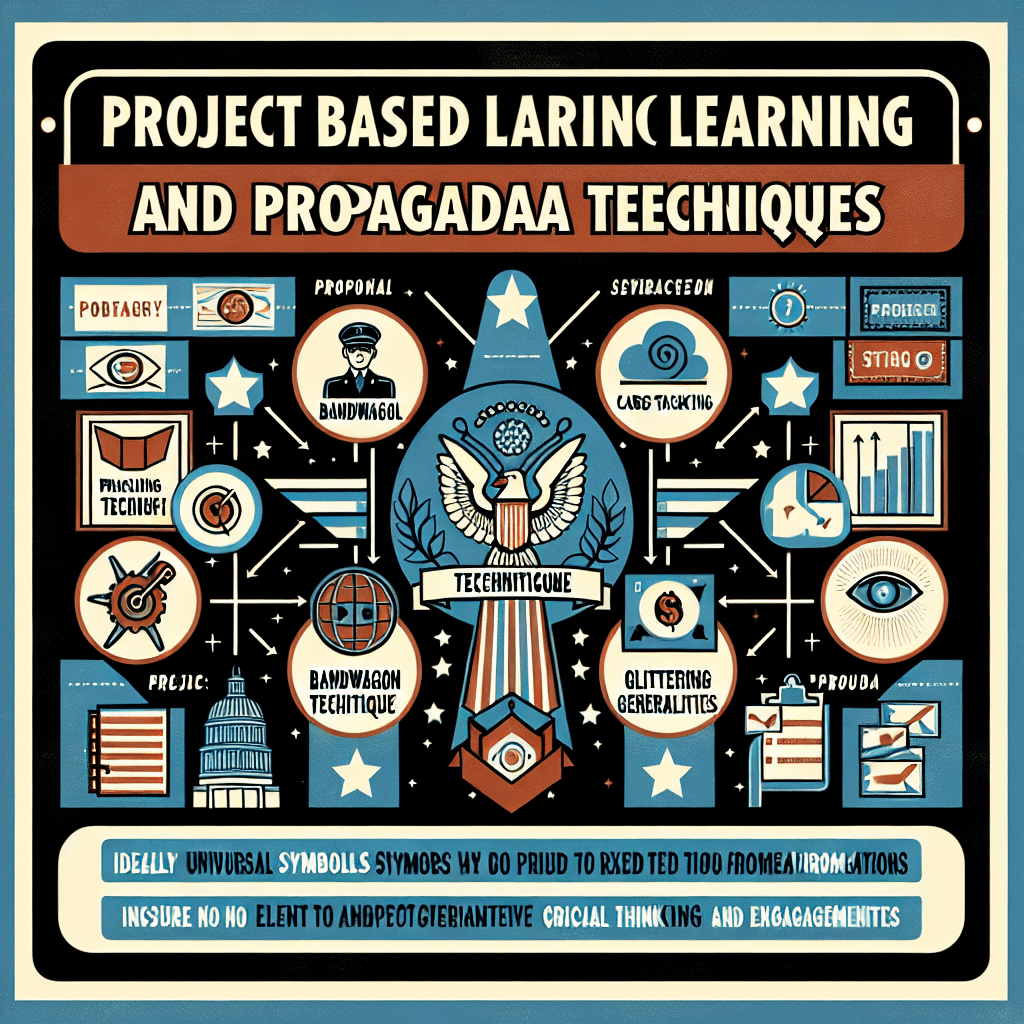
9th Grade Propaganda Techniques Exploration
Inquiry Framework
Question Framework
Driving Question
The overarching question that guides the entire project.How can we create an advertisement that effectively utilizes propaganda techniques to influence audiences, while being mindful of ethical implications?Essential Questions
Supporting questions that break down major concepts.- What is propaganda and how has it been used throughout history?
- How do different propaganda techniques influence the audience's thoughts and beliefs?
- What are the ethical implications of using propaganda?
- How can you identify and analyze propaganda in media?
- In what ways can propaganda shape public opinion or behavior?
Standards & Learning Goals
Learning Goals
By the end of this project, students will be able to:- Understand and identify various propaganda techniques and their historical contexts.
- Analyze the impact and effectiveness of different propaganda techniques on audiences.
- Create an advertisement using a chosen propaganda technique, demonstrating the ability to influence audience perception ethically.
- Evaluate the ethical implications of employing propaganda techniques.
- Enhance presentation skills through sharing advertisements and analyses with peers.
Common Core State Standards (CCSS) English Language Arts
Entry Events
Events that will be used to introduce the project to studentsAdvertisement Time Machine
Students are introduced to a collection of historical advertisements through a 'time machine' that utilizes augmented reality. This experience serves to identify propaganda evolution over the decades.Influence Hackathon
A hackathon event where students are tasked with creating the most persuasive and ethical campaign using propaganda techniques to promote a fictional product, focusing on modern digital platforms.Portfolio Activities
Portfolio Activities
These activities progressively build towards your learning goals, with each submission contributing to the student's final portfolio.Propaganda Technique Detective
Students investigate various propaganda techniques and their historical use. They begin to identify and understand specific methods like bandwagon, plain folks, and more, setting the base for creating their own pieces.Steps
Here is some basic scaffolding to help students complete the activity.Final Product
What students will submit as the final product of the activityA digital presentation analyzing a chosen propaganda technique, including historical examples and key characteristics.Alignment
How this activity aligns with the learning objectives & standardsCCSS.ELA-LITERACY.RI.9-10.8 (Delineate and evaluate the argument and specific claims in a text, assessing whether the reasoning is valid and the evidence is relevant and sufficient.)Propaganda Technique Workshop
Through guided workshops, students analyze selected propaganda examples to debate and discuss their implications and effects critically. These activities further hone their judgment and reasoning about the use of propaganda.Steps
Here is some basic scaffolding to help students complete the activity.Final Product
What students will submit as the final product of the activityA group report summarizing the structured debate and analysis of a modern propaganda example.Alignment
How this activity aligns with the learning objectives & standardsCCSS.ELA-LITERACY.RI.9-10.8 (Assess whether the reasoning is valid and the evidence is relevant and sufficient; identify false statements and fallacious reasoning.)Create Your Ethical Influence Campaign
In this hands-on activity, students apply their understanding of propaganda techniques to create a campaign that ethically influences the audience on an issue they are passionate about or to run for class president. This project encourages students to think critically about their messaging and explore the ethical side of influence, keeping in mind their unique passions.Steps
Here is some basic scaffolding to help students complete the activity.Final Product
What students will submit as the final product of the activityA campaign strategy presentation or digital advertisement that uses selected propaganda techniques to ethically advocate for a cause or candidacy.Alignment
How this activity aligns with the learning objectives & standardsCCSS.ELA-LITERACY.W.9-10.1 (Write arguments to support claims in an analysis of substantive topics or texts, using valid reasoning and relevant and sufficient evidence.)Propaganda Ethics Roundtable
Students engage in a roundtable discussion focused on the ethical implications of propaganda use. This builds critical thinking and discussion skills.Steps
Here is some basic scaffolding to help students complete the activity.Final Product
What students will submit as the final product of the activityA reflective essay or group consensus document discussing the ethical considerations of using propaganda techniques.Alignment
How this activity aligns with the learning objectives & standardsCCSS.ELA-LITERACY.SL.9-10.1 (Initiate and participate effectively in collaborative discussions with diverse partners.)Persuasive Presentation Parade
Students present their advertisements to the class, practicing clear and logical presentation skills and providing feedback based on set criteria.Steps
Here is some basic scaffolding to help students complete the activity.Final Product
What students will submit as the final product of the activityA classroom presentation showcasing the student's advertisement with a focus on propaganda techniques and ethical considerations.Alignment
How this activity aligns with the learning objectives & standardsCCSS.ELA-LITERACY.SL.9-10.4 (Present information clearly, concisely, and logically.)Rubric & Reflection
Portfolio Rubric
Grading criteria for assessing the overall project portfolioPropaganda Techniques Project Rubric
Understanding of Propaganda Techniques
Assessing the student's ability to identify, describe, and analyze various propaganda techniques and their historical significance.Identification and Description
Criterion measures the ability to accurately identify and describe chosen propaganda techniques.
Exemplary
4 PointsInsightfully identifies and describes a variety of propaganda techniques with precise vocabulary and comprehensive context.
Proficient
3 PointsAccurately identifies and describes chosen propaganda techniques using appropriate terminology.
Developing
2 PointsCorrectly identifies some propaganda techniques but lacks detailed description and context.
Beginning
1 PointsStruggles to accurately identify or describe propaganda techniques, exhibiting minimal understanding.
Historical Analysis
Measures the ability to relate propaganda techniques to their historical context and significance.
Exemplary
4 PointsProvides insightful analysis of the historical application and evolution of propaganda techniques with rich examples.
Proficient
3 PointsAnalyzes historical use of propaganda techniques with relevant and mostly accurate examples.
Developing
2 PointsProvides some analysis of historical use but lacking detail or accuracy.
Beginning
1 PointsOffers little to no analysis, indicating minimal understanding of historical relevance.
Creative Application and Ethical Consideration
Evaluating the creation of advertisements using propaganda techniques with a focus on ethical considerations.Creative Execution
Criterion measures the creativity and originality in developing the advertisement using propaganda techniques.
Exemplary
4 PointsInnovatively applies propaganda techniques in a creative, original, and engaging manner.
Proficient
3 PointsAppropriately applies propaganda techniques creatively with originality.
Developing
2 PointsApplies propaganda techniques with some originality, though predictably.
Beginning
1 PointsStruggles to apply propaganda techniques creatively, often predictable or incomplete.
Ethical Consideration
Assessment of the consideration for ethical implications within propaganda use in student work.
Exemplary
4 PointsThoroughly integrates ethical considerations, demonstrating deep awareness and responsibility.
Proficient
3 PointsAcknowledges important ethical considerations with clear awareness.
Developing
2 PointsConsiders some ethical implications, though lacking depth.
Beginning
1 PointsMinimal to no consideration of ethical implications in work.
Presentation Skills and Collaboration
Focuses on the ability to communicate ideas clearly, logically, and collaboratively through presentations.Presentation Clarity
Criterion measures clarity, conciseness, and logical flow of the presentation.
Exemplary
4 PointsPresents information clearly and logically with excellent audience engagement and structured coherence.
Proficient
3 PointsPresents information clearly with logical flow and audience awareness.
Developing
2 PointsPresents with some clarity, though lacking in cohesive flow.
Beginning
1 PointsStruggles to present information clearly with no logical flow or audience engagement.
Collaborative Participation
Measures active participation and contribution in group settings.
Exemplary
4 PointsLeads discussions effectively, contributing insightful ideas and encouraging peers constructively.
Proficient
3 PointsContributes effectively to discussions and collaboration with peers.
Developing
2 PointsParticipates in discussions but contributes minimally or inconsistently.
Beginning
1 PointsRarely participates or contributes to group discussions.