
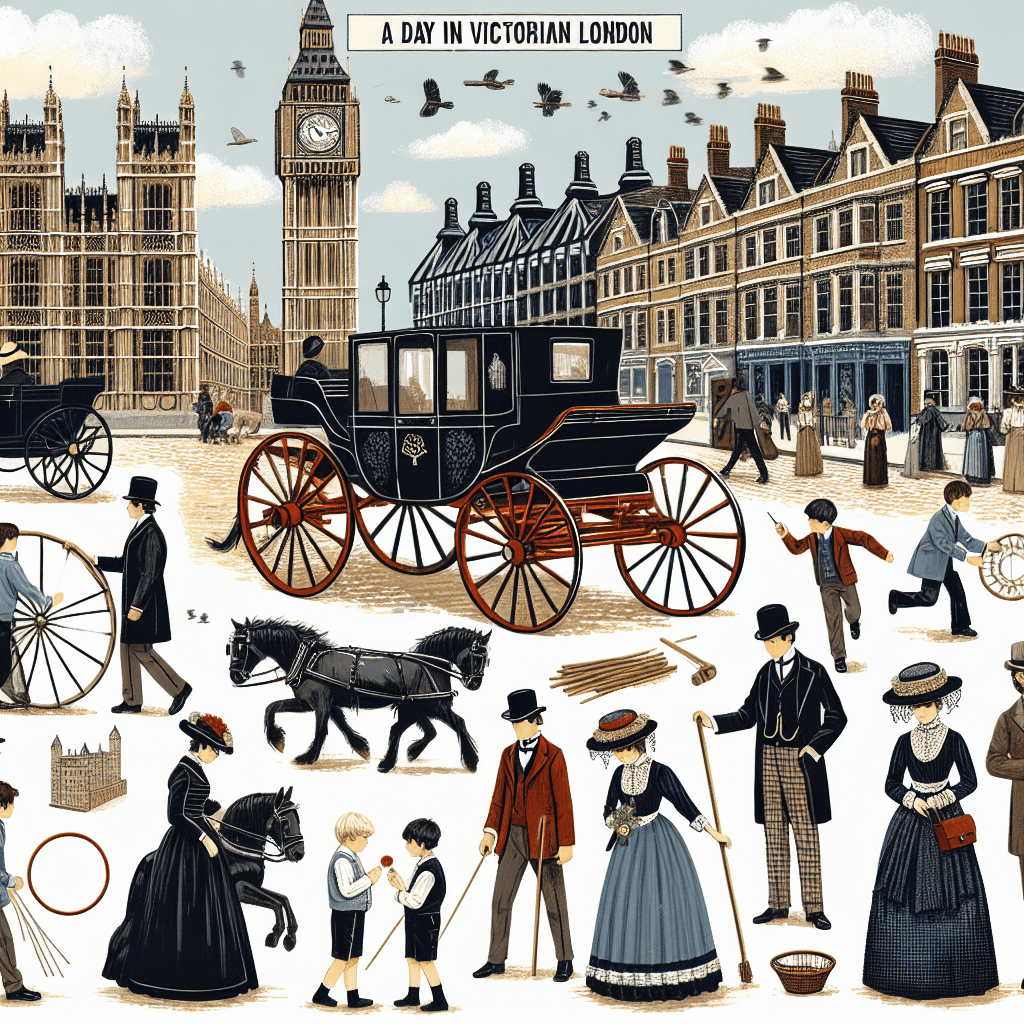
A Day in Victorian London: A Living History Project
Inquiry Framework
Question Framework
Driving Question
The overarching question that guides the entire project.How can we, as historians and digital storytellers, recreate a ‘day in the life’ of a Victorian Londoner from a specific social class, using digital tools to highlight the social inequalities, technological impacts, and cultural values that shaped their daily experiences?Essential Questions
Supporting questions that break down major concepts.- How did technological advancements and industrialization impact the lives of people during the Victorian era?
- What social and economic inequalities existed in Victorian London, and how did they affect different groups of people?
- In what ways did Victorian literature, art, and culture reflect the realities and aspirations of the time?
- How can digital tools enhance our ability to research, collaborate, and present a realistic depiction of Victorian London?
- How did Victorian values and beliefs shape the experiences of individuals living in London during that period?
Standards & Learning Goals
Learning Goals
By the end of this project, students will be able to:- Students will research and analyze primary and secondary sources to understand the daily lives of Victorian Londoners from different social classes.
- Students will create a digital narrative or presentation that accurately depicts a 'day in the life' of a selected Victorian Londoner, incorporating details about their social class, occupation, challenges, and cultural context.
- Students will collaborate in teams to develop a cohesive and engaging digital story, ensuring historical accuracy and creative storytelling.
- Students will use digital tools such as Google Slides, Canva, Book Creator, or ThingLink to create interactive timelines, maps, and multimedia presentations that enhance the audience's understanding of Victorian London.
- Students will reflect on the social and economic inequalities present in Victorian London, and how these inequalities shaped the experiences of individuals from different social classes.
- Students will evaluate the impact of technological advancements and industrialization on the daily lives of Victorian Londoners.
- Students will improve their communicative competence through speaking, listening, reading, and writing tasks in English.
- Students will develop skills in digital literacy, including research, collaboration, and presentation using digital tools.
Common European Framework of Reference for Languages
Key Competences for Lifelong Learning
DigCompEdu (Digital Competence Framework for Educators)
Entry Events
Events that will be used to introduce the project to studentsThe Mystery Package
Students receive a mysterious package containing artifacts from Victorian London (reproductions, of course!): a letter, a coin, a newspaper clipping, a photograph. Working in groups, they must analyze the items and deduce the identity of the person who owned them, their social class, and their daily life. This launches their inquiry into Victorian society.Portfolio Activities
Portfolio Activities
These activities progressively build towards your learning goals, with each submission contributing to the student's final portfolio.Contextual Timeline: Mapping History
Students will research the historical context surrounding their chosen character's life, focusing on significant events, social issues, and technological advancements that would have impacted their daily routine. They will then create a digital timeline of these events using a tool like Google Slides or Canva.Steps
Here is some basic scaffolding to help students complete the activity.Final Product
What students will submit as the final product of the activityA digital timeline with at least 5 key events, each with a brief description and visual representation (image or short video clip). The timeline should be embedded within their broader presentation.Alignment
How this activity aligns with the learning objectives & standardsAddresses CEFR B1 (writing connected text), Multilingual competence (research in English), and Digital competence (creating timelines).Voices of Inequality: Argumentative Analysis
Students, working in teams, will analyze the social inequalities faced by their chosen character and create a short argumentative piece (either written or a short video) discussing the challenges and injustices of the Victorian era.Steps
Here is some basic scaffolding to help students complete the activity.Final Product
What students will submit as the final product of the activityA 300-400 word argumentative essay OR a 2-3 minute video presenting a clear argument about the social inequalities faced by their chosen character, supported by evidence from their research.Alignment
How this activity aligns with the learning objectives & standardsAddresses CEFR B2 (expressing opinions and arguments), Citizenship competence (exploring social justice issues), and Personal, social and learning to learn competence (teamwork).A Day in the Life: Digital Storytelling
Students will combine their previous work (morning narrative, historical timeline, and social analysis) to create a cohesive digital story that depicts a 'day in the life' of their chosen Victorian Londoner. They will use digital tools like Book Creator or ThingLink to create an interactive presentation that integrates text, images, audio, and video.Steps
Here is some basic scaffolding to help students complete the activity.Final Product
What students will submit as the final product of the activityAn interactive digital story presented using Book Creator or ThingLink, including the morning narrative, historical timeline, and social analysis. The story should be engaging, informative, and historically accurate.Alignment
How this activity aligns with the learning objectives & standardsAddresses CEFR B1+ (narrating a story), Digital competence (creating digital stories), and DigCompEdu Area 6 (facilitating learners’ digital competence).Reflections on Victorian Lives: Gallery Walk & Synthesis
Students will participate in a gallery walk where they present their digital stories to their classmates. After the gallery walk, students will write a reflection piece on what they learned about Victorian London, the challenges of digital storytelling, and the importance of understanding historical context.Steps
Here is some basic scaffolding to help students complete the activity.Final Product
What students will submit as the final product of the activityA 300-400 word reflection piece summarizing what they learned about Victorian London, the digital storytelling process, and the importance of historical context, and social inequalities.Alignment
How this activity aligns with the learning objectives & standardsAddresses Literacy competence (reading comprehension), Cultural awareness and expression (understanding customs), and DigCompEdu Area 5 (empowering learners).Rubric & Reflection
Portfolio Rubric
Grading criteria for assessing the overall project portfolioVictorian London Portfolio Rubric
Historical Contextualization
Assesses the accuracy, depth, clarity, and visual appeal of the digital timeline.Historical Accuracy and Depth
Accuracy and depth of historical information presented in the timeline.
Beginning
1 PointsTimeline includes inaccurate or irrelevant information. Shows a lack of understanding of the historical context.
Developing
2 PointsTimeline includes mostly accurate information but lacks depth. Demonstrates a basic understanding of the historical context.
Proficient
3 PointsTimeline is accurate, well-researched, and includes relevant information. Demonstrates a thorough understanding of the historical context.
Exemplary
4 PointsTimeline is exceptionally accurate, thoroughly researched, and includes insightful details. Demonstrates a sophisticated understanding of the historical context and its impact on the character's life.
Timeline Presentation and Design
Clarity, organization, and visual appeal of the digital timeline.
Beginning
1 PointsTimeline is disorganized, difficult to follow, and lacks visual appeal. Makes it difficult to understand the information presented.
Developing
2 PointsTimeline is somewhat organized but could be clearer and more visually appealing. Some elements may be confusing or distracting.
Proficient
3 PointsTimeline is clear, well-organized, and visually appealing. Enhances the understanding of the historical events and their significance.
Exemplary
4 PointsTimeline is exceptionally clear, engaging, and visually stunning. Uses design elements effectively to create an immersive and informative experience.
Social Inequality Analysis
Evaluates the clarity, persuasiveness, and evidentiary support of the argumentative analysis of social inequalities.Argumentative Strength
Clarity and persuasiveness of the argument regarding social inequalities.
Beginning
1 PointsArgument is unclear, lacks supporting evidence, and fails to address the impact of social inequalities.
Developing
2 PointsArgument is somewhat clear but lacks sufficient evidence or depth. Partially addresses the impact of social inequalities.
Proficient
3 PointsArgument is clear, well-supported by evidence, and effectively addresses the impact of social inequalities on the chosen character's life.
Exemplary
4 PointsArgument is exceptionally clear, insightful, and persuasively argues the profound impact of social inequalities on the character’s life, demonstrating a nuanced understanding of the issues.
Evidentiary Support
Quality of evidence used to support the argument (historical facts, examples, quotes).
Beginning
1 PointsEvidence is minimal, irrelevant, or inaccurate. Fails to support the argument effectively.
Developing
2 PointsEvidence is present but weak or not fully relevant. Partially supports the argument.
Proficient
3 PointsEvidence is relevant, accurate, and effectively supports the argument. Demonstrates strong research skills.
Exemplary
4 PointsEvidence is compelling, diverse, and meticulously integrated to create a powerful and well-substantiated argument. Demonstrates exceptional research and analytical skills.
Digital Storytelling Effectiveness
Assesses the cohesion, engagement, and effective use of digital tools in the final digital story.Narrative Cohesion and Engagement
Integration of the morning narrative, historical timeline, and social analysis into a cohesive and engaging digital story.
Beginning
1 PointsElements are disjointed and do not form a cohesive narrative. The digital story is confusing and lacks engagement.
Developing
2 PointsElements are somewhat integrated but the narrative flow is weak. The digital story is partially engaging.
Proficient
3 PointsElements are well-integrated to create a cohesive and engaging digital story that effectively depicts a 'day in the life'.
Exemplary
4 PointsElements are seamlessly interwoven to create a captivating and immersive digital story that provides a rich and nuanced understanding of the character’s life and the Victorian era.
Digital Tool Proficiency
Effective use of digital tools (Book Creator or ThingLink) to enhance the story with images, audio, video, and interactive elements.
Beginning
1 PointsDigital tools are used ineffectively or not at all. The story lacks visual and interactive elements.
Developing
2 PointsDigital tools are used minimally and do not significantly enhance the story. Interactive elements are limited or ineffective.
Proficient
3 PointsDigital tools are used effectively to enhance the story with appropriate images, audio, video, and interactive elements.
Exemplary
4 PointsDigital tools are used innovatively and masterfully to create a highly engaging and interactive digital story that showcases exceptional digital competence.
Metacognitive Reflection
Evaluates the depth, insightfulness, clarity, and organization of the student's reflection on their learning experience.Reflective Insight
Depth and insightfulness of the reflection on the learning experience, Victorian London, and digital storytelling.
Beginning
1 PointsReflection is superficial and lacks insight. Fails to demonstrate understanding of Victorian London or the digital storytelling process.
Developing
2 PointsReflection is somewhat thoughtful but lacks depth. Partially demonstrates understanding of Victorian London and the digital storytelling process.
Proficient
3 PointsReflection is thoughtful and insightful, demonstrating a good understanding of Victorian London, the digital storytelling process, and the importance of historical context.
Exemplary
4 PointsReflection is exceptionally insightful and demonstrates a profound understanding of Victorian London, the challenges and rewards of digital storytelling, and the broader implications of historical context and social inequalities.
Reflection Presentation
Clarity, coherence, and organization of the reflection piece.
Beginning
1 PointsReflection is poorly written, disorganized, and difficult to understand.
Developing
2 PointsReflection is somewhat clear but lacks coherence and organization. Some elements may be confusing or distracting.
Proficient
3 PointsReflection is clear, well-organized, and coherent. Effectively summarizes the learning experience and key insights.
Exemplary
4 PointsReflection is exceptionally well-written, articulate, and thoughtfully organized, presenting a compelling and insightful analysis of the learning experience.