
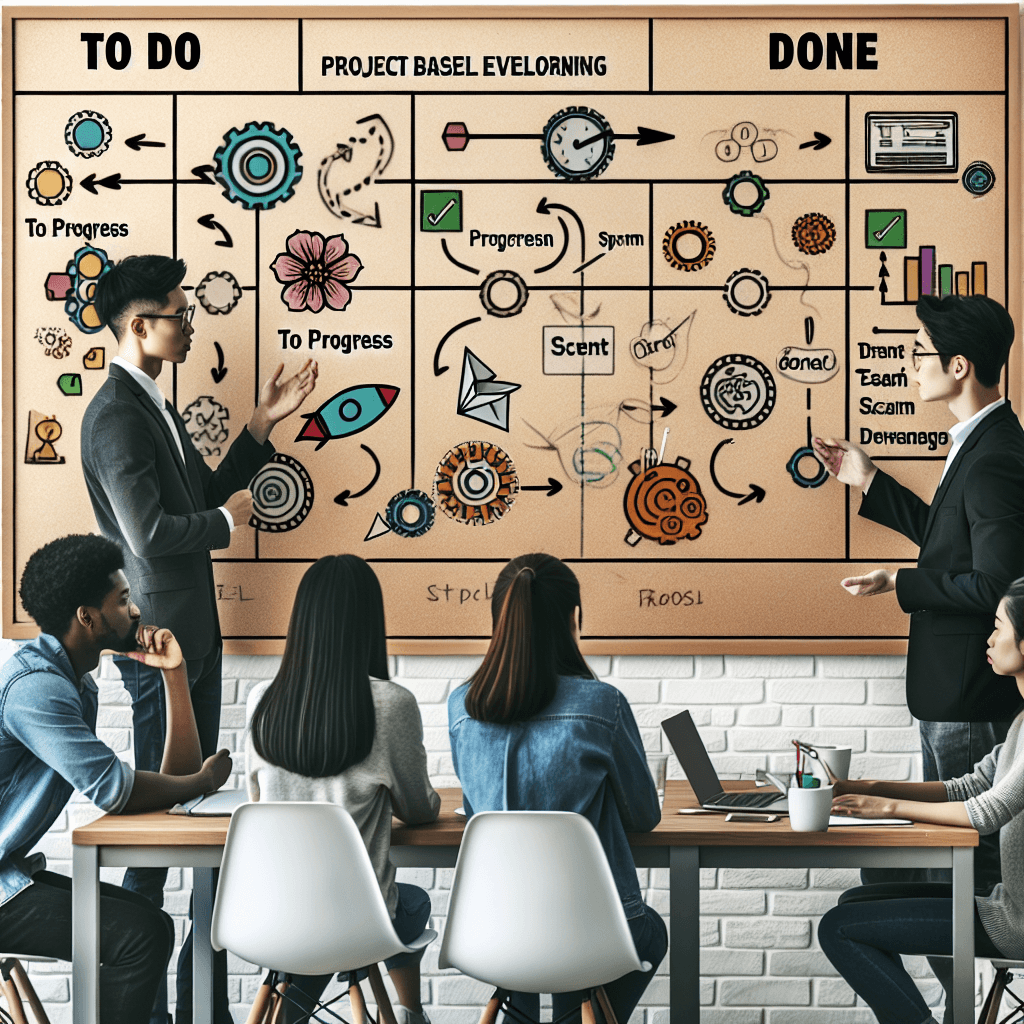
Inquiry Framework
Question Framework
Driving Question
The overarching question that guides the entire project.How can we design and develop an engaging and effective simulation game that teaches the principles of Agile software development and Scrum project management, addresses the common challenges faced by Scrum teams, promotes collaboration and communication, measures player progress, incorporates ethical considerations, and is accessible and inclusive for diverse learners?Essential Questions
Supporting questions that break down major concepts.- How can the principles of Agile software development be effectively simulated in a game environment?
- What are the key artifacts and ceremonies of Scrum, and how can they be represented interactively?
- How can a simulation game be designed to teach effective decision-making within the Scrum framework?
- What are the common challenges faced by Scrum teams, and how can these be incorporated into the game's scenarios?
- How can the game mechanics be designed to promote collaboration and communication among players, reflecting real-world Scrum team dynamics?
- How can player progress and understanding of Agile principles be measured within the game?
- What game design elements can enhance player engagement and motivation while learning about Scrum?
- What are the ethical considerations in designing a game that simulates real-world project management scenarios?
- How can the game be designed to be accessible and inclusive for players of diverse backgrounds and learning styles?
- How can feedback from players and educators be used to iterate and improve the game's effectiveness as a learning tool?
Standards & Learning Goals
Learning Goals
By the end of this project, students will be able to:- Students will be able to explain the principles of Agile software development.
- Students will be able to apply Scrum artifacts and events in a simulated project environment.
- Students will be able to design and develop a functional simulation game using a suitable game development platform.
- Students will be able to evaluate the effectiveness of their simulation game in teaching Agile and Scrum principles.
- Students will be able to demonstrate effective teamwork and communication skills throughout the project.
Entry Events
Events that will be used to introduce the project to studentsTrial by Fire: Agile Project Rescue
Imagine you're suddenly the project manager for a high-stakes software project that's already behind schedule. Your team is stressed, the client is impatient, and you need to deliver a working product…fast. This simulation plunges you into the world of Agile and Scrum, where you'll learn by doing.The Agile Sprint Challenge
Engage in a fast-paced 'Build Challenge' where teams compete to design, develop, and test software features within strict time constraints and evolving requirements, mirroring a real-world Agile sprint.Agile Success Stories: Deconstructing the Triumphs
Analyze case studies of successful software projects developed using Agile and Scrum methodologies. Identify the key factors that contributed to their success. Propose alternative strategies or approaches to optimize performance based on evidence from the analysis.Portfolio Activities
Portfolio Activities
These activities progressively build towards your learning goals, with each submission contributing to the student's final portfolio.Agile Foundations
In this initial activity, students will individually explore and define core Agile principles and Scrum artifacts. They will then connect these concepts to potential game mechanics, laying the groundwork for the simulation design.Steps
Here is some basic scaffolding to help students complete the activity.Final Product
What students will submit as the final product of the activityA written document outlining key Agile principles, Scrum artifacts, and initial game mechanic ideas.Alignment
How this activity aligns with the learning objectives & standardsExplaining Agile Principles, Applying Scrum Artifacts, Evaluating Game EffectivenessScrum Board Game Design
Students will form Scrum teams and collaboratively design a basic Scrum board game. This activity reinforces their understanding of Scrum artifacts and the flow of a sprint.Steps
Here is some basic scaffolding to help students complete the activity.Final Product
What students will submit as the final product of the activityA playable Scrum board game prototype.Alignment
How this activity aligns with the learning objectives & standardsApplying Scrum Artifacts, Teamwork and Communication, Designing Simulation GameDigital Prototype Development
Students will choose a game development platform and begin prototyping their digital simulation game. They will implement core game mechanics and Scrum elements.Steps
Here is some basic scaffolding to help students complete the activity.Final Product
What students will submit as the final product of the activityA digital prototype of the simulation game with basic functionality.Alignment
How this activity aligns with the learning objectives & standardsDesigning Simulation Game, Applying Scrum Artifacts, Evaluating Game Effectiveness, Teamwork and CommunicationIterative Prototype Refinement
Students will iterate on their digital prototype based on feedback and add more complex Scrum features, such as sprint planning and retrospectives.Steps
Here is some basic scaffolding to help students complete the activity.Final Product
What students will submit as the final product of the activityA refined digital prototype with enhanced functionality and Scrum features.Alignment
How this activity aligns with the learning objectives & standardsDesigning Simulation Game, Applying Scrum Artifacts, Evaluating Game Effectiveness, Teamwork and CommunicationUser Testing and Feedback
Students will conduct user testing with external players and gather feedback on the effectiveness of their simulation game in teaching Agile and Scrum principles.Steps
Here is some basic scaffolding to help students complete the activity.Final Product
What students will submit as the final product of the activityA report summarizing user feedback and proposed improvements.Alignment
How this activity aligns with the learning objectives & standardsEvaluating Game Effectiveness, Teamwork and CommunicationFinalization and Presentation
Students will finalize their simulation game based on user feedback and prepare a presentation showcasing their project.Steps
Here is some basic scaffolding to help students complete the activity.Final Product
What students will submit as the final product of the activityA fully functional simulation game and a presentation showcasing the project.Alignment
How this activity aligns with the learning objectives & standardsEvaluating Game Effectiveness, Applying Scrum Artifacts, Teamwork and CommunicationRubric & Reflection
Portfolio Rubric
Grading criteria for assessing the overall project portfolioMaster's Capstone Simulation Game Rubric
Agile and Scrum Principles
Assessment of understanding and application of Agile and Scrum principles in the simulation game.Understanding of Agile Principles
Measures the student's comprehension of Agile principles and their relevance to software development.
Exemplary
4 PointsDemonstrates a sophisticated and comprehensive understanding of Agile principles, and articulates their importance in software development with exceptional clarity.
Proficient
3 PointsDemonstrates thorough understanding of Agile principles, explaining their relevance and application effectively.
Developing
2 PointsShows emerging understanding of Agile principles, with ability to identify some key aspects but lacking depth.
Beginning
1 PointsShows initial understanding with major gaps in explaining Agile principles and their importance.
Application of Scrum Artifacts
Evaluates how well students can apply Scrum artifacts within their simulation.
Exemplary
4 PointsApplies Scrum artifacts innovatively and accurately represents them within the simulation game.
Proficient
3 PointsCorrectly applies and represents key Scrum artifacts within the simulation game.
Developing
2 PointsApplies some Scrum artifacts but with inaccuracies in representation or omissions.
Beginning
1 PointsStruggles to apply Scrum artifacts and fails to accurately represent them in the simulation.
Game Design and Development
Evaluation of the creativity, functionality, and educational effectiveness of the game design and development process.Creativity and Innovation
Assesses the creativity and innovation in the game's design and mechanics.
Exemplary
4 PointsDemonstrates exceptional creativity and innovation, with unique and engaging game mechanics and design elements.
Proficient
3 PointsShows effective creativity and innovation, using appropriate game mechanics and design elements.
Developing
2 PointsDisplays some creativity with basic game mechanics and design that may lack engagement.
Beginning
1 PointsShows minimal creativity in design, relying on standard and uninspired mechanics.
Game Functionality
Measures the functional execution of the game, including user interface and user experience.
Exemplary
4 PointsProvides a highly functional, intuitive, and visually appealing game experience.
Proficient
3 PointsDelivers a functional and user-friendly game experience with minor usability issues.
Developing
2 PointsDemonstrates some functionality with noticeable usability issues or bugs.
Beginning
1 PointsPresents significant functionality issues, affecting the user experience substantially.
Evaluation and Feedback Incorporation
Assessment of the team's ability to evaluate the game's effectiveness and incorporate feedback.Evaluation of Effectiveness
Evaluates how well students analyze and assess the educational impact of their game.
Exemplary
4 PointsConducts comprehensive evaluation with strong evidence of the game's educational impact and proposes insightful improvements.
Proficient
3 PointsCarries out thorough evaluation and identifies key areas for improvement based on evidence.
Developing
2 PointsPerforms basic evaluation with limited evidence or clarity in proposed improvements.
Beginning
1 PointsStruggles to conduct meaningful evaluation or propose relevant improvements.
Incorporation of Feedback
Assesses how effectively the team integrates feedback to enhance the game.
Exemplary
4 PointsSkillfully integrates feedback to significantly enhance game functionality and educational value.
Proficient
3 PointsEffectively incorporates feedback to improve game design and execution.
Developing
2 PointsIncorporates some feedback with moderate impact on game improvement.
Beginning
1 PointsStruggles to effectively incorporate feedback into the game design.
Teamwork and Communication
Evaluation of collaboration and communication within the team throughout the project.Collaboration
Assesses the effectiveness of teamwork and collaboration among students.
Exemplary
4 PointsExhibits outstanding collaboration dynamics, with high levels of participation and mutual support.
Proficient
3 PointsDemonstrates strong collaboration with active participation and effective communication.
Developing
2 PointsShows occasional collaboration issues, with room for improved communication and participation.
Beginning
1 PointsExhibits poor collaboration with limited participation and ineffective communication.
Communication Skills
Evaluates the quality of communication both within the team and in presenting the final project.
Exemplary
4 PointsDemonstrates exceptional communication skills with clear, concise, and engaging presentation.
Proficient
3 PointsCommunicates effectively within the team and during presentations.
Developing
2 PointsDisplays basic communication skills, with occasional clarity issues.
Beginning
1 PointsStruggles with communication, both within the team and in public presentation.