
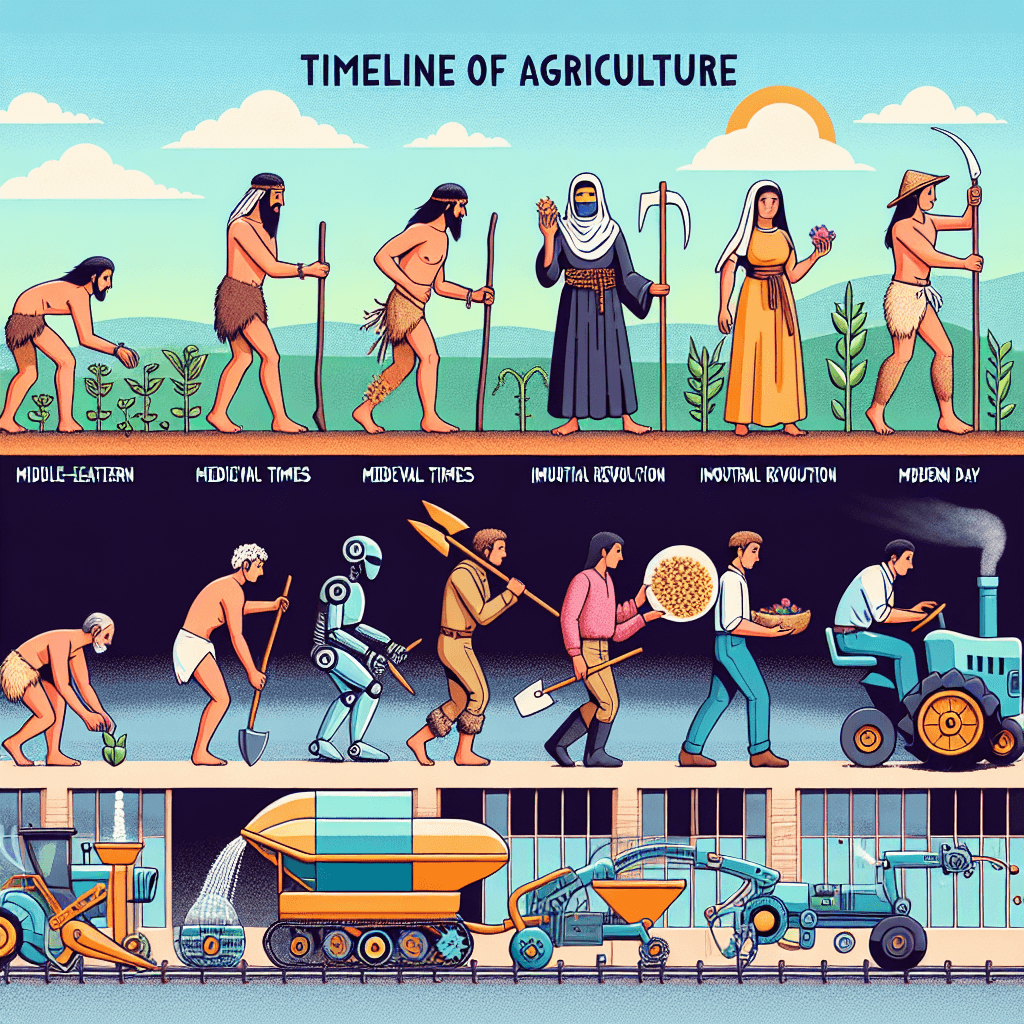
Agriculture: A Timeline from Early Man to the Future
Inquiry Framework
Question Framework
Driving Question
The overarching question that guides the entire project.How did the environment and innovation shape agricultural practices from early civilizations to today, and how might these changes impact societies in the future?Essential Questions
Supporting questions that break down major concepts.- How did the environment impact early agricultural practices?
- What are the key advancements in agriculture from early civilizations to today?
- How has agriculture changed societies?
- What are the possible future trends in agriculture?
Standards & Learning Goals
Learning Goals
By the end of this project, students will be able to:- Students will be able to identify the key advancements in agriculture from early civilizations to today.
- Students will be able to analyze how the environment impacted early agricultural practices.
- Students will be able to explain how agriculture has changed societies.
- Students will be able to predict possible future trends in agriculture.
Unknown
Entry Events
Events that will be used to introduce the project to studentsThe Time-Traveling Archaeologist
A time-traveling archaeologist bursts into the classroom, urgently seeking the students' expertise to understand mysterious agricultural artifacts from different eras. The archaeologist needs the students to create timelines that will help them understand how agriculture has changed. This interactive scenario immediately thrusts students into the role of experts, sparking their curiosity about the evolution of agriculture.Message from the Future Farmer
Students receive a cryptic message from a 'future farmer' describing the challenges of feeding a growing population with limited resources. The message tasks the students with researching agricultural history to understand the roots of these challenges and to propose sustainable solutions for the future. This creates a sense of urgency and connects historical study to contemporary global issues.Portfolio Activities
Portfolio Activities
These activities progressively build towards your learning goals, with each submission contributing to the student's final portfolio.Ancient Agricultural Advancements
Students will explore the key agricultural innovations and practices that emerged during the River Valley Civilizations and Classical Empires period. They will create annotated timeline entries detailing these advancements and their impact on society.Steps
Here is some basic scaffolding to help students complete the activity.Final Product
What students will submit as the final product of the activityAn annotated timeline showcasing agricultural advancements from 3500 BCE to 600 CE, with a focus on innovations and their societal impact.Alignment
How this activity aligns with the learning objectives & standardsThis activity covers 6.G.HE.1 by focusing on agricultural developments within the specified time frame (3500 BCE-600 CE) and how these developments allowed civilizations to thrive.Modern Marvels and Challenges
Students will continue their agricultural timeline into the modern era, investigating significant advancements in farming technology, crop science, and food distribution. They will analyze the social, economic, and environmental impacts of these changes.Steps
Here is some basic scaffolding to help students complete the activity.Final Product
What students will submit as the final product of the activityAn extended timeline that includes modern agricultural advancements, along with an analysis of their impacts on society and the environment.Alignment
How this activity aligns with the learning objectives & standardsThis activity extends the timeline into more modern times and aligns with 6.G.HE.1 by encouraging students to think critically about how historical agricultural practices have shaped modern societies and environments.Seeding the Future
Building on their understanding of agricultural history and current trends, students will predict possible future developments in agriculture. They will propose innovative solutions for sustainable food production that address challenges like climate change, resource scarcity, and population growth.Steps
Here is some basic scaffolding to help students complete the activity.Final Product
What students will submit as the final product of the activityA presentation outlining future agricultural trends and proposing sustainable solutions for food production, supported by research and critical analysis.Alignment
How this activity aligns with the learning objectives & standardsThis activity requires students to apply their understanding of historical trends to predict future developments, encouraging them to think about sustainable solutions in agriculture, linking back to the environmental factors discussed in 6.G.HE.1.River Valley Roots
Students will investigate the geographical and environmental conditions of early River Valley Civilizations (e.g., Mesopotamia, Egypt, Indus Valley, and China) and how these conditions influenced the development of their agricultural practices.Steps
Here is some basic scaffolding to help students complete the activity.Final Product
What students will submit as the final product of the activityA detailed chart comparing the environmental conditions and agricultural practices of at least three River Valley Civilizations.Alignment
How this activity aligns with the learning objectives & standardsThis activity introduces the concept of agriculture in River Valley Civilizations and aligns with 6.G.HE.1 by setting the stage for understanding the influence of physical environments on early agricultural practices.Rubric & Reflection
Portfolio Rubric
Grading criteria for assessing the overall project portfolioAgricultural Evolution and Future
Timeline Construction and Analysis
Assessment of the timeline's content, organization, and analytical depth.Content Accuracy and Relevance
Accuracy and relevance of information presented on the timeline.
Exemplary
4 PointsTimeline entries are exceptionally accurate, thoroughly researched, and directly relevant to the evolution of agriculture.
Proficient
3 PointsTimeline entries are accurate, well-researched, and relevant to the evolution of agriculture.
Developing
2 PointsTimeline entries contain some inaccuracies or lack sufficient research and relevance.
Beginning
1 PointsTimeline entries are largely inaccurate, poorly researched, and irrelevant to the evolution of agriculture.
Timeline Clarity and Organization
Clarity and organization of the timeline, including visual appeal and chronological accuracy.
Exemplary
4 PointsTimeline is exceptionally clear, well-organized, visually appealing, and chronologically accurate, enhancing understanding of agricultural advancements.
Proficient
3 PointsTimeline is clear, well-organized, visually appealing, and chronologically accurate, facilitating understanding of agricultural advancements.
Developing
2 PointsTimeline lacks clarity, organization, visual appeal, or chronological accuracy, hindering understanding of agricultural advancements.
Beginning
1 PointsTimeline is confusing, disorganized, visually unappealing, and chronologically inaccurate, severely hindering understanding of agricultural advancements.
Analysis and Insights
Depth of analysis and insights into the impact of agricultural advancements on society and the environment.
Exemplary
4 PointsProvides exceptionally deep analysis and insightful perspectives on the wide-ranging impacts of agricultural advancements on society and the environment.
Proficient
3 PointsProvides thorough analysis and clear perspectives on the significant impacts of agricultural advancements on society and the environment.
Developing
2 PointsProvides superficial analysis and limited perspectives on the impacts of agricultural advancements on society and the environment.
Beginning
1 PointsProvides minimal analysis and lacks perspective on the impacts of agricultural advancements on society and the environment.
Future Solutions Proposal
Assessment of the student's ability to research, innovate, and communicate solutions for future agricultural challenges.Research Depth
Thoroughness of research on past, present, and future agricultural practices and challenges.
Exemplary
4 PointsDemonstrates exceptionally thorough research on past, present, and future agricultural practices, challenges, and innovations.
Proficient
3 PointsDemonstrates thorough research on past, present, and future agricultural practices, challenges, and innovations.
Developing
2 PointsDemonstrates partial or incomplete research on past, present, and future agricultural practices, challenges, and innovations.
Beginning
1 PointsDemonstrates minimal research on past, present, and future agricultural practices, challenges, and innovations.
Solution Innovation
Creativity and innovation in proposed solutions for sustainable food production.
Exemplary
4 PointsProposes exceptionally creative, innovative, and practical solutions for sustainable food production, addressing current and future challenges effectively.
Proficient
3 PointsProposes creative, innovative, and practical solutions for sustainable food production, addressing current and future challenges.
Developing
2 PointsProposes solutions for sustainable food production that lack creativity, innovation, or practicality.
Beginning
1 PointsFails to propose viable solutions for sustainable food production.
Presentation Quality
Clarity and persuasiveness of the presentation, including supporting evidence and logical reasoning.
Exemplary
4 PointsPresents proposals with exceptional clarity, persuasiveness, strong supporting evidence, and logical reasoning, captivating the audience.
Proficient
3 PointsPresents proposals with clarity, persuasiveness, supporting evidence, and logical reasoning.
Developing
2 PointsPresents proposals that lack clarity, persuasiveness, supporting evidence, or logical reasoning.
Beginning
1 PointsPresents proposals that are confusing, unpersuasive, unsupported, and illogical.
River Valley Civilizations Analysis
Assessment of the student's understanding of the relationship between environment and agriculture in River Valley Civilizations.Chart Accuracy and Completeness
Accuracy and completeness of the comparative chart, including key geographical and environmental factors.
Exemplary
4 PointsComparative chart is exceptionally accurate, complete, and insightful, providing a comprehensive understanding of the relationship between environment and agriculture.
Proficient
3 PointsComparative chart is accurate, complete, and informative, providing a clear understanding of the relationship between environment and agriculture.
Developing
2 PointsComparative chart is partially accurate, incomplete, or lacks key geographical and environmental factors.
Beginning
1 PointsComparative chart is inaccurate, incomplete, and lacks essential geographical and environmental factors.
Environmental Impact Analysis
Depth of analysis and understanding of the relationship between environmental conditions and agricultural practices in River Valley Civilizations.
Exemplary
4 PointsDemonstrates exceptionally deep analysis and understanding of the complex relationship between environmental conditions and agricultural practices in River Valley Civilizations.
Proficient
3 PointsDemonstrates thorough analysis and clear understanding of the significant relationship between environmental conditions and agricultural practices in River Valley Civilizations.
Developing
2 PointsDemonstrates superficial analysis and limited understanding of the relationship between environmental conditions and agricultural practices in River Valley Civilizations.
Beginning
1 PointsDemonstrates minimal analysis and lacks understanding of the relationship between environmental conditions and agricultural practices in River Valley Civilizations.
Cross-Civilization Comparison
Effective comparison of agricultural practices across different River Valley Civilizations.
Exemplary
4 PointsProvides an exceptionally effective and insightful comparison of agricultural practices across multiple River Valley Civilizations, highlighting key similarities and differences.
Proficient
3 PointsProvides an effective and informative comparison of agricultural practices across different River Valley Civilizations.
Developing
2 PointsProvides a limited or superficial comparison of agricultural practices across different River Valley Civilizations.
Beginning
1 PointsFails to provide a meaningful comparison of agricultural practices across different River Valley Civilizations.