
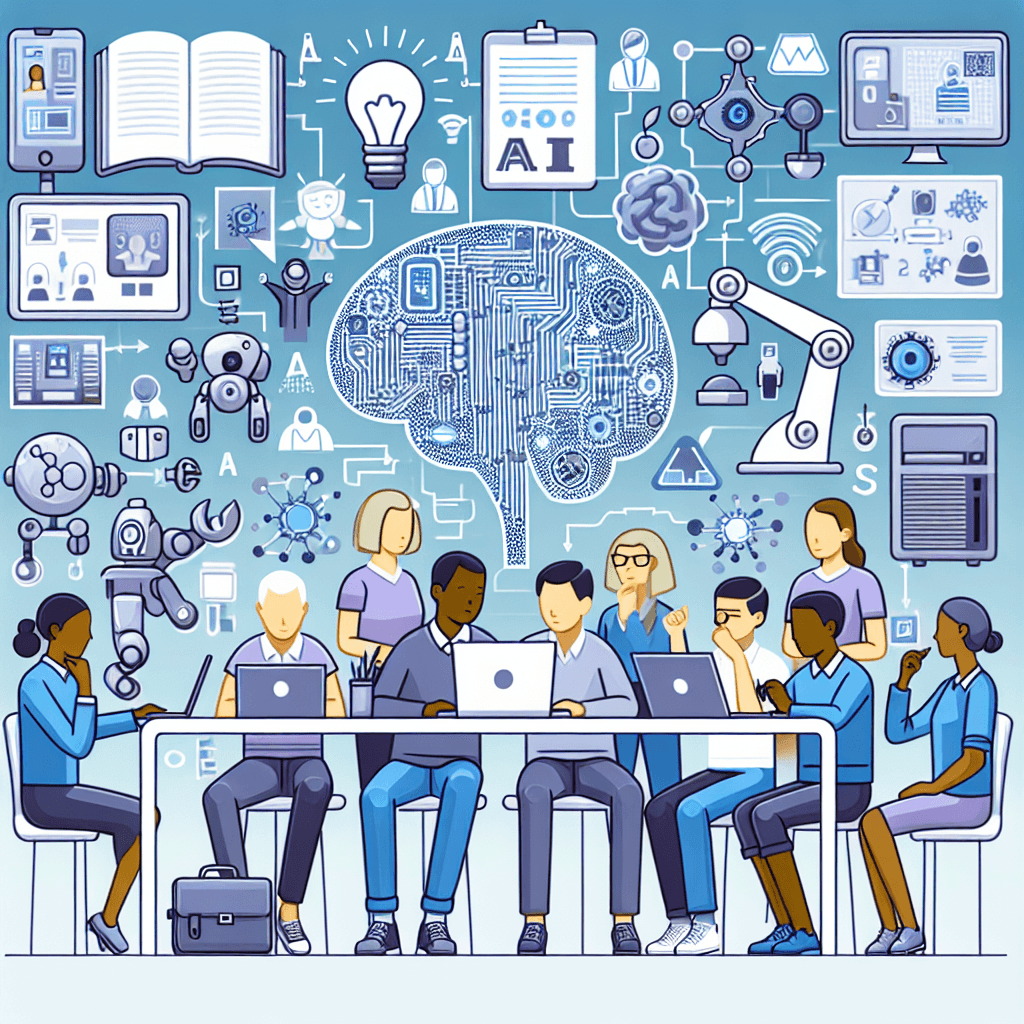
AI Basics for Adult Educators
Inquiry Framework
Question Framework
Driving Question
The overarching question that guides the entire project.How can we effectively integrate artificial intelligence into technology education for adults while addressing ethical implications and maximizing educational benefits?Essential Questions
Supporting questions that break down major concepts.- How can artificial intelligence be applied in various aspects of technology education?
- What are the ethical implications of using AI in technology sectors, and how can they be addressed?
- In what ways can AI be used to enhance adult education and training methods?
- How do different AI technologies work and what are their potential benefits and limitations in educational settings?
Standards & Learning Goals
Learning Goals
By the end of this project, students will be able to:- Understand the practical applications and benefits of AI in adult educational technology settings.
- Critically examine and discuss the ethical considerations surrounding the use of AI in technology.
- Develop strategies for integrating AI tools in educational contexts to enhance learning and teaching experiences.
- Explore various AI technologies to determine their functionality and utility in different educational scenarios.
International Technology and Engineering Educators Association (ITEEA) Standards for Technological Literacy.
International Society for Technology in Education (ISTE) Standards for Educators
Common Core State Standards (CCSS) for English Language Arts & Literacy
Entry Events
Events that will be used to introduce the project to studentsAI in Everyday Life
Students begin by exploring how AI impacts their daily routines, from voice assistants to recommendation algorithms. They will record a day in their life and identify moments where AI influences their choices or actions, sparking curiosity about the technology's functioning and implications.Portfolio Activities
Portfolio Activities
These activities progressively build towards your learning goals, with each submission contributing to the student's final portfolio.AI Ethics Roundtable
Students will engage in discussions about the ethical implications of AI in education, debating key issues and proposing solutions.Steps
Here is some basic scaffolding to help students complete the activity.Final Product
What students will submit as the final product of the activityA set of ethical guidelines for AI integration in education.Alignment
How this activity aligns with the learning objectives & standardsAligns with ISTE-E by fostering critical thinking and collaboration in designing educational experiences with AI.AI Technology Exploration
Hands-on exploration of various AI technologies used in education to understand their benefits and limitations.Steps
Here is some basic scaffolding to help students complete the activity.Final Product
What students will submit as the final product of the activityA comprehensive report detailing the functionality, benefits, and limitations of different AI tools in education.Alignment
How this activity aligns with the learning objectives & standardsAligns with ITEEA-ET and ISTE-E by encouraging practical application of AI technologies to promote educational innovation.AI Integration Strategy Development
Students will develop strategies to integrate AI into adult education, enhancing learning experiences.Steps
Here is some basic scaffolding to help students complete the activity.Final Product
What students will submit as the final product of the activityA detailed strategy document outlining AI integration in an educational context.Alignment
How this activity aligns with the learning objectives & standardsSupports ITEEA-ET and ISTE-E by applying strategic planning to incorporate AI effectively in education.AI Daily Diary
In this activity, students explore how AI impacts their everyday life by recording a day in their life and identifying AI interactions. This sparks curiosity about how AI functions and its implications.Steps
Here is some basic scaffolding to help students complete the activity.Final Product
What students will submit as the final product of the activityA detailed diary showcasing AI interactions and their reflective insights.Alignment
How this activity aligns with the learning objectives & standardsSupports ITEEA-ET by applying observational skills to real-world AI interactions.Rubric & Reflection
Portfolio Rubric
Grading criteria for assessing the overall project portfolioArtificial Intelligence Integration in Adult Education
Understanding AI Applications
Evaluates the learner's comprehension of AI technology applications in education and the ability to reflect on ethical implications.Comprehensive Understanding
The depth of understanding of AI applications in educational settings and ethical considerations.
Exemplary
4 PointsDemonstrates sophisticated understanding of AI applications and ethical implications, providing insightful examples.
Proficient
3 PointsDemonstrates thorough understanding of AI applications and ethical implications with relevant examples.
Developing
2 PointsShows emerging understanding of AI applications and ethical implications with some examples.
Beginning
1 PointsShows initial understanding of AI applications with minimal mention of ethical implications.
Reflective Analysis
Ability to critically analyze and reflect on AI tools’ functionality and ethical use in education.
Exemplary
4 PointsProvides comprehensive analysis with deep reflection on AI functionality and ethical use, offering innovative insights.
Proficient
3 PointsProvides thorough analysis and reflection on AI functionality and ethical use with clear insights.
Developing
2 PointsProvides developing analysis with some reflection on AI functionality and ethical considerations.
Beginning
1 PointsProvides basic analysis with limited reflection on AI functionality and ethics.
Practical Application of AI Tools
Assesses the learner's ability to practically test, analyze, and report on AI tools in educational scenarios.Tool Evaluation
Effectiveness in evaluating AI educational tools based on functionality, benefits, and limitations.
Exemplary
4 PointsConducts an in-depth evaluation of AI tools, demonstrating exceptional insight into their educational benefits and limitations.
Proficient
3 PointsConducts a comprehensive evaluation of AI tools, showing clear understanding of their educational benefits and limitations.
Developing
2 PointsConducts a basic evaluation of AI tools, identifying some benefits and limitations.
Beginning
1 PointsConducts a limited evaluation of AI tools with minimal identification of benefits and limitations.
Strategy Development
Ability to develop and propose strategies for AI integration in educational settings.
Exemplary
4 PointsCreates detailed, innovative AI integration strategies with comprehensive plans for education.
Proficient
3 PointsDevelops clear AI integration strategies with well-defined plans for educational application.
Developing
2 PointsDevelops basic AI integration strategies with general plans for application.
Beginning
1 PointsDevelops limited AI integration strategies with incomplete plans for application.
Communication and Collaboration
Evaluates the learner's ability to communicate ideas effectively and collaborate with peers in discussions and presentations.Engagement and Collaboration
Level of collaboration and engagement in discussions and activities related to AI in education.
Exemplary
4 PointsExhibits leadership and exceptional collaboration skills, actively engaging and contributing in all discussions and activities.
Proficient
3 PointsEffectively collaborates and contributes to discussions and activities, showing solid engagement.
Developing
2 PointsParticipates in discussions and activities with some contribution to collaboration.
Beginning
1 PointsNeeds assistance to participate in discussions and activities, with minimal contribution.