
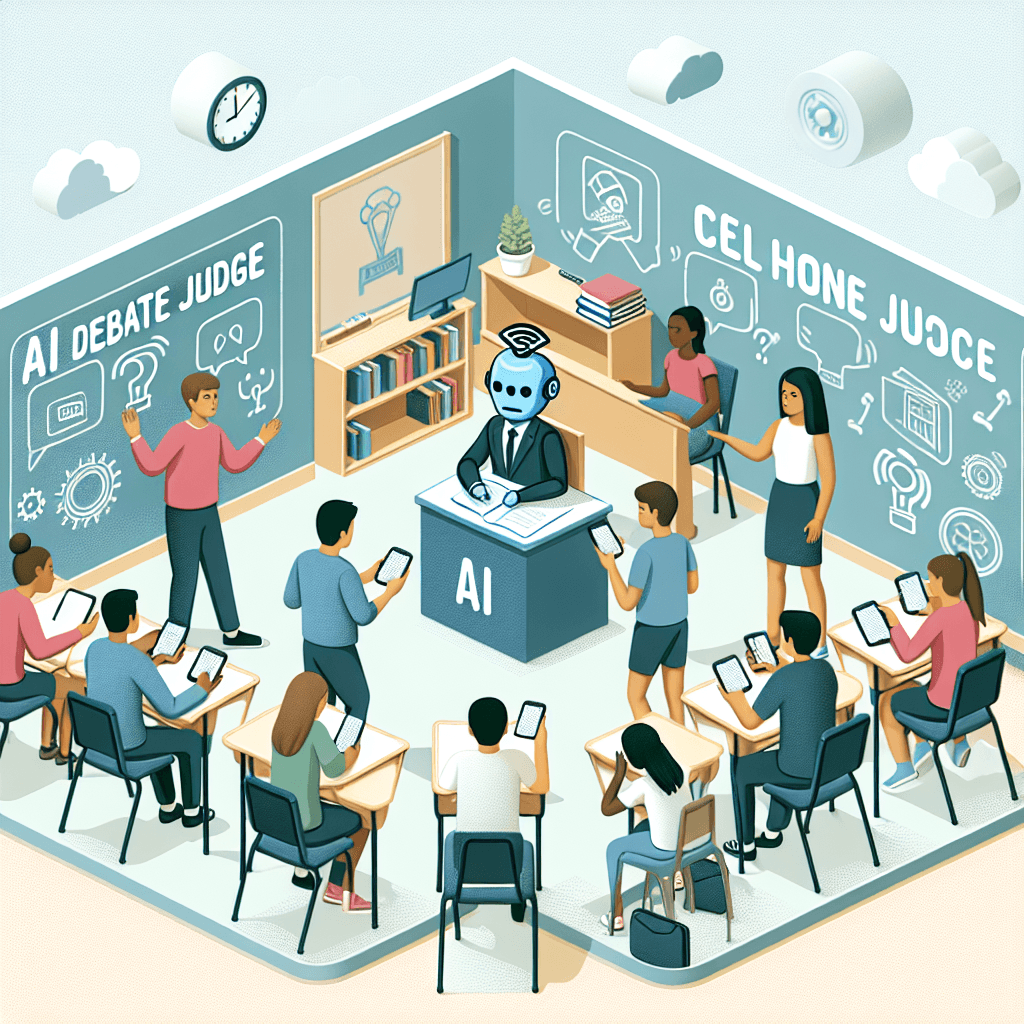
AI Debate Judge: Cell Phone Use in Schools
Inquiry Framework
Question Framework
Driving Question
The overarching question that guides the entire project.How can we develop an AI debate judge that facilitates a balanced and respectful discussion, moderated by the teacher, regarding cell phone use in schools, addressing both the benefits for social connection and the ethical considerations, while ensuring a fair evaluation of arguments from diverse perspectives?Essential Questions
Supporting questions that break down major concepts.- How can AI be designed to evaluate arguments objectively and fairly?
- What constitutes a strong and well-reasoned debate argument?
- How can subjective criteria for debate evaluation be translated into quantifiable metrics suitable for AI assessment, ensuring consideration of different viewpoints?
- What are the ethical implications of using AI to judge human debates, and how can we mitigate potential biases?
- What are the diverse perspectives on the pros and cons of cell phone use in the classroom, considering students' social connections, the learning environment, and potential distractions?
- How can a teacher effectively moderate a debate to ensure a balanced and respectful discussion?
Standards & Learning Goals
Learning Goals
By the end of this project, students will be able to:- Students will learn the basics of AI and its applications in evaluating arguments.
- Students will understand the components of a strong debate and how to translate subjective criteria into quantifiable metrics for AI assessment.
- Students will explore the ethical considerations of using AI to judge human performance.
- Students will analyze the pros and cons of cell phone use in the classroom and daily life.
- Students will design and build an AI system to judge classroom debates about cell phone use.
Entry Events
Events that will be used to introduce the project to studentsEmpathy Exercise: Walk a Mile in Their Shoes (Connected Edition)
Students role-play different stakeholders (e.g., a student who relies on a cell phone for medical reasons, a teacher struggling with classroom distraction, a parent concerned about cyberbullying) and argue their case for/against cell phone use. This exercise fosters empathy and helps students appreciate the diverse needs and challenges related to technology in schools.Portfolio Activities
Portfolio Activities
These activities progressively build towards your learning goals, with each submission contributing to the student's final portfolio.Argument Analysis: Deconstructing Debate Dynamics
Students will analyze sample debates, breaking down arguments into claims, evidence, and reasoning. They will identify logical fallacies and assess the overall strength of each argument.Steps
Here is some basic scaffolding to help students complete the activity.Final Product
What students will submit as the final product of the activityA detailed report analyzing the structure and effectiveness of arguments in the sample debates.Alignment
How this activity aligns with the learning objectives & standardsLearning Goal: Students will understand the components of a strong debate and how to translate subjective criteria into quantifiable metrics for AI assessment.Ethical AI: Bias Detection and Mitigation
Students will explore the ethical implications of using AI in debate judging, focusing on potential biases. They will research methods to mitigate bias in AI systems and design their AI judge with fairness in mind.Steps
Here is some basic scaffolding to help students complete the activity.Final Product
What students will submit as the final product of the activityA report outlining the ethical considerations and bias mitigation strategies for their AI debate judge.Alignment
How this activity aligns with the learning objectives & standardsLearning Goal: Students will explore the ethical considerations of using AI to judge human performance.Quantifiable Metrics: From Subjective to Objective
Students will translate subjective debate criteria (e.g., clarity, persuasiveness, logical consistency) into quantifiable metrics that an AI can assess. They will define scales and rubrics for evaluating these metrics.Steps
Here is some basic scaffolding to help students complete the activity.Final Product
What students will submit as the final product of the activityA detailed rubric defining quantifiable metrics for evaluating debate performance.Alignment
How this activity aligns with the learning objectives & standardsLearning Goal: Students will understand the components of a strong debate and how to translate subjective criteria into quantifiable metrics for AI assessment.AI Judge Design: Blueprinting the System
Students will design the architecture of their AI debate judge, specifying the input data (e.g., speech transcripts, video recordings), the AI algorithms to be used (e.g., natural language processing, sentiment analysis), and the output format (e.g., scores, feedback).Steps
Here is some basic scaffolding to help students complete the activity.Final Product
What students will submit as the final product of the activityA detailed design document outlining the AI debate judge architecture.Alignment
How this activity aligns with the learning objectives & standardsLearning Goal: Students will design and build an AI system to judge classroom debates about cell phone use.Rubric & Reflection
Portfolio Rubric
Grading criteria for assessing the overall project portfolioAI Debate Judge Portfolio Rubric - Grade 9
Argument Analysis
This category assesses the student's ability to deconstruct and analyze arguments presented in sample debates, identifying claims, evidence, reasoning, and logical fallacies.Deconstruction of Arguments
Effectively breaks down arguments into their core components: claims, evidence, and reasoning.
Exemplary
4 PointsThe student expertly deconstructs arguments, clearly identifying claims, evidence, and reasoning, and demonstrates a nuanced understanding of their relationships within the debate.
Proficient
3 PointsThe student thoroughly deconstructs arguments, accurately identifying claims, evidence, and reasoning in most cases.
Developing
2 PointsThe student partially deconstructs arguments, identifying some claims, evidence, and reasoning, but may struggle with more complex arguments.
Beginning
1 PointsThe student struggles to deconstruct arguments, demonstrating difficulty in identifying claims, evidence, and reasoning.
Evaluation of Evidence
Assesses the quality, relevance, and credibility of evidence presented in the arguments.
Exemplary
4 PointsThe student critically evaluates the quality, relevance, and credibility of evidence with exceptional insight, identifying subtle biases and inconsistencies.
Proficient
3 PointsThe student thoroughly evaluates the quality, relevance, and credibility of evidence, identifying strengths and weaknesses in most cases.
Developing
2 PointsThe student evaluates the quality, relevance, and credibility of evidence, but may miss some nuances or have difficulty assessing credibility.
Beginning
1 PointsThe student struggles to evaluate the quality, relevance, and credibility of evidence, demonstrating a limited understanding of these concepts.
Detection of Fallacies and Biases
Identifies logical fallacies and biases present in the arguments.
Exemplary
4 PointsThe student expertly detects and articulates a wide range of logical fallacies and biases with sophisticated understanding of their impact on the arguments.
Proficient
3 PointsThe student accurately detects and identifies common logical fallacies and biases in the arguments.
Developing
2 PointsThe student identifies some logical fallacies and biases, but may miss more subtle or complex examples.
Beginning
1 PointsThe student struggles to identify logical fallacies and biases in the arguments.
Ethical AI
This category assesses the student's understanding of ethical considerations related to AI and their ability to mitigate bias in their AI debate judge.Identification of Ethical Considerations
Recognizes and articulates the ethical implications of using AI in debate judging.
Exemplary
4 PointsThe student demonstrates a comprehensive understanding of the ethical implications of using AI in debate judging, including nuanced considerations of fairness, transparency, and accountability.
Proficient
3 PointsThe student thoroughly identifies and articulates the key ethical implications of using AI in debate judging.
Developing
2 PointsThe student identifies some ethical considerations, but may not fully articulate their implications for debate judging.
Beginning
1 PointsThe student struggles to identify the ethical considerations of using AI in debate judging.
Bias Mitigation Strategies
Develops and incorporates strategies to mitigate bias in the AI system design.
Exemplary
4 PointsThe student develops and integrates innovative and effective bias mitigation strategies, demonstrating a deep understanding of bias detection and prevention techniques.
Proficient
3 PointsThe student develops and incorporates practical strategies to mitigate bias in the AI system design.
Developing
2 PointsThe student proposes some bias mitigation strategies, but they may not be fully developed or effectively integrated into the AI system design.
Beginning
1 PointsThe student struggles to develop or incorporate bias mitigation strategies into the AI system design.
Ethical Guidelines
Creates clear and comprehensive ethical guidelines for the AI debate judge.
Exemplary
4 PointsThe student creates exceptionally clear, comprehensive, and nuanced ethical guidelines that address a wide range of potential ethical dilemmas and promote responsible AI use.
Proficient
3 PointsThe student develops a clear and comprehensive set of ethical guidelines for their AI debate judge.
Developing
2 PointsThe student develops some ethical guidelines, but they may be incomplete or lack clarity.
Beginning
1 PointsThe student struggles to develop ethical guidelines for the AI debate judge.
Quantifiable Metrics
This category assesses the student's ability to translate subjective debate criteria into quantifiable metrics suitable for AI assessment.Translation of Subjective Criteria
Effectively translates subjective debate criteria into quantifiable metrics.
Exemplary
4 PointsThe student expertly translates a wide range of subjective criteria into innovative and highly effective quantifiable metrics that capture the nuances of debate performance.
Proficient
3 PointsThe student thoroughly translates subjective criteria into quantifiable metrics that are appropriate for AI assessment.
Developing
2 PointsThe student partially translates subjective criteria into quantifiable metrics, but some metrics may be vague or difficult to assess.
Beginning
1 PointsThe student struggles to translate subjective criteria into quantifiable metrics.
Development of Scales and Rubrics
Develops clear and reliable scales and rubrics for assessing the defined metrics.
Exemplary
4 PointsThe student develops exceptionally clear, detailed, and reliable scales and rubrics that provide a comprehensive framework for assessing debate performance.
Proficient
3 PointsThe student develops clear and reliable scales and rubrics for assessing the defined metrics.
Developing
2 PointsThe student develops scales and rubrics, but they may lack clarity or reliability.
Beginning
1 PointsThe student struggles to develop scales and rubrics for assessing the defined metrics.
Reliability and Validity Testing
Tests the rubrics to ensure reliability and validity of assessment.
Exemplary
4 PointsThe student rigorously tests the rubrics, demonstrating a sophisticated understanding of reliability and validity principles and using diverse methods to ensure accurate and consistent assessment.
Proficient
3 PointsThe student tests the rubrics and provides evidence of their reliability and validity.
Developing
2 PointsThe student attempts to test the rubrics, but the methods used may be limited or lack rigor.
Beginning
1 PointsThe student does not test the rubrics or provide evidence of their reliability or validity.
AI Judge Design
This category assesses the student's ability to design the architecture of their AI debate judge, specifying input data, algorithms, and output format.Specification of Input Data
Clearly defines the input data required for the AI system.
Exemplary
4 PointsThe student expertly defines the input data with exceptional clarity and detail, demonstrating a deep understanding of the data's relevance to AI analysis.
Proficient
3 PointsThe student clearly defines the input data required for the AI system.
Developing
2 PointsThe student defines some input data, but the specifications may be incomplete or lack clarity.
Beginning
1 PointsThe student struggles to define the input data required for the AI system.
Selection of AI Algorithms
Selects appropriate AI algorithms for analyzing the input data and judging the debate.
Exemplary
4 PointsThe student expertly selects and justifies the use of innovative and highly effective AI algorithms, demonstrating a deep understanding of their capabilities and limitations in the context of debate judging.
Proficient
3 PointsThe student selects appropriate AI algorithms for analyzing the input data and judging the debate.
Developing
2 PointsThe student selects some AI algorithms, but their appropriateness for the task may be questionable.
Beginning
1 PointsThe student struggles to select appropriate AI algorithms.
Design of Output Format
Creates a clear and informative output format for the AI system.
Exemplary
4 PointsThe student creates an exceptionally clear, informative, and user-friendly output format that provides comprehensive feedback and facilitates meaningful analysis of debate performance.
Proficient
3 PointsThe student designs a clear and informative output format for the AI system.
Developing
2 PointsThe student designs an output format, but it may be unclear or lack important information.
Beginning
1 PointsThe student struggles to design an output format for the AI system.
System Architecture Diagram
Develops a clear and accurate flowchart or diagram illustrating the AI system architecture.
Exemplary
4 PointsThe student develops an exceptionally clear, detailed, and accurate system architecture diagram that provides a comprehensive overview of the AI system's components and their interactions.
Proficient
3 PointsThe student creates a clear and accurate flowchart or diagram illustrating the AI system architecture.
Developing
2 PointsThe student creates a system architecture diagram, but it may be incomplete or lack clarity.
Beginning
1 PointsThe student struggles to create a system architecture diagram.