
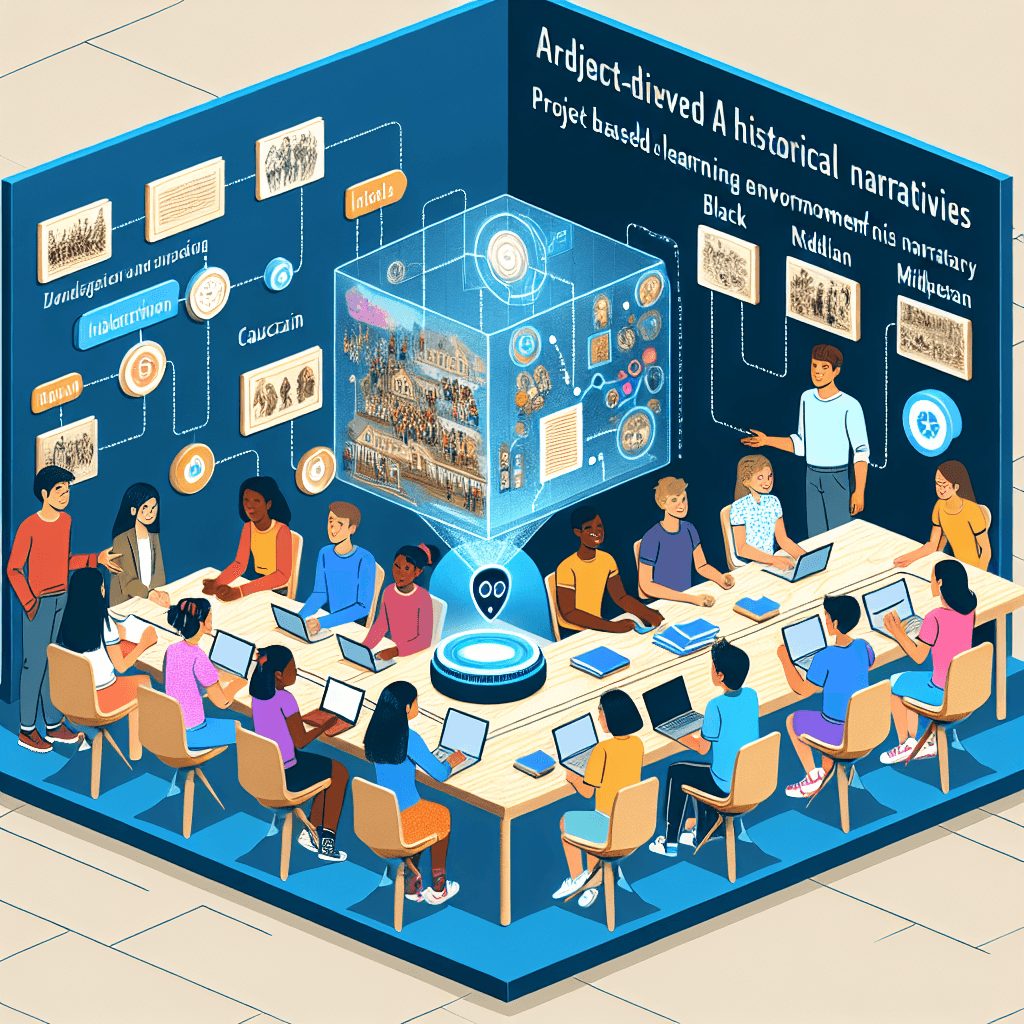
AI-Driven Historical Narratives Creation
Inquiry Framework
Question Framework
Driving Question
The overarching question that guides the entire project.How can we use artificial intelligence to create accurate and ethical historical narratives while considering the benefits and challenges of integrating AI in humanities?Essential Questions
Supporting questions that break down major concepts.- What is artificial intelligence and how does it function in our daily lives?
- How can AI be applied to interpret and recreate historical events?
- What are the ethical considerations in using AI for generating historical narratives?
- How can AI-generated narratives be critically evaluated for accuracy and bias?
- What are the benefits and challenges of integrating AI in humanities subjects, specifically history and literature?
Standards & Learning Goals
Learning Goals
By the end of this project, students will be able to:- Understand the basics of artificial intelligence and its functionalities.
- Apply AI technologies to create historical narratives based on accurate historical data.
- Critically evaluate AI-generated historical narratives for accuracy and bias.
- Develop ethical guidelines for using AI in creating humanistic content.
- Explore the challenges and benefits of integrating AI into humanities, focusing on history and literature.
Custom AI Education Standards
Entry Events
Events that will be used to introduce the project to studentsAI-Powered Time Travel Symposium
Kick off the project with an event that simulates a time travel experience where students use an AI-driven platform to glimpse historical events. This experience would spark curiosity about how AI interprets and reconstructs the past, fitting perfectly with core project goals of exploring AI in humanities and history.Historical Secrets Decoded: AI Challenge
Present a mysterious artifact or historical document and challenge students to use AI tools to decode its secrets and construct a narrative around it. This event encourages students to explore AI applications in deciphering historical mysteries, greatly enhancing their problem-solving skills.Virtual Debate with Historical Figures
Organize a virtual debate where students use AI algorithms to embody historical figures and engage in discussions about their respective eras. This not only captivates students' interests but also pushes them to understand the historical context and the capabilities of AI in simulating personalities.AI Writer's Retreat: Past Meets Present
Host a retreat where students collaborate with AI to create historical fiction pieces, investigating how AI can assist in storytelling based on real historical data. This entry event emphasizes AI's role in the creative process, challenging students to push the boundaries of traditional historical narratives.Portfolio Activities
Portfolio Activities
These activities progressively build towards your learning goals, with each submission contributing to the student's final portfolio.AI Basics Bootcamp
This activity introduces students to the fundamentals of artificial intelligence, setting a foundation for understanding how AI functions and its potential applications in historical narrative creation.Steps
Here is some basic scaffolding to help students complete the activity.Final Product
What students will submit as the final product of the activityA foundational understanding of AI basics and its applications in real life.Alignment
How this activity aligns with the learning objectives & standardsThis activity aligns with AI101 standard on understanding AI fundamentals, essential for utilizing AI tools in historical narratives.Historical Data Mining Workshop
Students will learn how to gather and prepare historical data for AI-driven narratives, crucial for creating accurate storytelling.Steps
Here is some basic scaffolding to help students complete the activity.Final Product
What students will submit as the final product of the activityA curated and cleaned dataset ready for AI narrative creation.Alignment
How this activity aligns with the learning objectives & standardsSupports AI104 by exploring AI applications in humanities, enhancing skills in data handling for narrative creation.Narrative Sculptors: AI in Action
In this activity, students apply AI tools to generate historical narratives from curated data, merging technology with storytelling.Steps
Here is some basic scaffolding to help students complete the activity.Final Product
What students will submit as the final product of the activityAn AI-generated historical narrative, refined and edited for accuracy and readability.Alignment
How this activity aligns with the learning objectives & standardsAligns with AI104 by demonstrating practical AI applications in creating humanities content.Critique Circle: Evaluating AI Narratives
Students will engage in a critical evaluation of AI-generated narratives, focusing on accuracy, bias, and ethical considerations.Steps
Here is some basic scaffolding to help students complete the activity.Final Product
What students will submit as the final product of the activityWritten evaluations of AI-generated narratives, with notes on accuracy and bias.Alignment
How this activity aligns with the learning objectives & standardsSupports AI103 by developing the ability to critically evaluate AI outputs for ethical and accuracy issues.Ethical AI Advocates: Regulation Workshop
The final activity involves developing ethical guidelines and regulations for using AI in humanities, ensuring responsible and fair use.Steps
Here is some basic scaffolding to help students complete the activity.Final Product
What students will submit as the final product of the activityA collaboratively written set of ethical guidelines for using AI in humanities projects.Alignment
How this activity aligns with the learning objectives & standardsDirectly supports AI103 by focusing on ethical considerations and creating regulations for AI usage.Rubric & Reflection
Portfolio Rubric
Grading criteria for assessing the overall project portfolioAI-Driven Historical Fiction Rubric
Understanding and Application of AI
Evaluates students' comprehension of artificial intelligence concepts and their ability to apply AI tools effectively in creating historical narratives.Understanding AI Concepts
Measures the degree to which students understand artificial intelligence and its applications in narrative creation.
Exemplary
4 PointsDemonstrates a sophisticated understanding of AI, incorporating advanced concepts into narrative creation effectively.
Proficient
3 PointsShows thorough understanding of AI concepts and applies them appropriately in generating historical narratives.
Developing
2 PointsDisplays an emerging understanding of AI with inconsistent applications in narrative generation.
Beginning
1 PointsExhibits initial understanding of AI, struggling to apply concepts in narrative contexts.
Application of AI Tools
Assesses the ability to utilize AI technologies effectively in the narrative creation process.
Exemplary
4 PointsApplies AI tools with expertise, producing creative and accurate historical narratives that demonstrate innovation.
Proficient
3 PointsUtilizes AI tools effectively to generate high-quality historical narratives.
Developing
2 PointsUses AI tools with partial success, creating narratives of varying quality.
Beginning
1 PointsStruggles to use AI tools efficiently, resulting in incomplete or inaccurate narratives.
Historical and Ethical Analysis
Focuses on students' ability to critique and analyze AI-generated narratives for historical accuracy, bias, and ethical concerns.Critique of Historical Accuracy and Bias
Evaluates how well students can identify and address inaccuracies and biases in AI-generated narratives.
Exemplary
4 PointsProvides comprehensive analysis of narratives, identifying subtle biases and inaccuracies with extensive evidence.
Proficient
3 PointsConducts clear evaluations of narratives, identifying major inaccuracies and biases.
Developing
2 PointsOffers limited analysis of narratives with occasional recognition of significant biases or inaccuracies.
Beginning
1 PointsShows minimal ability to critique narratives, often overlooking inaccuracies and biases.
Development of Ethical Guidelines
Assesses student capability in developing ethical considerations and guidelines for AI applications in humanities projects.
Exemplary
4 PointsCreates comprehensive, insightful guidelines that address multiple ethical dimensions of AI usage in narratives.
Proficient
3 PointsDrafts clear ethical guidelines, encompassing key concerns for AI use in historical narratives.
Developing
2 PointsFormulates basic guidelines with limited scope on ethical issues in AI applications.
Beginning
1 PointsProduces minimal or incomplete ethical guidelines, lacking depth and scope.
Collaboration and Communication
Measures students’ abilities to work collaboratively and communicate ideas effectively in group settings and peer reviews.Collaborative Engagement
Evaluates the extent and quality of students' participation and contribution in group activities and discussions.
Exemplary
4 PointsExhibits leadership in group settings, encouraging others and facilitating productive collaboration.
Proficient
3 PointsEngages effectively in group work, contributing constructively to discussions and activities.
Developing
2 PointsParticipates in group activities with varying levels of engagement and contribution.
Beginning
1 PointsShows limited participation in group work, often needing support to engage with peers.