
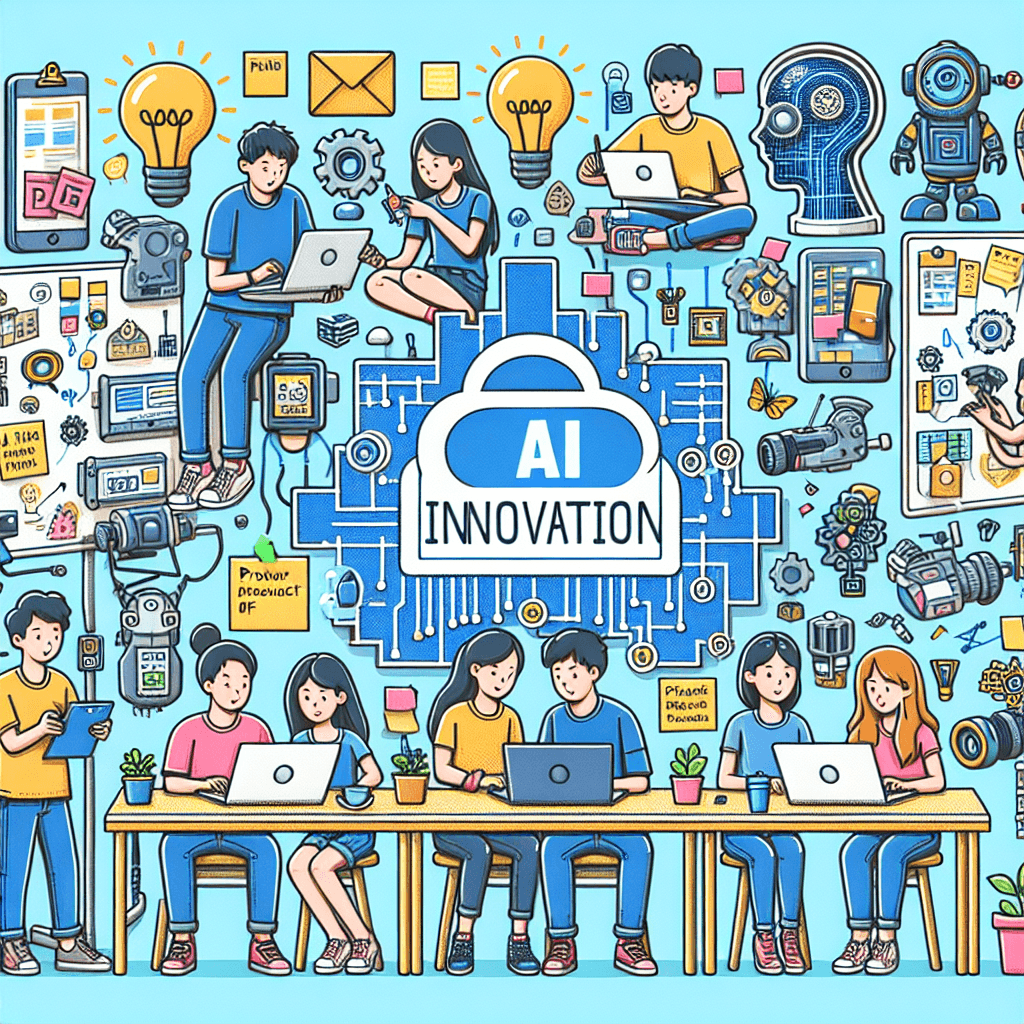
AI-Powered Product Innovation Challenge
Inquiry Framework
Question Framework
Driving Question
The overarching question that guides the entire project.How can we leverage AI technologies to enhance everyday products, and what are the potential impacts on design accessibility and innovation?Essential Questions
Supporting questions that break down major concepts.- What is design thinking and how can it be applied to improve everyday products?
- How does machine learning work and in what ways can it aid in the design of products?
- What role does data play in enhancing product design through AI?
- How can AI be used to democratize design and allow for inclusive innovation?
- What are the ethical considerations of using AI in product design?
Standards & Learning Goals
Learning Goals
By the end of this project, students will be able to:- Students will understand the principles of design thinking and apply them to enhance everyday products using AI technologies.
- Students will learn how to identify key data points necessary for AI to aid in product design and collect and analyze this data.
- Students will explore the ethical implications of using AI in product design and consider how this affects inclusivity and accessibility in innovation.
- Students will demonstrate the ability to conduct research and utilize findings to inform the design and improvement of everyday products using AI.
Next Generation Science Standards
Common Core Standards
Entry Events
Events that will be used to introduce the project to studentsAI Revolution in Design
Kick off the project with a video documentary showcasing how AI has transformed product design in various industries. Highlight real-world examples where AI has led to groundbreaking innovations. Encourage students to explore how these transformations intersect with subjects like physics (material selection), chemistry (sustainability in production), and math (algorithm development).AI-Powered Scavenger Hunt
Organize an AI-themed scavenger hunt in the school, where students must solve clues related to AI applications in product design across different subjects. Each clue they solve should lead them to a practical AI application, driving curiosity about AI's role in everyday products they use.Product Design Hackathon
Host an AI product design hackathon, where teams of students must choose a common product and brainstorm ways to enhance it using AI within a limited timeframe. Provide resources and facilitators to guide them through design thinking processes, challenging them to find creative and practical solutions.From Idea to Reality with AI
Invite a panel of local entrepreneurs who have used AI to bring their designs to market. Allow students to pitch their initial product ideas to this panel, gaining feedback and insights on improvement and feasibility. This simulates real-world pitch sessions and emphasizes the impact of AI in transforming ideas into viable products.Portfolio Activities
Portfolio Activities
These activities progressively build towards your learning goals, with each submission contributing to the student's final portfolio.Discover Your Inner Designer
Students are introduced to design thinking and the impact of AI on product innovation, encouraging them to reflect on how they could improve a product they use daily with the help of AI technologies.Steps
Here is some basic scaffolding to help students complete the activity.Final Product
What students will submit as the final product of the activityA reflective paragraph detailing the chosen product and potential AI-inspired improvements.Alignment
How this activity aligns with the learning objectives & standardsAligns with HS-ETS1-4 (Use computer simulations to model real-world problems) and CCSS.ELA-LITERACY.CCRA.W.7 (Conduct research and demonstrate understanding).AI Data Detective
Students investigate the types of data AI would need to improve the chosen product and explore how to collect and analyze this data effectively.Steps
Here is some basic scaffolding to help students complete the activity.Final Product
What students will submit as the final product of the activityA presentation detailing the data needed for AI to improve the product, including a collection and analysis plan.Alignment
How this activity aligns with the learning objectives & standardsAligns with CCSS.ELA-LITERACY.CCRA.W.7 (Conduct research and demonstrate understanding) and CCSS.MATH.PRACTICE.MP4 (Model with mathematics).Prototype Creation and Testing
Students create a prototype of their improved product, using AI data analysis to refine their design.Steps
Here is some basic scaffolding to help students complete the activity.Final Product
What students will submit as the final product of the activityA refined prototype of the improved product, informed by data analysis and feedback.Alignment
How this activity aligns with the learning objectives & standardsAligns with HS-ETS1-4 (Model impact of solutions) and HS-PS3-3 (Consider energy transformations in design).AI Ethics Explorer
Students explore the ethical considerations of using AI in product design, focusing on inclusivity and accessibility.Steps
Here is some basic scaffolding to help students complete the activity.Final Product
What students will submit as the final product of the activityA reflective essay on the ethical implications of AI in design innovation.Alignment
How this activity aligns with the learning objectives & standardsAligns with CCSS.ELA-LITERACY.CCRA.W.7 (Conduct research and write reflectively).Pitch Your AI-Enhanced Product
Students present their finalized AI-enhanced product design to a panel, simulating a real-world pitch scenario.Steps
Here is some basic scaffolding to help students complete the activity.Final Product
What students will submit as the final product of the activityA comprehensive pitch presentation and business proposal for the AI-enhanced product.Alignment
How this activity aligns with the learning objectives & standardsAligns with HS-ETS1-4 (Model solutions to real-world problems) and CCSS.ELA-LITERACY.CCRA.W.7 (Demonstrate understanding through research and presentation).Rubric & Reflection
Portfolio Rubric
Grading criteria for assessing the overall project portfolioAI-Enhanced Product Design Evaluation Rubric
Design Thinking and Innovative Problem Solving
Assessment of students' application of design thinking principles to creatively solve problems using AI.Understanding and Application of Design Thinking
Evaluates how well students understand and apply design thinking methodologies to improve products using AI.
Exemplary
4 PointsDemonstrates sophisticated understanding of design thinking with innovative and creative product solutions clearly grounded in AI integration.
Proficient
3 PointsShows thorough understanding and appropriate application of design thinking methodologies, resulting in practical AI-enhanced product solutions.
Developing
2 PointsShows emerging understanding of design thinking, with attempts to apply it leading to simple or limited product improvements.
Beginning
1 PointsMinimal understanding of design thinking evident, with little to no practical application for product improvement using AI.
Innovation and Creativity
Evaluates the creativity and innovation in students' product enhancement ideas leveraging AI.
Exemplary
4 PointsExhibits remarkable creativity and innovation, proposing distinctive and impactful AI-driven product enhancements.
Proficient
3 PointsDisplays solid creativity and innovation with compelling product enhancements using AI effectively.
Developing
2 PointsSome creativity and innovation evidenced, with basic enhancements suggested for the product using AI.
Beginning
1 PointsLimited creativity and sparse innovation shown; struggled to propose meaningful enhancements for the product via AI.
Research and Data Analysis
Assessment of research skills and data analysis competency to collect and utilize information for AI product enhancement.Research Skills
Evaluates students’ ability to conduct comprehensive research necessary for AI product enhancement.
Exemplary
4 PointsConducts rigorous research, integrating multiple sources to yield insightful conclusions significantly benefiting product design.
Proficient
3 PointsConducts effective research utilizing relevant sources, resulting in useful insights for product enhancement.
Developing
2 PointsResearch performed with limited scope or depth, offering incomplete insights into product design enhancement.
Beginning
1 PointsMinimal research with weak or no reliable sources employed, yielding insufficient insights for product enhancement.
Data Analysis for Product Improvement
Evaluates students' ability to identify, collect, and analyze data relevant for AI-driven product improvement.
Exemplary
4 PointsExpertly collects and analyzes pertinent data, deriving complex insights leading to substantial product improvements using AI.
Proficient
3 PointsEfficiently collects and interprets relevant data, leading to meaningful enhancements in product design via AI.
Developing
2 PointsData collection and analysis show limited depth or connectivity, achieving minor product improvements.
Beginning
1 PointsStruggles with data collection and analysis, leading to few or no discernible improvements in product design.
Ethical Considerations in AI
Assessment of understanding and integration of ethical considerations in AI-driven product design.Ethical Analysis and Considerations
Evaluates students’ ability to identify and address ethical considerations in AI product innovation.
Exemplary
4 PointsPresents a comprehensive ethical analysis with thoroughly considered perspectives, effectively integrating ethics within AI product design.
Proficient
3 PointsProvides clear ethical analysis, acknowledging relevant perspectives and ethical dimensions in AI-based design.
Developing
2 PointsEthical analysis demonstrates limited range or depth, lacking complete integration into product design process.
Beginning
1 PointsExhibits minimal or unclear ethical analysis, with little evidence of consideration in product design.
Presentation and Communication Skills
Assessment of students' skills in presenting and communicating their AI-driven product enhancement results.Clarity and Persuasiveness of Communication
Evaluates the clarity, coherence, and persuasiveness of students' presentations about their AI-enhanced products.
Exemplary
4 PointsDelivers highly persuasive, coherent, and clear presentation with well-organized and compelling communication of ideas.
Proficient
3 PointsPresents clear and coherent arguments effectively, with convincing communication of product designs.
Developing
2 PointsPresents ideas with some clarity and persuasion but lacks full coherence and impactful delivery.
Beginning
1 PointsStruggles to communicate ideas clearly or persuasively, with disorganized or unclear presentation format.