
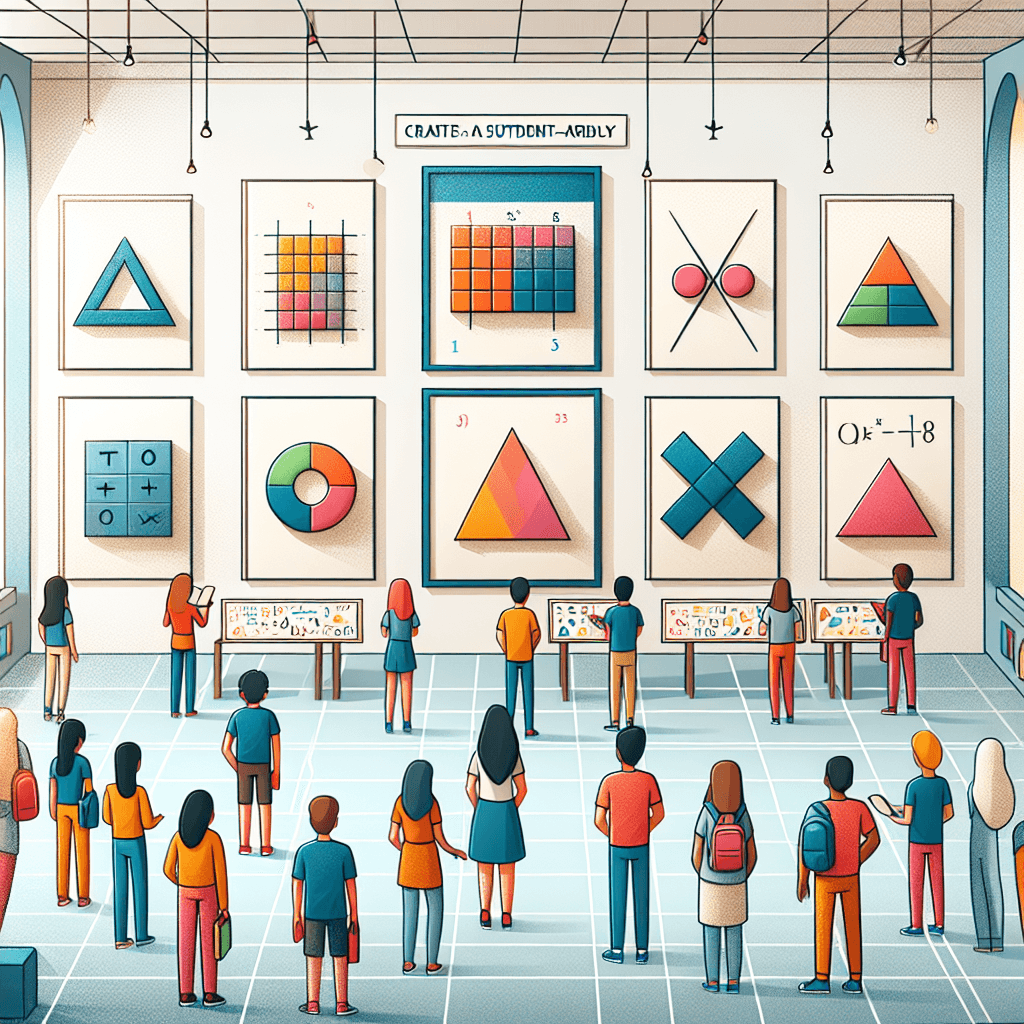
Algebraic Art Gallery
Inquiry Framework
Question Framework
Driving Question
The overarching question that guides the entire project.How can we design an art gallery where the dimensions of the artworks are determined by algebraic expressions, and how do changes in those expressions impact the overall aesthetic and mathematical properties of the gallery?Essential Questions
Supporting questions that break down major concepts.- How can algebraic expressions represent real-world measurements and shapes?
- How does changing the variables in an algebraic expression affect the final outcome (the art piece)?
- In what ways can art be used to communicate mathematical ideas?
- How can we add algebraic expressions to find the perimeter and area of different shapes in our art?
- How do coefficients and constants affect the size and position of shapes represented by algebraic expressions?
Standards & Learning Goals
Learning Goals
By the end of this project, students will be able to:- Understand how algebraic expressions can represent dimensions in art.
- Learn to manipulate algebraic expressions to change the size and shape of art pieces.
- Apply addition of algebraic expressions to calculate perimeter and area.
- Communicate mathematical ideas through art.
Common Core Standards
Entry Events
Events that will be used to introduce the project to studentsDesign a Community Mural
The local community is commissioning a mural, but the design specifications are given only in algebraic terms. Students must collaborate to interpret these expressions and create a visually appealing mural design that meets the community's needs.Algebraic Art Auction
Host an art auction where the artwork's value is determined by the complexity and accuracy of the algebraic expressions used in its creation. Students create and bid on artwork, justifying the value of their pieces based on their algebraic properties.Portfolio Activities
Portfolio Activities
These activities progressively build towards your learning goals, with each submission contributing to the student's final portfolio.Algebraic Expression Basics
Students will start by learning the basic components of algebraic expressions and how they can represent real-world measurements.Steps
Here is some basic scaffolding to help students complete the activity.Final Product
What students will submit as the final product of the activityA worksheet with correctly identified parts of algebraic expressions and translations of measurements into algebraic expressions.Alignment
How this activity aligns with the learning objectives & standardsLaying the groundwork for CCSS.Math.Content.7.EE.A.1 by understanding the components of algebraic expressions.Shape Dimensions with Algebra
Students will design basic geometric shapes where the dimensions are represented by algebraic expressions.Steps
Here is some basic scaffolding to help students complete the activity.Final Product
What students will submit as the final product of the activityA drawing of geometric shapes with labeled algebraic dimensions.Alignment
How this activity aligns with the learning objectives & standardsApplying algebraic expressions to represent real-world measurements and shapes, aligning with CCSS.Math.Content.7.EE.A.1.Perimeter Calculations
Students will calculate the perimeter of their shapes by adding the algebraic expressions representing the side lengths.Steps
Here is some basic scaffolding to help students complete the activity.Final Product
What students will submit as the final product of the activityA simplified algebraic expression for the perimeter of the shape, along with a calculated numerical perimeter for a given value of the variable.Alignment
How this activity aligns with the learning objectives & standardsDirectly addressing the addition of algebraic expressions to calculate perimeter, in line with CCSS.Math.Content.7.EE.A.1.Area Calculations
Students will calculate the area of their shapes, involving multiplication and addition of algebraic expressions.Steps
Here is some basic scaffolding to help students complete the activity.Final Product
What students will submit as the final product of the activityA simplified algebraic expression for the area of the shape, along with a calculated numerical area for a given value of the variable.Alignment
How this activity aligns with the learning objectives & standardsExtending the application of algebraic expressions to calculate area, further reinforcing CCSS.Math.Content.7.EE.A.1.Algebraic Art Piece Creation
Students will create a final art piece using multiple shapes with algebraic dimensions, calculating the total perimeter and area of the composite shape.Steps
Here is some basic scaffolding to help students complete the activity.Final Product
What students will submit as the final product of the activityA completed art piece with all dimensions defined by algebraic expressions, along with calculations for total perimeter and area.Alignment
How this activity aligns with the learning objectives & standardsComprehensive application of algebraic expression manipulation and addition to create a final art piece, fully aligning with CCSS.Math.Content.7.EE.A.1.Rubric & Reflection
Portfolio Rubric
Grading criteria for assessing the overall project portfolioAlgebraic Art Gallery Rubric
Algebraic Representation
Accurately translates real-world measurements and shapes into algebraic expressions.Expression Accuracy
How accurately the student represents dimensions using algebraic expressions.
Exemplary
4 PointsAlgebraic expressions precisely represent dimensions with correct use of variables, coefficients, and constants.
Proficient
3 PointsAlgebraic expressions accurately represent dimensions with minor errors in coefficients or constants.
Developing
2 PointsAlgebraic expressions represent dimensions but contain significant errors in variables, coefficients, or constants.
Beginning
1 PointsStruggles to represent dimensions using algebraic expressions; expressions are largely inaccurate.
Perimeter and Area Calculations
Correctly calculates the perimeter and area of shapes using algebraic expressions and simplifies the expressions accurately.Calculation Accuracy
The accuracy of perimeter and area calculations using algebraic expressions.
Advanced
5 PointsDemonstrates exceptional mastery and innovation beyond standard expectations
Exemplary
4 PointsPerimeter and area calculations are entirely accurate, with correct simplification and substitution.
Proficient
3 PointsPerimeter and area calculations are mostly accurate with minor errors in simplification or substitution.
Developing
2 PointsPerimeter and area calculations contain significant errors in simplification or substitution.
Beginning
1 PointsUnable to calculate perimeter and area accurately using algebraic expressions.
Artistic Design and Presentation
Effectively communicates mathematical ideas through artistic design and presents the work clearly and aesthetically.Visual Communication
How effectively the art piece communicates mathematical concepts.
Exemplary
4 PointsArt piece creatively and clearly communicates mathematical ideas with a cohesive and aesthetically pleasing design.
Proficient
3 PointsArt piece effectively communicates mathematical ideas with a generally pleasing design.
Developing
2 PointsArt piece attempts to communicate mathematical ideas, but the design is unclear or lacks aesthetic appeal.
Beginning
1 PointsArt piece does not effectively communicate mathematical ideas and lacks a clear design.
Presentation Clarity
The clarity and organization of the presentation of the art piece, including algebraic expressions and calculations.
Exemplary
4 PointsPresentation is exceptionally clear, organized, and visually appealing, with all algebraic expressions and calculations displayed logically and neatly.
Proficient
3 PointsPresentation is clear and organized, with all algebraic expressions and calculations displayed logically.
Developing
2 PointsPresentation is somewhat disorganized, making it difficult to follow the algebraic expressions and calculations.
Beginning
1 PointsPresentation is disorganized and unclear, with algebraic expressions and calculations missing or difficult to understand.