
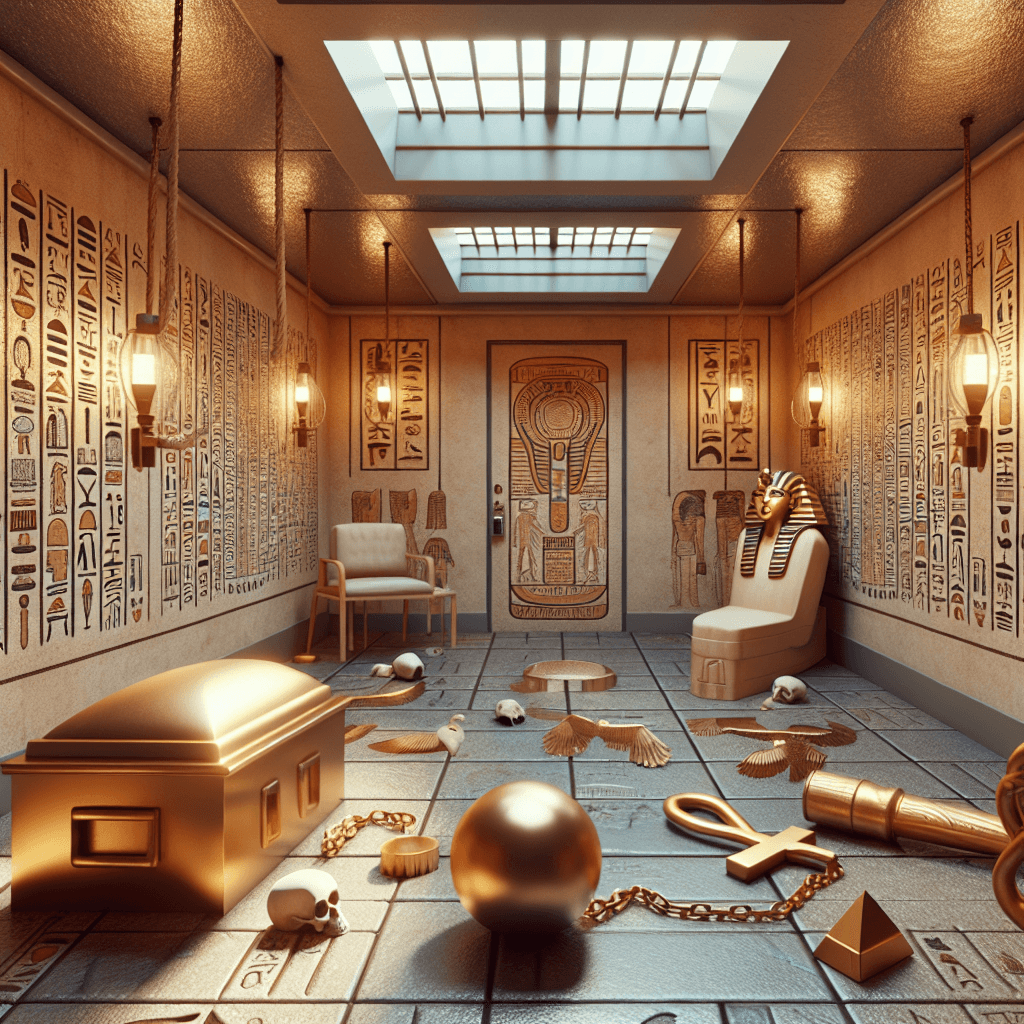
Ancient Egypt Tomb Escape Room Challenge
Inquiry Framework
Question Framework
Driving Question
The overarching question that guides the entire project.How can we, as 6th grade social studies students, design and construct a historically accurate and engaging booby-trapped tomb that reflects ancient Egyptian problem-solving, beliefs about the afterlife, and challenges visitors to think critically about this ancient civilization?Essential Questions
Supporting questions that break down major concepts.- How did ancient Egyptians use problem-solving to design and build pyramids and tombs?
- What were the purposes of these tombs, and how did they reflect Egyptian beliefs about the afterlife?
- How can we use our knowledge of ancient Egyptian traps and problem-solving to design our own booby-trapped tomb?
- What types of challenges and puzzles can we incorporate into our tomb to make it engaging and educational for others?
- How can we ensure our booby traps are safe and historically accurate?
- How can we collaborate effectively as a team to design and build our tomb?
- How will we present our tomb and explain the historical context to others?
Standards & Learning Goals
Learning Goals
By the end of this project, students will be able to:- Students will apply problem-solving skills to design historically accurate booby traps.
- Students will learn about ancient Egyptian beliefs about the afterlife and reflect those beliefs in their tomb design.
- Students will learn about the design and purpose of ancient Egyptian tombs and pyramids.
- Students will collaborate to design and build a booby-trapped tomb.
- Students will present their tomb and explain its historical context to others.
- Students will incorporate challenges and puzzles into their tomb that are engaging and educational.
- Students will ensure that their booby traps are safe and historically accurate
Entry Events
Events that will be used to introduce the project to studentsAn Archaeologist's Plea
The class receives a cryptic letter from a renowned archaeologist, seeking their help in deciphering the secrets of a newly discovered tomb. The letter includes fragmented maps, hieroglyphs, and riddles that students must solve to unlock the tomb's design and purpose.Escape the Tomb
Students participate in an 'escape room' challenge set in a simulated Egyptian tomb. They must solve puzzles and overcome obstacles to 'escape' within a time limit, inspiring them to create their own, more elaborate tomb designs.Pharaoh's Commission
The class is divided into teams, each representing a family commissioned by a pharaoh to design his tomb. They must compete to create the most impressive and secure tomb, considering the pharaoh's status, beliefs, and the need to protect his treasures.Portfolio Activities
Portfolio Activities
These activities progressively build towards your learning goals, with each submission contributing to the student's final portfolio.Tomb Architect
Students work in teams to integrate their individual designs into a cohesive tomb plan.Steps
Here is some basic scaffolding to help students complete the activity.Final Product
What students will submit as the final product of the activityA complete architectural plan for the booby-trapped tomb, including the layout of the rooms, the placement of booby traps, and the puzzles that visitors will encounter.Alignment
How this activity aligns with the learning objectives & standardsLearning Goal: Students will collaborate to design and build a booby-trapped tomb.Puzzle Master
Students design a puzzle that will challenge visitors while teaching them about ancient Egyptian history or culture.Steps
Here is some basic scaffolding to help students complete the activity.Final Product
What students will submit as the final product of the activityA detailed plan for an original puzzle, including instructions for how to solve it and an explanation of its connection to ancient Egypt.Alignment
How this activity aligns with the learning objectives & standardsLearning Goal: Students will incorporate challenges and puzzles into their tomb that are engaging and educational.Rubric & Reflection
Portfolio Rubric
Grading criteria for assessing the overall project portfolioBooby-Trapped Tomb Design Rubric
Tomb Architecture and Design
Focuses on the quality and accuracy of the architectural plan, the integration of historical elements, and the overall cohesiveness of the design.Plan Clarity and Accuracy
The clarity and accuracy of the architectural plan, including room layouts and trap placements
Beginning
1 PointsThe architectural plan is incomplete, inaccurate, and lacks detail. Room layouts and trap placements are unclear and illogical.
Developing
2 PointsThe architectural plan shows some understanding of room layouts and trap placements, but lacks detail or accuracy in certain areas.
Proficient
3 PointsThe architectural plan is clear, accurate, and includes detailed room layouts and trap placements that are logically connected.
Exemplary
4 PointsThe architectural plan is exceptionally clear, accurate, and detailed, demonstrating a sophisticated understanding of spatial design and trap mechanics. Room layouts and trap placements are innovative and logically integrated to enhance the tomb's realism and engagement.
Historical Accuracy
The degree to which the tomb design reflects historically accurate features of ancient Egyptian tombs and pyramids.
Beginning
1 PointsThe tomb design shows little to no understanding of ancient Egyptian architecture or historical context.
Developing
2 PointsThe tomb design incorporates some historically accurate features, but shows inconsistencies or inaccuracies.
Proficient
3 PointsThe tomb design accurately reflects key features of ancient Egyptian tombs and pyramids, demonstrating a good understanding of historical context.
Exemplary
4 PointsThe tomb design meticulously integrates historically accurate details, demonstrating deep research and understanding of ancient Egyptian architecture, beliefs, and cultural practices. The design goes beyond basic accuracy to incorporate nuanced elements that enhance the educational value and immersive experience of the tomb.
Design Cohesion
The extent to which the design integrates individual ideas into a cohesive and well-structured tomb plan.
Beginning
1 PointsThe team struggled to integrate individual ideas, resulting in a disjointed and poorly structured tomb plan.
Developing
2 PointsThe tomb plan shows some integration of individual ideas, but lacks cohesion or logical flow.
Proficient
3 PointsThe tomb plan effectively integrates individual ideas into a cohesive and well-structured design.
Exemplary
4 PointsThe tomb plan seamlessly integrates individual ideas, resulting in an exceptionally cohesive, innovative, and well-structured design. The collaborative effort enhances the overall quality and functionality of the tomb, creating a unified and engaging experience for visitors.
Puzzle Design
Focuses on the puzzle's design, instructions, and its connection to ancient Egyptian history.Puzzle Originality and Complexity
The originality and complexity of the designed puzzle.
Beginning
1 PointsThe puzzle is unoriginal, simplistic, and lacks intellectual challenge.
Developing
2 PointsThe puzzle shows some originality and complexity, but could be more challenging or engaging.
Proficient
3 PointsThe puzzle is original, complex, and provides an appropriate level of intellectual challenge.
Exemplary
4 PointsThe puzzle is exceptionally original, highly complex, and masterfully designed to challenge visitors intellectually while seamlessly integrating historical and cultural elements of ancient Egypt. The puzzle's innovation enhances the tomb's educational value and engagement.
Instruction Clarity
The clarity and completeness of the puzzle instructions, including how to solve the puzzle.
Beginning
1 PointsThe puzzle instructions are unclear, incomplete, or missing key information needed to solve the puzzle.
Developing
2 PointsThe puzzle instructions are somewhat clear but may contain ambiguities or missing steps.
Proficient
3 PointsThe puzzle instructions are clear, complete, and easy to follow, providing all the necessary information to solve the puzzle.
Exemplary
4 PointsThe puzzle instructions are exceptionally clear, concise, and well-organized, ensuring seamless understanding and engagement for visitors. The instructions anticipate potential challenges and provide helpful hints or guidance, enhancing the overall puzzle-solving experience.
Historical Connection
The strength of the puzzle's connection to ancient Egyptian history, culture, or beliefs.
Beginning
1 PointsThe puzzle has little to no connection to ancient Egyptian history, culture, or beliefs.
Developing
2 PointsThe puzzle's connection to ancient Egypt is weak or superficial.
Proficient
3 PointsThe puzzle is clearly and directly related to ancient Egyptian history, culture, or beliefs, enhancing understanding of the civilization.
Exemplary
4 PointsThe puzzle intricately weaves elements of ancient Egyptian history, culture, and beliefs into its design, creating a deeply immersive and educational experience. The puzzle's connection to ancient Egypt enriches the visitor's understanding and appreciation of the civilization's complexities.