
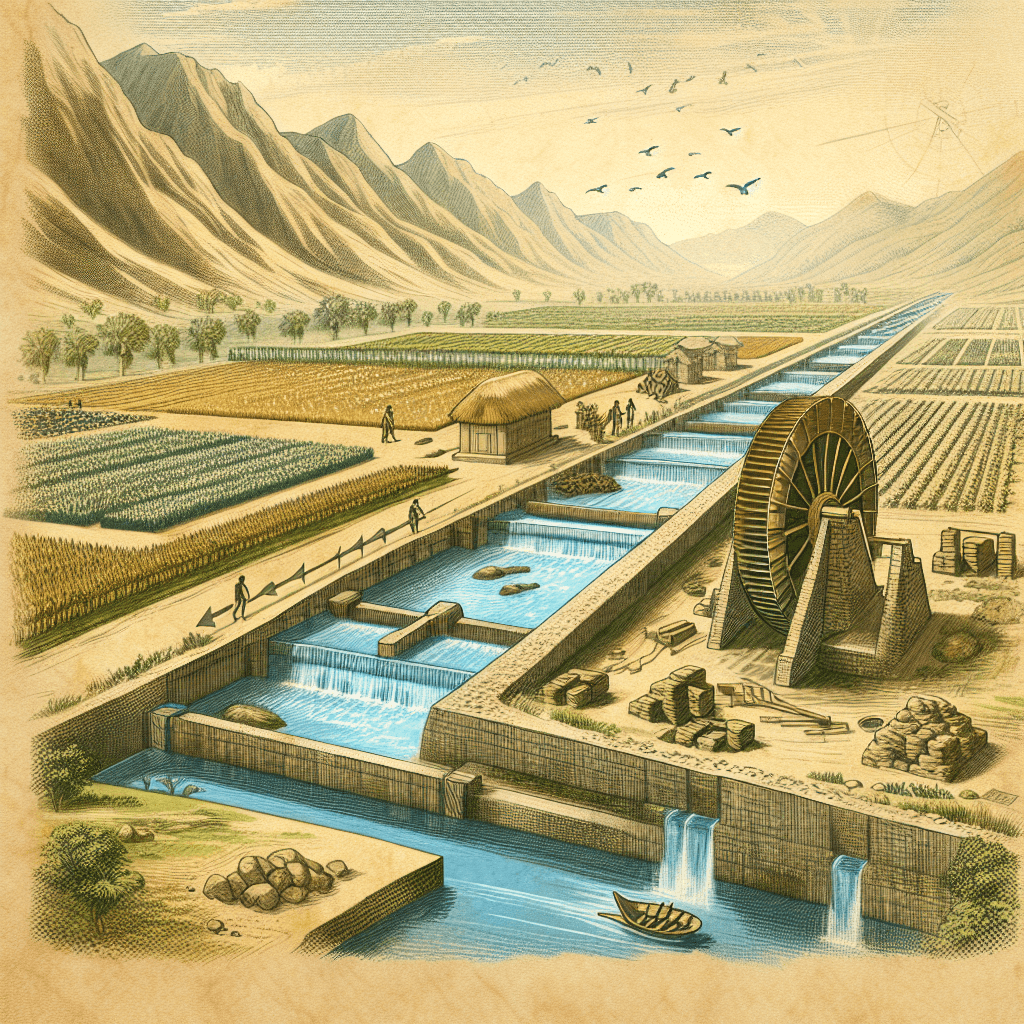
Ancient Irrigation Innovation: Design a Sustainable Water System
Inquiry Framework
Question Framework
Driving Question
The overarching question that guides the entire project.How can we, as informed historians and innovative engineers, design a sustainable irrigation system for a modern community, learning from the successes and failures of ancient civilizations, while considering environmental, social, and economic impacts?Essential Questions
Supporting questions that break down major concepts.- How did ancient civilizations adapt to their environments to develop successful irrigation systems?
- What are the environmental and social impacts of different irrigation techniques, both ancient and modern?
- How can we apply the lessons learned from ancient irrigation systems to create sustainable solutions for modern communities?
- What are the economic considerations involved in designing and implementing a new irrigation system?
- How do different social studies disciplines help us understand the challenges and opportunities in developing civilizations?
Standards & Learning Goals
Learning Goals
By the end of this project, students will be able to:- Students will research and analyze ancient irrigation systems, identifying key elements of their design, function, and sustainability.
- Students will evaluate the environmental, social, and economic impacts of ancient irrigation techniques.
- Students will apply their understanding of ancient systems to design a sustainable irrigation system for a modern community, considering local environmental conditions, resource availability, and community needs.
- Students will use evidence to support their claims.
- Students will consider and analyze the unintended costs and benefits of economic decisions related to irrigation systems.
- Students will explain how civilizations affected land use and were shaped by their environments.
Teacher Provided Standards
Entry Events
Events that will be used to introduce the project to studentsIrrigation Innovation Pitch
Simulate a 'Shark Tank' scenario where student teams pitch their irrigation solutions, inspired by ancient methods, to a panel of 'investors' (teachers/community members), fostering competitive problem-solving and real-world application.Portfolio Activities
Portfolio Activities
These activities progressively build towards your learning goals, with each submission contributing to the student's final portfolio.Environmental Influences on Ancient Irrigation
Students will research a specific ancient civilization and analyze how their physical environment (climate, geography, water sources) influenced the design and implementation of their irrigation systems. They will create a presentation that details these relationships.Steps
Here is some basic scaffolding to help students complete the activity.Final Product
What students will submit as the final product of the activityA presentation (slides, poster, or short video) that explains the environmental factors that shaped the irrigation methods of a chosen ancient civilization.Alignment
How this activity aligns with the learning objectives & standardsAligns with 6.G.HE.1 as it requires students to research and understand how different physical environments influenced the specific irrigation techniques developed by ancient civilizations.Irrigation and the Movement of Civilizations
Students will examine how the irrigation systems of their chosen civilization supported the movement of people, goods, and ideas, contributing to the civilization's development and expansion. They will write an essay discussing these connections.Steps
Here is some basic scaffolding to help students complete the activity.Final Product
What students will submit as the final product of the activityAn essay explaining how the irrigation system of the chosen civilization facilitated the movement of people, goods, and ideas, and contributed to its rise.Alignment
How this activity aligns with the learning objectives & standardsThis activity aligns with standard 6.G.MM.1 because it directly addresses how humans and their environment influenced the movement of goods (crops) and ideas (irrigation techniques). It also aligns with 6.H.CE.1 as it requires students to analyze the causes (environmental factors, societal needs) and effects (agricultural surplus, population growth) of the rise of River Valley Civilizations.The Costs and Benefits of Irrigation
Students will explore the economic and social costs and benefits of the irrigation system of their chosen civilization. They will create a cost-benefit analysis chart and present their findings to the class.Steps
Here is some basic scaffolding to help students complete the activity.Final Product
What students will submit as the final product of the activityA cost-benefit analysis chart and a brief presentation outlining the economic and social impacts of the civilization's irrigation system.Alignment
How this activity aligns with the learning objectives & standardsAligns with 6.I.CC.5 by tasking students to use different social studies disciplines (geography, economics, history) to describe problems, and with 6.E.MI.2 by making them predict and analyze costs and benefits.Reshaping the Land: Irrigation and Land Use
Students will investigate how the ancient irrigation system altered the landscape and land use patterns of their chosen civilization. They will write a report explaining these changes and their long-term consequences.Steps
Here is some basic scaffolding to help students complete the activity.Final Product
What students will submit as the final product of the activityA report detailing how the ancient irrigation system changed land use patterns and the environmental and social consequences of these changes.Alignment
How this activity aligns with the learning objectives & standardsAddresses 6.I.UE.1 as it involves making claims and supporting them with evidence, and 6.G.HI.1 as it requires students to understand how human actions (irrigation) have changed land use over time.Designing a Sustainable Irrigation System
Students will apply their knowledge of ancient irrigation systems to design a sustainable irrigation system for a modern community facing water scarcity challenges. They will develop a proposal outlining their design, its environmental impact, and its economic feasibility.Steps
Here is some basic scaffolding to help students complete the activity.Final Product
What students will submit as the final product of the activityA detailed proposal for a sustainable irrigation system for a modern community, including a design plan, environmental impact assessment, and economic analysis.Alignment
How this activity aligns with the learning objectives & standardsThis activity ties together all the previous learning and applies it to a modern context, directly addressing learning goals related to sustainable solutions.Rubric & Reflection
Portfolio Rubric
Grading criteria for assessing the overall project portfolioAncient Irrigation and Modern Sustainability Rubric
Environmental Influences Analysis
Assesses the quality of research, clarity of explanation, and effectiveness of visual aids in demonstrating the environmental influences on ancient irrigation systems.Research Accuracy
Accuracy of research on the chosen ancient civilization's irrigation techniques and environmental context.
Exemplary
4 PointsDemonstrates comprehensive and accurate research on the civilization's irrigation techniques and environmental context, exceeding expectations.
Proficient
3 PointsDemonstrates accurate research on the civilization's irrigation techniques and environmental context.
Developing
2 PointsDemonstrates partially accurate research on the civilization's irrigation techniques and environmental context.
Beginning
1 PointsDemonstrates inaccurate or incomplete research on the civilization's irrigation techniques and environmental context.
Presentation Clarity
Clarity and effectiveness of the presentation in explaining the relationship between environmental factors and irrigation methods.
Exemplary
4 PointsPresentation is exceptionally clear, engaging, and effectively communicates the complex relationship between environmental factors and irrigation methods.
Proficient
3 PointsPresentation is clear and effectively communicates the relationship between environmental factors and irrigation methods.
Developing
2 PointsPresentation is somewhat unclear and partially communicates the relationship between environmental factors and irrigation methods.
Beginning
1 PointsPresentation is unclear and fails to effectively communicate the relationship between environmental factors and irrigation methods.
Visual Quality
Quality of visuals (maps, diagrams) used to illustrate the environmental context and irrigation methods.
Exemplary
4 PointsVisuals are exceptionally high quality, informative, and enhance understanding of the environmental context and irrigation methods.
Proficient
3 PointsVisuals are high quality and illustrate the environmental context and irrigation methods.
Developing
2 PointsVisuals are adequate but may lack detail or clarity in illustrating the environmental context and irrigation methods.
Beginning
1 PointsVisuals are poor quality or missing, and fail to illustrate the environmental context and irrigation methods.
Civilization Movement Impact
Evaluates the strength of the argument, quality of evidence, and clarity of writing in the essay explaining how irrigation influenced the movement of civilizations.Argument Strength
Strength of the essay's argument connecting the irrigation system to the movement of people, goods, and ideas.
Exemplary
4 PointsEssay presents a compelling and insightful argument, demonstrating a deep understanding of the connections between the irrigation system and the movement of people, goods, and ideas, exceeding expectations.
Proficient
3 PointsEssay presents a strong argument, demonstrating a clear understanding of the connections between the irrigation system and the movement of people, goods, and ideas.
Developing
2 PointsEssay presents a weak or incomplete argument, demonstrating a limited understanding of the connections between the irrigation system and the movement of people, goods, and ideas.
Beginning
1 PointsEssay fails to present a coherent argument or demonstrate an understanding of the connections between the irrigation system and the movement of people, goods, and ideas.
Evidence Quality
Evidence provided to support the claim about the irrigation system's role in the civilization's development.
Exemplary
4 PointsProvides comprehensive and compelling evidence to support the claim about the irrigation system's role in the civilization's development.
Proficient
3 PointsProvides clear and sufficient evidence to support the claim about the irrigation system's role in the civilization's development.
Developing
2 PointsProvides limited or weak evidence to support the claim about the irrigation system's role in the civilization's development.
Beginning
1 PointsProvides insufficient or irrelevant evidence to support the claim about the irrigation system's role in the civilization's development.
Essay Clarity
Clarity and organization of the essay.
Exemplary
4 PointsEssay is exceptionally clear, well-organized, and effectively communicates complex ideas.
Proficient
3 PointsEssay is clear, well-organized, and effectively communicates ideas.
Developing
2 PointsEssay is somewhat unclear and disorganized, making it difficult to follow the argument.
Beginning
1 PointsEssay is unclear, disorganized, and fails to effectively communicate ideas.
Cost-Benefit Evaluation
Assesses the completeness and accuracy of the cost-benefit analysis, the depth of social impact analysis, and the effectiveness of the presentation.Chart Accuracy
Completeness and accuracy of the cost-benefit analysis chart.
Exemplary
4 PointsChart is exceptionally complete, accurate, and provides a comprehensive overview of the economic and social impacts, exceeding expectations.
Proficient
3 PointsChart is complete and accurate, providing a clear overview of the economic and social impacts.
Developing
2 PointsChart is incomplete or contains inaccuracies, providing a limited overview of the economic and social impacts.
Beginning
1 PointsChart is largely incomplete or inaccurate, failing to provide a meaningful overview of the economic and social impacts.
Social Impact Analysis
Insightfulness of the analysis of the social impacts of the irrigation system.
Exemplary
4 PointsAnalysis of the social impacts is exceptionally insightful, demonstrating a deep understanding of the complex social consequences.
Proficient
3 PointsAnalysis of the social impacts is insightful, demonstrating a clear understanding of the social consequences.
Developing
2 PointsAnalysis of the social impacts is superficial, demonstrating a limited understanding of the social consequences.
Beginning
1 PointsAnalysis of the social impacts is lacking, failing to demonstrate an understanding of the social consequences.
Presentation Effectiveness
Effectiveness of the presentation in communicating the findings of the cost-benefit analysis.
Exemplary
4 PointsPresentation is exceptionally effective in communicating the findings of the cost-benefit analysis in a clear and engaging manner.
Proficient
3 PointsPresentation is effective in communicating the findings of the cost-benefit analysis in a clear manner.
Developing
2 PointsPresentation is somewhat ineffective in communicating the findings of the cost-benefit analysis, lacking clarity or engagement.
Beginning
1 PointsPresentation is ineffective in communicating the findings of the cost-benefit analysis.
Land Reshaping Analysis
Focuses on the depth of investigation, clarity of explanation, and effectiveness of visual aids in detailing how irrigation reshaped the land and its consequences.Landscape Transformation
Depth of investigation into how the irrigation system transformed the natural landscape.
Exemplary
4 PointsInvestigation is exceptionally deep and thorough, demonstrating a comprehensive understanding of the transformations to the natural landscape.
Proficient
3 PointsInvestigation is thorough, demonstrating a clear understanding of the transformations to the natural landscape.
Developing
2 PointsInvestigation is superficial, demonstrating a limited understanding of the transformations to the natural landscape.
Beginning
1 PointsInvestigation is lacking, failing to demonstrate an understanding of the transformations to the natural landscape.
Consequence Explanation
Clarity and accuracy of the report in explaining the environmental and social consequences of the changes.
Exemplary
4 PointsReport is exceptionally clear, accurate, and insightful in explaining the environmental and social consequences of the changes.
Proficient
3 PointsReport is clear and accurate in explaining the environmental and social consequences of the changes.
Developing
2 PointsReport is somewhat unclear or inaccurate in explaining the environmental and social consequences of the changes.
Beginning
1 PointsReport is unclear and inaccurate in explaining the environmental and social consequences of the changes.
Visual Effectiveness
Effectiveness of maps and diagrams used to illustrate the changes in land use.
Exemplary
4 PointsMaps and diagrams are exceptionally effective in illustrating the changes in land use, enhancing understanding and providing valuable insights.
Proficient
3 PointsMaps and diagrams are effective in illustrating the changes in land use.
Developing
2 PointsMaps and diagrams are somewhat ineffective in illustrating the changes in land use, lacking clarity or detail.
Beginning
1 PointsMaps and diagrams are ineffective or missing, failing to illustrate the changes in land use.
Sustainable System Design
Evaluates the relevance and feasibility of the proposed system, the quality of the environmental impact assessment, and the soundness of the economic analysis.System Relevance
Relevance and feasibility of the proposed irrigation system for the modern community.
Exemplary
4 PointsProposed irrigation system is highly relevant, feasible, and demonstrates an exceptional understanding of the community's needs and resources.
Proficient
3 PointsProposed irrigation system is relevant and feasible, demonstrating a clear understanding of the community's needs and resources.
Developing
2 PointsProposed irrigation system is somewhat relevant or feasible, demonstrating a limited understanding of the community's needs and resources.
Beginning
1 PointsProposed irrigation system is irrelevant or infeasible, failing to demonstrate an understanding of the community's needs and resources.
Environmental Assessment
Thoroughness and accuracy of the environmental impact assessment.
Exemplary
4 PointsEnvironmental impact assessment is exceptionally thorough, accurate, and demonstrates a deep understanding of the potential environmental consequences.
Proficient
3 PointsEnvironmental impact assessment is thorough and accurate, demonstrating a clear understanding of the potential environmental consequences.
Developing
2 PointsEnvironmental impact assessment is incomplete or contains inaccuracies, demonstrating a limited understanding of the potential environmental consequences.
Beginning
1 PointsEnvironmental impact assessment is largely incomplete or inaccurate, failing to demonstrate an understanding of the potential environmental consequences.
Economic Soundness
Soundness of the economic analysis, including costs and benefits.
Exemplary
4 PointsEconomic analysis is exceptionally sound, providing a comprehensive and insightful evaluation of the costs and benefits.
Proficient
3 PointsEconomic analysis is sound, providing a clear and accurate evaluation of the costs and benefits.
Developing
2 PointsEconomic analysis is flawed or incomplete, providing a limited evaluation of the costs and benefits.
Beginning
1 PointsEconomic analysis is unsound, failing to provide a meaningful evaluation of the costs and benefits.