
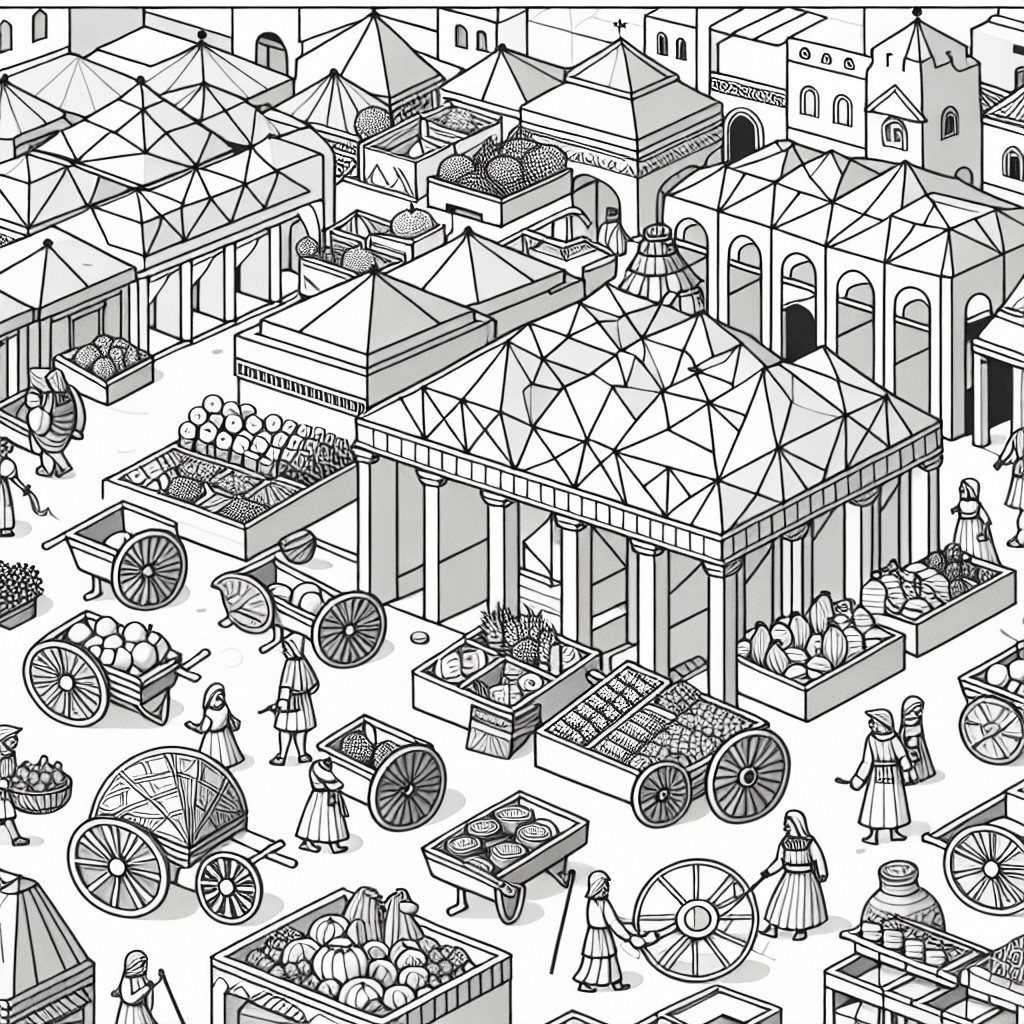
Ancient Market Design: Geometry Meets History
Inquiry Framework
Question Framework
Driving Question
The overarching question that guides the entire project.How did ancient markets function and what can we learn from them about the societies that created them?Essential Questions
Supporting questions that break down major concepts.- How did ancient markets function and what can we learn from them about the societies that created them?
- How can mathematical concepts such as geometry be applied to design and understand historical market scenes?
- What are the mathematical differences between positive and negative integers in the context of trade measurements?
- What role did individual and group contributions play in the development of ancient Chinese markets?
- How do shapes with the same areas have different perimeters, and why is this important in crafting market stalls or areas?
- How can I use historical and mathematical data to create an estimated ancient market scene?
- What historical connections can be made between ancient and modern markets regarding trade, measurement, and design?
- How can we use trading scenarios to practice calculating with both metric and imperial units of measure?
- In what ways can the ancient markets of China provide insight into cultural customs and ways of thinking of the time?
Standards & Learning Goals
Learning Goals
By the end of this project, students will be able to:- Students will be able to sequence historical events and understand the chronological order of ancient market developments.
- Students will apply mathematical operations to find differences between positive and negative integers within historical measurement scenarios.
- Students will explain historical market processes and present detailed observations effectively.
- Students will analyze how various individuals and groups influenced the development of trade in ancient China.
- Students will use geometrical formulae to calculate area and volume as part of designing ancient market layouts.
- Students will effectively gather, organize, and evaluate information from various sources to support historical and mathematical analysis.
- Students will calculate the areas of simple shapes for the purpose of recreating historical market floor plans.
- Students will use subject-specific vocabulary in discussing mathematical and historical concepts related to ancient markets.
Teacher-specified standards
Other relevant standards
Entry Events
Events that will be used to introduce the project to studentsVirtual Reality Ancient Bazaar
Using virtual reality headsets, students are transported to an ancient bazaar bustling with activity. They are tasked to investigate how geometry influenced market layouts and explore the mathematics behind trade and currency conversion in ancient times, deepening their understanding by replicating these ancient systems in modern settings.Portfolio Activities
Portfolio Activities
These activities progressively build towards your learning goals, with each submission contributing to the student's final portfolio.Chronological Market Mappers
In this activity, students will explore the timeline of ancient markets, identifying key events and developments using correct chronological terminology such as BC, AD, century, and decade.Steps
Here is some basic scaffolding to help students complete the activity.Final Product
What students will submit as the final product of the activityA chronological timeline that illustrates the development of ancient markets using correct historical terminology.Alignment
How this activity aligns with the learning objectives & standardsAligns with standard 6PP101 by enabling students to sequence events in chronological order using appropriate language.Integer Investigator: Market Math
Students will learn to find the difference between positive and negative integers in measurement contexts, focusing on ancient trade and currency conversions.Steps
Here is some basic scaffolding to help students complete the activity.Final Product
What students will submit as the final product of the activityA collection of solved integer problems related to ancient market trades.Alignment
How this activity aligns with the learning objectives & standardsMeets standard 6MMMC1 by focusing on mathematical differences in trade contexts.Market Scene Designers
Using ancient market layouts as inspiration, students will design their own market scene utilizing geometric formulas for area and volume.Steps
Here is some basic scaffolding to help students complete the activity.Final Product
What students will submit as the final product of the activityA creatively designed market scene using area and volume formulas accurately.Alignment
How this activity aligns with the learning objectives & standardsSupports standards 6MMMC5 and 6MMMC6 through geometric application in market design.Cultural Insights through Market Trade
This activity immerses students in the cultural aspects of ancient markets, encouraging them to analyze individual and group roles within these societies.Steps
Here is some basic scaffolding to help students complete the activity.Final Product
What students will submit as the final product of the activityAn analytical report on the influence of roles in ancient Chinese markets.Alignment
How this activity aligns with the learning objectives & standardsAligns with standard 6PP103 by analyzing contributions to market and societal development.Historical Market Researchers
This activity focuses on developing research skills by locating and synthesizing information from various sources about ancient markets.Steps
Here is some basic scaffolding to help students complete the activity.Final Product
What students will submit as the final product of the activityA comprehensive research paper detailing insights on ancient market practices.Alignment
How this activity aligns with the learning objectives & standardsSupports standard ERB18 by emphasizing information location, organization, and synthesis.Rubric & Reflection
Portfolio Rubric
Grading criteria for assessing the overall project portfolioAncient Markets: MasteryMate Rubric
Historical Understanding
Assesses the ability to understand and sequence historical events related to ancient markets logically.Chronological Sequencing
Evaluates the understanding and application of chronological terminology and sequencing of events.
Exceeding Expecations
4 PointsStudent consistently uses chronological terminology accurately and presents events in logical sequence with significant detail.
Developing Strongly
3 PointsStudent mostly uses chronological terminology accurately and presents events in logical sequence with adequate detail.
Developing Appropriately
2 PointsStudent uses some chronological terminology accurately and presents events in partial sequence with some detail.
Beginning to Develop
1 PointsStudent demonstrates limited accuracy in using chronological terminology and presents events without logical sequence or detail.
Cultural Contributions Analysis
Evaluates the ability to analyze the roles and contributions of individuals and groups in ancient markets and society.
Exceeding Expecations
4 PointsStudent provides sophisticated analysis of roles and contributions, using strong evidence and detailed explanations.
Developing Strongly
3 PointsStudent provides thorough analysis of roles and contributions, using adequate evidence and clear explanations.
Developing Appropriately
2 PointsStudent presents basic analysis of roles and contributions with minimal evidence and explanations.
Beginning to Develop
1 PointsStudent shows limited understanding of roles and contributions with no or unclear evidence and explanations.
Mathematical Application
Assesses the application of mathematical concepts such as geometry and measurements in the context of designing ancient markets.Geometry in Design
Evaluates the use of geometric formulas to calculate area and volume in market layouts.
Exceeding Expecations
4 PointsStudent accurately applies complex geometric formulas to design innovative market layouts with exceptional precision.
Developing Strongly
3 PointsStudent accurately applies geometric formulas to design effective market layouts.
Developing Appropriately
2 PointsStudent applies geometric formulas with some errors, resulting in partially accurate market layouts.
Beginning to Develop
1 PointsStudent struggles with applying geometric formulas, resulting in incorrect market layouts.
Integer Calculations
Assesses the ability to use integers in analyzing trade measurements and solving related problems.
Exceeding Expectations
4 PointsStudent excels in using integers to solve complex trade scenarios, providing accurate solutions consistently.
Developing Strongly
3 PointsStudent effectively uses integers in accurately solving trade scenarios and problems.
Developing Appropriately
2 PointsStudent occasionally uses integers accurately with some errors in solving trade problems.
Beginning to Develop
1 PointsStudent rarely uses integers accurately, struggling to solve trade-related problems.
Research and Communication
Evaluates research skills and the clarity and effectiveness of communication, especially related to ancient market studies.Research Skills
Measures the ability to locate, organize, and synthesize information from diverse sources about ancient markets.
Exceeding Expectations
4 PointsStudent excels in sourcing, organizing, and synthesizing information, presenting comprehensive findings with great clarity.
Developing Strongly
3 PointsStudent effectively locates and organizes sources with clear synthesis and presentation of findings.
Developing Appropriately
2 PointsStudent locates some relevant sources with partial synthesis and presentation of findings.
Beginning to Develop
1 PointsStudent struggles to locate relevant sources, with minimal synthesis and unclear presentation of findings.
Oral and Written Communication
Assesses the clarity, structure, and vocabulary use in oral and written reports about ancient market insights.
Exceeding Expectations
4 PointsStudent uses advanced vocabulary with clear and logical structure in presenting detailed and engaging reports.
Developing Strongly
3 PointsStudent uses appropriate vocabulary with clear structure in presenting coherent reports.
Developing Appropriately
2 PointsStudent uses basic vocabulary with partially clear structure, needing more detailed reports.
Beginning to Develop
1 PointsStudent struggles with vocabulary and structure, producing unclear and minimally detailed reports.