
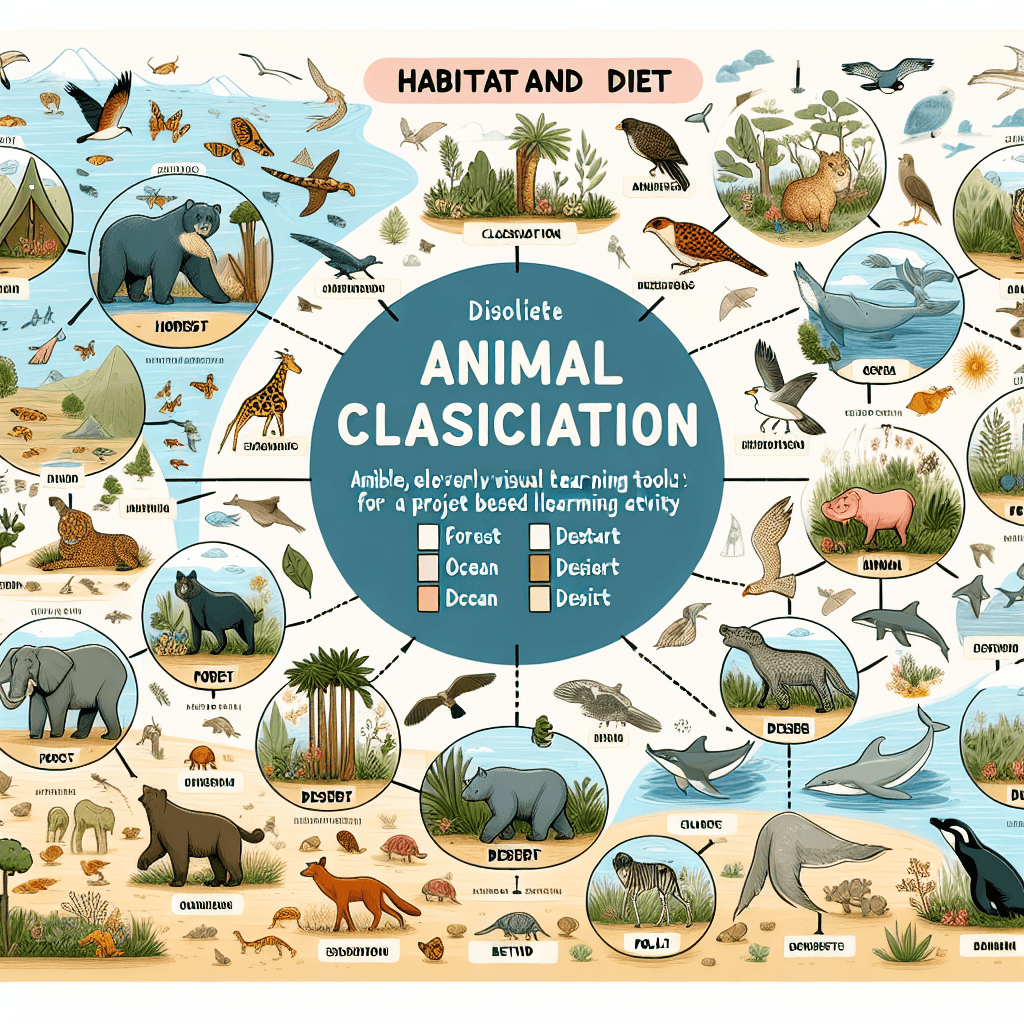
Animal Classification: Habitat and Diet Sorting with Diagrams
Inquiry Framework
Question Framework
Driving Question
The overarching question that guides the entire project.How can we use a Carroll diagram to classify animals based on their habitats and diets?Essential Questions
Supporting questions that break down major concepts.- How can we group animals based on where they live?
- What different types of food do animals eat?
- How can a Carroll diagram help us sort animals?
Standards & Learning Goals
Learning Goals
By the end of this project, students will be able to:- Students will be able to classify animals based on their habitat.
- Students will be able to classify animals based on their diet.
- Students will be able to construct a Carroll diagram to sort animals.
- Students will be able to interpret a Carroll diagram to identify animal characteristics.
Common Core Standards
Entry Events
Events that will be used to introduce the project to studentsMuddled Menagerie Rescue
Present students with a 'muddled menagerie' scenario: Animals are mixed up and placed in the wrong habitats. Students use a Carroll diagram to re-sort the animals by their correct habitat and diet, solving the mystery of the misplaced creatures and restoring order to the animal kingdom.Portfolio Activities
Portfolio Activities
These activities progressively build towards your learning goals, with each submission contributing to the student's final portfolio.Habitat Explorers
Students will begin by learning about different animal habitats and creating a list of animals that live in each one.Steps
Here is some basic scaffolding to help students complete the activity.Final Product
What students will submit as the final product of the activityA list of animals sorted by their habitat.Alignment
How this activity aligns with the learning objectives & standardsAligns with MA.2.MD.D.10 by focusing on sorting animals using a Carroll diagram based on habitat.Diet Detectives
Students will investigate the diets of different animals, categorizing them as herbivores, carnivores, or omnivores.Steps
Here is some basic scaffolding to help students complete the activity.Final Product
What students will submit as the final product of the activityA chart classifying animals by their diet.Alignment
How this activity aligns with the learning objectives & standardsAligns with MA.2.MD.D.10 by focusing on sorting animals using a Carroll diagram based on diet.Carroll Diagram Creators
Students will create a Carroll diagram and sort animals based on their habitat (forest/not forest) and diet (herbivore/not herbivore).Steps
Here is some basic scaffolding to help students complete the activity.Final Product
What students will submit as the final product of the activityA completed Carroll diagram with animals sorted correctly.Alignment
How this activity aligns with the learning objectives & standardsCovers MA.2.MD.D.10 as it involves constructing and using a Carroll diagram to sort animals based on two criteria (habitat and diet).Diagram Decoder
Students will analyze a completed Carroll diagram to answer questions about the characteristics of different animals.Steps
Here is some basic scaffolding to help students complete the activity.Final Product
What students will submit as the final product of the activityA worksheet with correct answers based on the Carroll diagram.Alignment
How this activity aligns with the learning objectives & standardsAddresses MA.2.MD.D.10 by requiring students to interpret a completed Carroll diagram to identify animal characteristics.Rubric & Reflection
Portfolio Rubric
Grading criteria for assessing the overall project portfolioAnimal Classification with Carroll Diagrams Rubric
Classification Accuracy
Focuses on the accuracy of classifying animals by their habitats and diets. This category is important for assessing students' understanding of basic animal characteristics and their ability to apply these characteristics to categorization tasks.Habitat Classification
Accuracy of animal classification based on habitat.
Exemplary
4 PointsAll animals are correctly classified according to their habitat with no errors.
Proficient
3 PointsMost animals are correctly classified according to their habitat with only 1-2 minor errors.
Developing
2 PointsSeveral animals are misclassified according to their habitat, indicating some confusion.
Beginning
1 PointsMany animals are misclassified according to their habitat, showing a lack of understanding.
Diet Classification
Accuracy of animal classification based on diet.
Exemplary
4 PointsAll animals are correctly classified according to their diet with no errors.
Proficient
3 PointsMost animals are correctly classified according to their diet with only 1-2 minor errors.
Developing
2 PointsSeveral animals are misclassified according to their diet, indicating some confusion.
Beginning
1 PointsMany animals are misclassified according to their diet, showing a lack of understanding.
Carroll Diagram Usage
Focuses on the student's ability to create and utilize a Carroll diagram effectively. This category assesses the student's understanding of the diagram structure and their ability to sort data based on two criteria.Diagram Construction
Correct construction and labeling of the Carroll diagram.
Exemplary
4 PointsCarroll diagram is perfectly constructed with accurate labels for all categories (Forest/Not Forest, Herbivore/Not Herbivore).
Proficient
3 PointsCarroll diagram is mostly correct with accurate labels for most categories; minor errors may be present.
Developing
2 PointsCarroll diagram shows significant errors in construction or labeling, indicating misunderstanding.
Beginning
1 PointsCarroll diagram is poorly constructed and lacks accurate labels, showing little understanding.
Data Sorting
Ability to appropriately sort animals into the Carroll diagram based on two criteria (habitat and diet).
Exemplary
4 PointsAll animals are correctly sorted into the Carroll diagram based on both habitat and diet criteria.
Proficient
3 PointsMost animals are correctly sorted into the Carroll diagram based on both habitat and diet criteria, with only 1-2 errors.
Developing
2 PointsSeveral animals are incorrectly sorted into the Carroll diagram, showing difficulty applying both criteria.
Beginning
1 PointsMany animals are incorrectly sorted into the Carroll diagram, showing a lack of understanding of the sorting criteria.
Interpretation and Communication
Focuses on the student's ability to interpret and communicate the data presented in the Carroll diagram. This category is critical for assessing higher-order thinking skills and the ability to draw meaningful conclusions from sorted data.Data Interpretation
Quality and thoughtfulness of answers provided about the animals in each section of the Carroll diagram.
Exemplary
4 PointsAnswers are thorough, accurate, and insightful, demonstrating a deep understanding of the data presented in the Carroll diagram.
Proficient
3 PointsAnswers are mostly accurate and demonstrate a good understanding of the data presented in the Carroll diagram.
Developing
2 PointsAnswers are basic and show a limited understanding of the data presented in the Carroll diagram.
Beginning
1 PointsAnswers are incomplete or inaccurate, showing a poor understanding of the data presented in the Carroll diagram.
Communication of Findings
Clarity and effectiveness in communicating findings and conclusions drawn from the Carroll diagram.
Exemplary
4 PointsExplanations are exceptionally clear, concise, and effectively communicate the key findings and conclusions from the Carroll diagram.
Proficient
3 PointsExplanations are clear and effectively communicate the main findings and conclusions from the Carroll diagram.
Developing
2 PointsExplanations are somewhat unclear and require further clarification to fully understand the findings from the Carroll diagram.
Beginning
1 PointsExplanations are unclear and fail to effectively communicate the findings or conclusions from the Carroll diagram.