
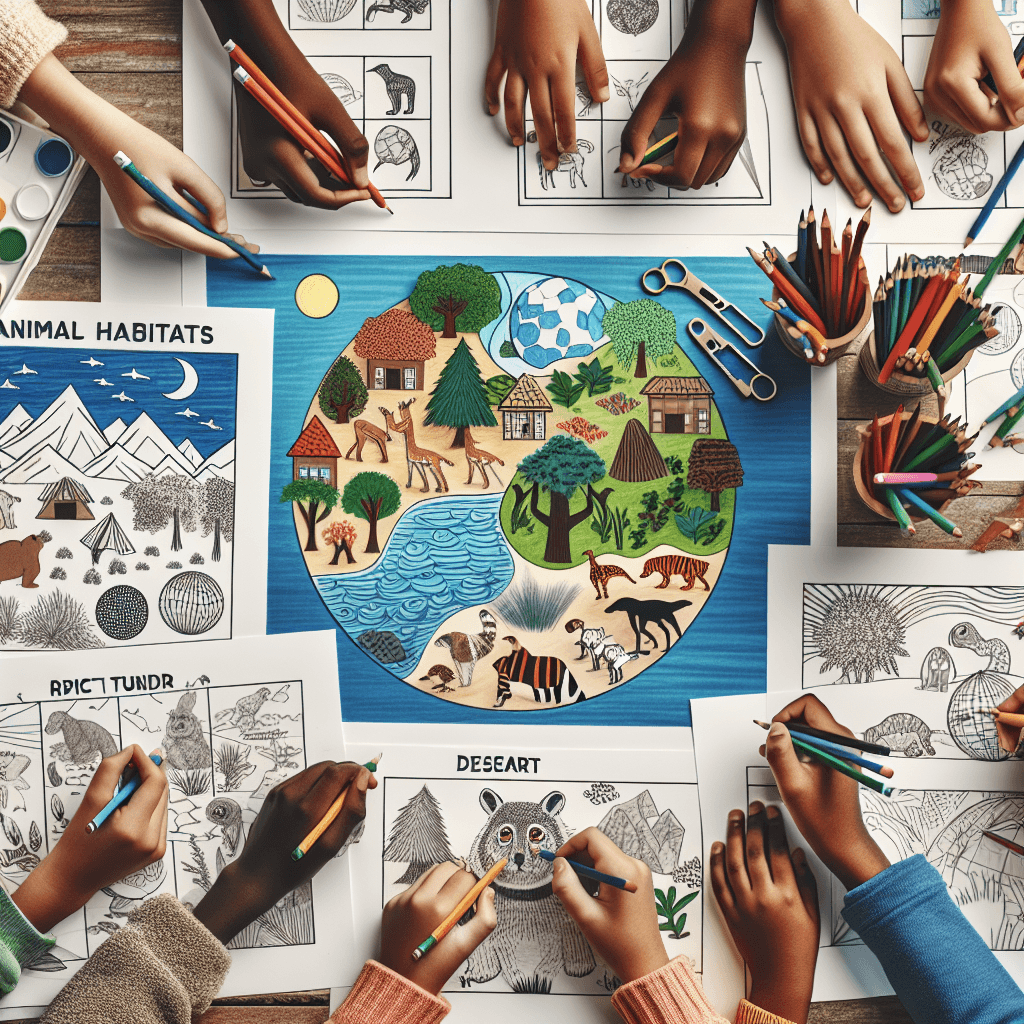
Animal Habitat Designers
Inquiry Framework
Question Framework
Driving Question
The overarching question that guides the entire project.How can we, as young habitat designers, identify and solve the lack of essential parts in an animal's habitat to help them survive and thrive, and what inspiration can we draw from this to address human challenges?Essential Questions
Supporting questions that break down major concepts.- What is an ecosystem and why is it important for animals?
- What parts of a habitat are necessary for animals to survive and thrive?
- How can we identify what's missing in an animal's habitat by looking at photos?
- How do the external parts of plants and animals help them survive in their habitats?
- What can we learn from the ways plants and animals use their external parts that can help us solve human problems?
- How do habitats change and what are the impacts on the animals living there?
Standards & Learning Goals
Learning Goals
By the end of this project, students will be able to:- Students will be able to identify essential parts of animal habitats necessary for survival and articulate why each component is important.
- Students will be able to analyze images of animal habitats to determine missing elements.
- Students will be able to design a habitat addressing missing elements by using knowledge of how plants and animals use their external parts.
- Students will be able to construct explanations for their design choices, reflecting on structure and function principles.
- Students will be able to communicate their findings and solutions clearly, using appropriate scientific terminology.
STEELS Standards
Science and Engineering Practices
Crosscutting Concepts
Disciplinary Core Ideas
Common Core Standards
Entry Events
Events that will be used to introduce the project to studentsAnimal Detective Mystery
Introduce an intriguing mystery where an animal is missing certain habitat elements, affecting its survival. Students become detectives tasked with gathering clues and evidence through observing images and video clips, learning to identify what elements are essential for that animal's well-being.Mystery Box Challenge
Students receive boxes containing items that represent parts of a habitat. Using these items, they brainstorm and create connections to real-life habitats, water their curiosity about how each piece affects the overall ecosystem and what might happen if one is missing.Virtual Habitat Tour
Kick off the project with a virtual tour of various animal habitats around the world. As students embark on this digital journey, they'll jot down elements that make each habitat unique yet essential for the animals living there, sparking questions about the implications of missing elements.Portfolio Activities
Portfolio Activities
These activities progressively build towards your learning goals, with each submission contributing to the student's final portfolio.Habitat Detective Explorer
In this activity, students will embark on a journey as habitat detectives, tasked with observing animal habitats through photos and videos. They will identify essential elements within these habitats and discern what might be missing. This serves as an introduction to ecosystems and how they cater to animal needs.Steps
Here is some basic scaffolding to help students complete the activity.Final Product
What students will submit as the final product of the activityA list of identified elements present and missing in various habitats, presented in a simple chart or worksheet.Alignment
How this activity aligns with the learning objectives & standardsThis activity supports the standard 1-LS1-1 by introducing students to how habitats fulfill animal needs, laying the groundwork for understanding the function of external animal parts.Habitat Structure Function Analysis
Building on their detective work, students will now focus on understanding how each identified element supports animal survival. Through collaborative discussions and guided inquiry, they will explore structure-function relationships in ecosystems.Steps
Here is some basic scaffolding to help students complete the activity.Final Product
What students will submit as the final product of the activityA detailed description sheet illustrating how each habitat element supports the animal, enhanced with simple illustrations.Alignment
How this activity aligns with the learning objectives & standardsThis activity aligns with CCC (Structure and Function) by clarifying how specific structures within a habitat support animal life.Habitat Enhancement Workshop
Students will engage in a hands-on activity where they create or modify a habitat model using various materials. The focus is on addressing the missing elements identified earlier and ensuring each component has a clear purpose for the animal's survival.Steps
Here is some basic scaffolding to help students complete the activity.Final Product
What students will submit as the final product of the activityA three-dimensional habitat model that incorporates the missing elements, complete with explanations on the role of each part.Alignment
How this activity aligns with the learning objectives & standardsAligns with 1-LS1-1 and SEP by tasking students with designing a solution to a habitat challenge, emphasizing the function of structures.Design Reflection Journal
Reflecting on their new understandings, students maintain a journal to document their thought process throughout the habitat design project. They will make connections between their models and real-world animal needs.Steps
Here is some basic scaffolding to help students complete the activity.Final Product
What students will submit as the final product of the activityA reflective journal capturing insights on habitat design, connecting knowledge of animal structures to human problems.Alignment
How this activity aligns with the learning objectives & standardsSupports all standards by synthesizing and articulating understanding of structure, function, and design in habitats.Habitat Solution Presentation
As a culminating activity, students will present their habitat models and reflections to the class or a wider audience. They will articulate their learning journey, explaining the importance of each habitat component and drawing parallels to human innovations.Steps
Here is some basic scaffolding to help students complete the activity.Final Product
What students will submit as the final product of the activityA class presentation showcasing the habitat model and design process, highlighting solutions and connections to human challenges.Alignment
How this activity aligns with the learning objectives & standardsBuilds on DCI and CCC standards by requiring students to communicate detailed understanding of structure and function in their designed solutions.Rubric & Reflection
Portfolio Rubric
Grading criteria for assessing the overall project portfolioAnimal Habitat Design Rubric
Understanding of Habitats
Assessment of students' grasp of essential habitat components and their role in animal survival.Identification of Habitat Elements
Measures ability to recognize and list critical habitat elements from observations.
Exemplary
4 PointsThoroughly identifies all essential habitat elements, showcasing in-depth understanding and recall of examples from lessons.
Proficient
3 PointsAccurately lists most essential habitat elements with mostly correct recall of examples.
Developing
2 PointsIdentifies some essential habitat elements with several omissions or inaccuracies.
Beginning
1 PointsShows difficulty in identifying or listing habitat elements, with major gaps in understanding.
Understanding of Structure and Function
Evaluates comprehension of how habitat elements support animal life through structure and function insights.
Exemplary
4 PointsShows exceptional understanding of structure-function relationships, articulating clear and detailed explanations.
Proficient
3 PointsDemonstrates a good understanding of structure and function with clear but less detailed explanations.
Developing
2 PointsShows some understanding of structure and function but with limited or unclear explanations.
Beginning
1 PointsDemonstrates minimal understanding of structure and function, with incomplete or inaccurate explanations.
Creativity and Innovation
Evaluation of creativity in designing solutions to habitat challenges, incorporating missing elements in an innovative manner.Design and Solution Creativity
Measures the creativity and innovativeness in the habitat model designed by the student.
Exemplary
4 PointsDemonstrates high levels of creativity and innovation in design, with unique integration of missing habitat elements.
Proficient
3 PointsDisplays creativity with effective incorporation of missing habitat elements into the design.
Developing
2 PointsShows some creativity, but with limited integration of missing habitat elements or common ideas.
Beginning
1 PointsExhibits minimal creativity or innovation in design, with incomplete incorporation of elements.
Communication and Reflection
Assessment of the student's ability to communicate their design process and reflections effectively.Clarity of Presentation
Evaluates how well the student presents their habitat model and design process, including reasoning for choices.
Exemplary
4 PointsPresents with exceptional clarity and detail, articulating reasoning and decisions persuasively.
Proficient
3 PointsCommunicates clearly with good reasoning and explanation of design decisions.
Developing
2 PointsPresentation is somewhat clear but lacks detail or cohesive reasoning in explanations.
Beginning
1 PointsPresents with minimal clarity or cohesion, with unclear or unsupported reasoning.
Reflective Journal Insights
Assesses depth of insights and connections made in reflective journal entries.
Exemplary
4 PointsReflective journal contains insightful observations and robust connections between animal and human adaptations.
Proficient
3 PointsJournal includes clear insights and some connections to human-related adaptations.
Developing
2 PointsJournal shows limited insights and weak connections between adaptations.
Beginning
1 PointsReflective entries are minimal or lack clear insights or connections.