
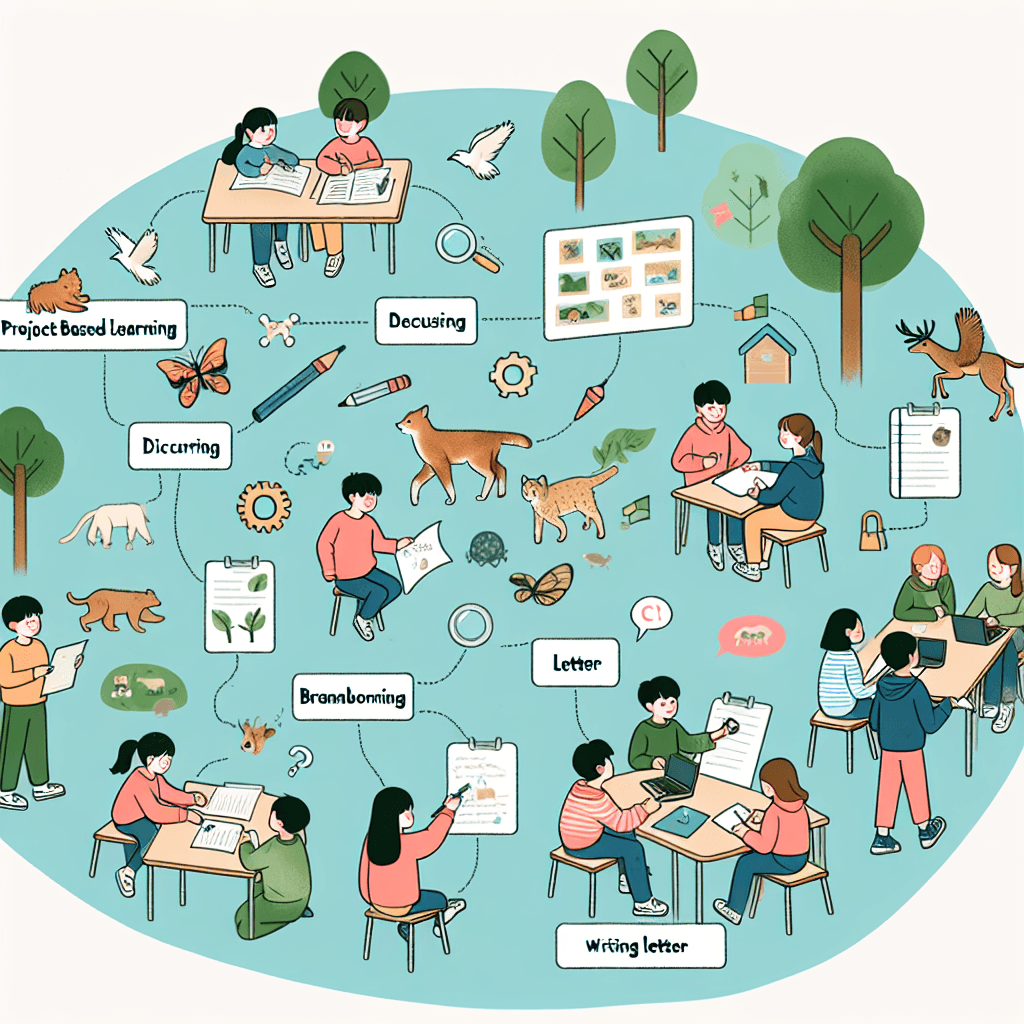
Animal Habitat Letter Writing
Inquiry Framework
Question Framework
Driving Question
The overarching question that guides the entire project.How can we effectively write letters from the perspective of an animal to explain how their unique adaptations help them survive in their specific habitat, while creatively exploring the importance of these adaptations?Essential Questions
Supporting questions that break down major concepts.- What are the different types of habitats animals live in?
- How do animals adapt to their habitats?
- What are some examples of animal adaptations?
- How do animals depend on their habitat for survival?
- Why is it important for animals to be adapted to their habitat?
Standards & Learning Goals
Learning Goals
By the end of this project, students will be able to:- Students will understand what a habitat is and identify different types of habitats animals live in.
- Students will be able to explain how animals adapt to their specific habitats and give examples of animal adaptations.
- Students will write letters from the perspective of an animal, creatively incorporating their understanding of animal adaptations.
- Students will improve their letter writing skills focusing on structure, clarity, and descriptive language.
- Students will demonstrate an understanding of the importance of animal adaptations for survival in their habitats.
Common Core Standards
Next Generation Science Standards
Entry Events
Events that will be used to introduce the project to studentsMystery Animal Postcards
Begin the project by having students receive a mysterious postcard from an 'animal' pen pal. Each postcard includes clues about the animal's adaptations and habitat. Students are tasked with solving the mystery of which animal sent the postcard, sparking curiosity and setting the stage for inquiry into different animal habitats.Habitat Detective Challenge
Create a classroom mystery where students must determine which animal could live in a specific 'found' habitat. Provide them with clues like sounds, images of plants, weather conditions, and paw prints. This challenge engages students in critical thinking and ties directly to understanding animal adaptations and survival needs.Interactive Habitat Exhibit
Transform the classroom into an interactive animal habitat museum with different stations representing various ecosystems. Students rotate through stations, learning about specific animal adaptations and writing reflections as if they were the animals. This tactile experience creates an authentic connection to the writing project.Portfolio Activities
Portfolio Activities
These activities progressively build towards your learning goals, with each submission contributing to the student's final portfolio.Postcard Mystery Solvers
Students solve a mystery by working to identify the animal that sent them a postcard. This activity introduces animal adaptations and habitats through clues and critical thinking.Steps
Here is some basic scaffolding to help students complete the activity.Final Product
What students will submit as the final product of the activityA brief report or presentation on the identified animal and its habitat.Alignment
How this activity aligns with the learning objectives & standardsThis activity aligns with CCSS.ELA-LITERACY.W.1.8 as students gather information from provided sources to identify animals.Habitat Detective Journals
Students create a detective journal to record observations and reflections from inquiry activities related to different habitats and the animals living within them.Steps
Here is some basic scaffolding to help students complete the activity.Final Product
What students will submit as the final product of the activityA detective journal filled with observations and reflections on different habitats and their corresponding animal life.Alignment
How this activity aligns with the learning objectives & standardsThis activity directly supports NGSS.1-LS1-2 as it involves analyzing habitats to understand animal adaptations and survival.Animal Perspective Letters
Students write a letter from the perspective of an animal in its habitat, creatively describing adaptations and survival challenges.Steps
Here is some basic scaffolding to help students complete the activity.Final Product
What students will submit as the final product of the activityA creatively written letter from the perspective of an animal, detailing its daily life and adaptations.Alignment
How this activity aligns with the learning objectives & standardsThis task aligns with CCSS.ELA-LITERACY.W.1.3 by supporting letter writing that recounts events, uses sequence signals, and includes closure.Rubric & Reflection
Portfolio Rubric
Grading criteria for assessing the overall project portfolioAnimal Perspective Letter Writing Rubric
Content Understanding
Evaluates the student's grasp of animal habitats and adaptations, as well as their ability to accurately represent them in their writing.Knowledge of Habitats
Assesses the student's understanding of the animal's habitat, its characteristics, and how these influence the animal's life.
Exemplary
4 PointsDemonstrates excellent understanding of the animal's habitat with detailed and accurate descriptions of its characteristics and influences on the animal's life.
Proficient
3 PointsShows solid understanding of the animal's habitat with mostly accurate descriptions and some detail about its characteristics and influence.
Developing
2 PointsShows basic understanding of the animal's habitat with some key characteristics noted, but limited in detail and accuracy.
Beginning
1 PointsDisplays minimal understanding of the animal's habitat with few characteristics noted and inaccuracies present.
Understanding Adaptations
Assesses the student's knowledge of how the animal's adaptations aid in its survival within its habitat.
Exemplary
4 PointsProvides a sophisticated explanation of adaptations with clear examples of how they aid survival in the habitat.
Proficient
3 PointsProvides a clear explanation of adaptations with examples showing how they aid survival, but lacks some detail.
Developing
2 PointsGives a basic explanation of adaptations with limited examples, and their connection to survival is not clear.
Beginning
1 PointsOffers minimal explanation of adaptations with few or no examples, and little connection to survival.
Writing Quality
Evaluates the writing structure, use of descriptive language, and adherence to letter format.Use of Descriptive Language
Measures the use of vivid and descriptive language to create an engaging narrative from the animal's perspective.
Exemplary
4 PointsUses rich, descriptive language that vividly paints the animal's perspective and makes the writing engaging and detailed.
Proficient
3 PointsUses clear and appropriate descriptive language that effectively conveys the animal's perspective.
Developing
2 PointsUses some descriptive language, but the writing lacks vividness and may not fully engage the reader.
Beginning
1 PointsUses minimal or no descriptive language; the writing is plain and fails to engage the reader.
Organization and Structure
Assesses the logical flow of events and information, including the use of temporal language to signal event order.
Exemplary
4 PointsExcellently organizes events logically using clear and varied temporal language, providing a seamless flow.
Proficient
3 PointsOrganizes events logically with mostly clear temporal language, ensuring good flow of ideas.
Developing
2 PointsShows basic organization with limited use of temporal language, resulting in some confusion.
Beginning
1 PointsLacks organization with little to no use of temporal language, making the writing hard to follow.
Creativity and Engagement
Assesses the creativity in storytelling and the student's ability to engage the reader from the animal's perspective.Engagement and Interest
Evaluates how well the writing captivates the reader and maintains interest through creative storytelling.
Exemplary
4 PointsCaptivates the reader throughout with exceptionally creative storytelling that maintains high interest.
Proficient
3 PointsEngages the reader with creative storytelling that maintains interest for most of the piece.
Developing
2 PointsShows some creative elements, but the writing may not consistently engage the reader.
Beginning
1 PointsLacks creativity and engagement, failing to capture the reader's interest.