
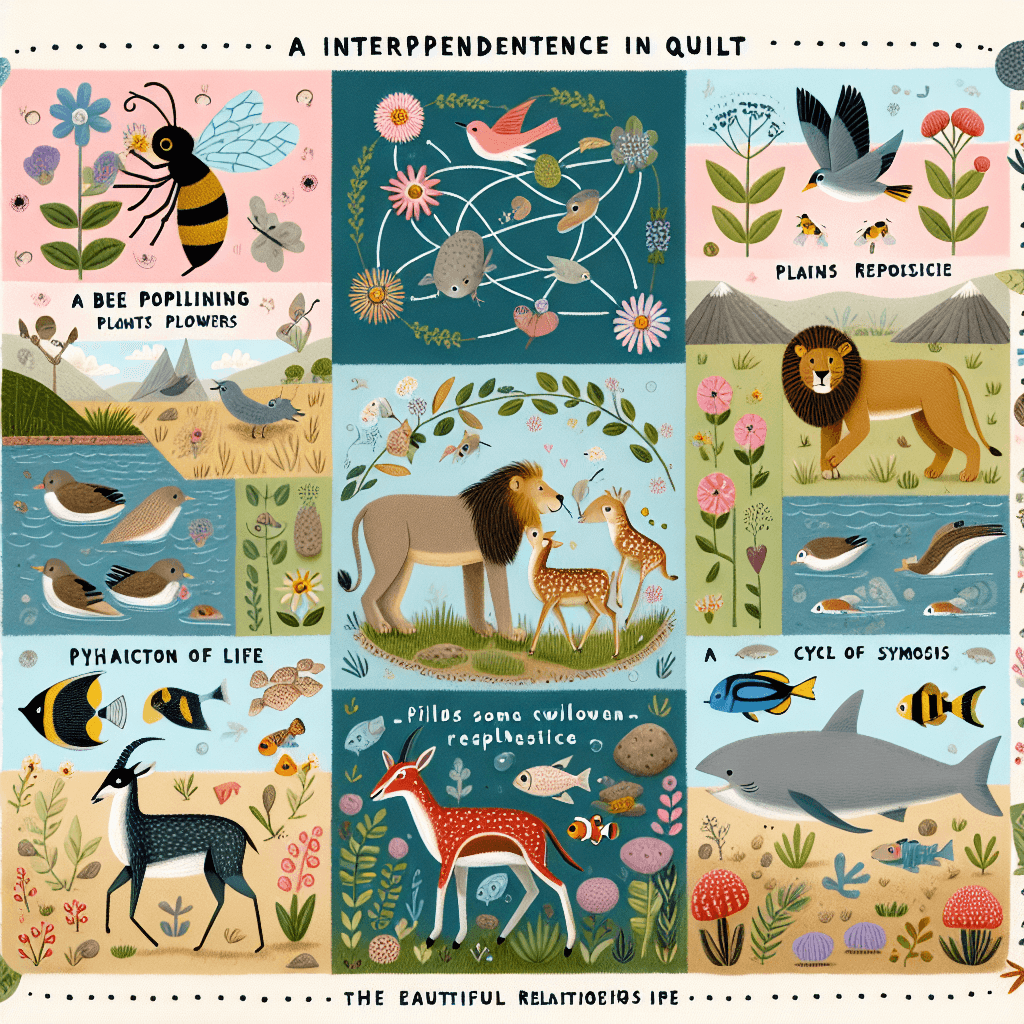
Animal Relationships Quilt: Exploring Interdependence in Nature
Inquiry Framework
Question Framework
Driving Question
The overarching question that guides the entire project.How can we, as nature artists and writers, create a class quilt that shows how different plant and animal relationships contribute to a healthy ecosystem, and why it's important to protect them?Essential Questions
Supporting questions that break down major concepts.- How do different animals and plants depend on each other in their environments?
- What happens to an ecosystem when one relationship between animals or plants is disrupted?
- How can we use our understanding of animal relationships to protect biodiversity?
Standards & Learning Goals
Learning Goals
By the end of this project, students will be able to:- Students will be able to identify and describe different types of relationships between plants and animals (e.g., predator-prey, mutualism).
- Students will be able to explain how these relationships contribute to the health of an ecosystem.
- Students will be able to represent these relationships visually and in writing.
- Students will be able to use academic vocabulary related to ecology (e.g., interdependence, camouflage, adaptation, biodiversity, habitat).
- Students will be able to reflect on the importance of protecting these relationships to maintain biodiversity.
Teacher Provided Standards
Next Generation Science Standards
Entry Events
Events that will be used to introduce the project to studentsNature Documentary Pitch
Students are tasked with developing a pitch for a nature documentary focusing on a specific animal relationship. They must highlight the unique aspects of the relationship and its significance within the ecosystem to convince the class to 'fund' their documentary.Portfolio Activities
Portfolio Activities
These activities progressively build towards your learning goals, with each submission contributing to the student's final portfolio.Relationship Reporter: Initial Observations
Students begin by revisiting provided texts to identify and record initial observations of animal relationships. This activity serves as a foundation for deeper exploration.Steps
Here is some basic scaffolding to help students complete the activity.Final Product
What students will submit as the final product of the activityA completed worksheet with examples of animal relationships observed from the texts.Alignment
How this activity aligns with the learning objectives & standardsAligns with 3.RI.3D (Demonstrate comprehension by writing about what is read using the text for support) and 3.DSR.E (Use reading strategies as needed to monitor comprehension when encountering challenging sections of text).Ecosystem Explorers: Deep Dive Discussion
Following the initial text review, students participate in a guided class discussion to analyze and synthesize their observations, enhancing their understanding of interdependence.Steps
Here is some basic scaffolding to help students complete the activity.Final Product
What students will submit as the final product of the activityActive participation in a class discussion, demonstrating an understanding of different animal relationships and their importance.Alignment
How this activity aligns with the learning objectives & standardsAligns with 3.RI.3D (Demonstrate comprehension by writing about what is read using the text for support) and 3-LS4-3 (Construct an argument with evidence that in a particular habitat some organisms can survive well, some survive less well, and some cannot survive at all).Relationship Spotlight: Choice Time & Exit Ticket
Students choose one specific animal relationship to focus on for their quilt square, solidifying their understanding and preparing for creative representation.Steps
Here is some basic scaffolding to help students complete the activity.Final Product
What students will submit as the final product of the activityAn exit ticket with the chosen animal relationship described in one sentence.Alignment
How this activity aligns with the learning objectives & standardsAligns with 3.W.1B (Write personal or fictional narratives that organize event sequences that unfold naturally) and 3.LU.1A (Produce, expand, and rearrange simple and compound sentences when speaking and writing).Quilt Square Creators: Art & Explanation
Students create their quilt square, integrating visual and written elements to represent their chosen animal relationship and demonstrate their understanding of key vocabulary.Steps
Here is some basic scaffolding to help students complete the activity.Final Product
What students will submit as the final product of the activityA completed quilt square with a drawing, caption/paragraph, and academic vocabulary usage.Alignment
How this activity aligns with the learning objectives & standardsAligns with 3.W.1B (Write personal or fictional narratives that organize event sequences that unfold naturally), 3.LU.1A (Produce, expand, and rearrange simple and compound sentences when speaking and writing), and 3.W.3B (With guidance and support from peers and adults, edit writing for format and conventions such as capitalization, usage, punctuation, and spelling).Ecosystem Experts: Peer Review & Refinement
Students share their quilt squares with peers, receiving and providing feedback to refine their work and deepen their understanding of the represented relationships.Steps
Here is some basic scaffolding to help students complete the activity.Final Product
What students will submit as the final product of the activityA revised quilt square, refined based on peer feedback.Alignment
How this activity aligns with the learning objectives & standardsAligns with 3.W.3B (With guidance and support from peers and adults, edit writing for format and conventions such as capitalization, usage, punctuation, and spelling) and 3-LS4-3 (Construct an argument with evidence that in a particular habitat some organisms can survive well, some survive less well, and some cannot survive at all).Biodiversity Showcase: Gallery Walk Presentations
Students present their quilt squares to the class, articulating what they learned and reflecting on the importance of protecting animal relationships and biodiversity.Steps
Here is some basic scaffolding to help students complete the activity.Final Product
What students will submit as the final product of the activityA presentation of the quilt square and a reflection on the importance of protecting animal relationships and biodiversity.Alignment
How this activity aligns with the learning objectives & standardsAligns with 3.RI.3D (Demonstrate comprehension by writing about what is read using the text for support), 3-LS4-4 (Make a claim about the merit of a solution to a problem caused when the environment changes and the types of plants and animals that live there may change) and 3.DSR.E (Use reading strategies as needed to monitor comprehension when encountering challenging sections of text).Rubric & Reflection
Portfolio Rubric
Grading criteria for assessing the overall project portfolioEcosystem Interdependence Quilt: A Collaborative Exploration of Animal Relationships
Understanding of Animal Relationships
Demonstrates understanding of the chosen animal relationship and its role in the ecosystem.Accuracy of Representation
How accurately the student represents the chosen animal relationship based on provided texts and class discussions.
Exemplary
4 PointsThe student accurately and thoroughly represents the chosen animal relationship, demonstrating a deep understanding of its components and dynamics. The representation goes beyond the basic facts and shows nuanced comprehension.
Proficient
3 PointsThe student accurately represents the core aspects of the chosen animal relationship, showing a solid understanding of its main features. The representation is clear and mostly complete.
Developing
2 PointsThe student represents some aspects of the animal relationship correctly, but there are inaccuracies or omissions that indicate a partial understanding. The representation may lack clarity or depth.
Beginning
1 PointsThe student struggles to accurately represent the animal relationship, demonstrating a limited understanding of its components or dynamics. The representation contains significant errors or misunderstandings.
Explanation of Interdependence
Clarity and depth of the student's explanation of how the chosen relationship demonstrates interdependence within the ecosystem.
Exemplary
4 PointsThe student provides a clear, insightful, and comprehensive explanation of how the animal relationship demonstrates interdependence, connecting it to broader ecosystem health. The explanation demonstrates sophisticated reasoning and analysis.
Proficient
3 PointsThe student provides a clear and thorough explanation of how the animal relationship demonstrates interdependence, showing a good understanding of its significance within the ecosystem. The explanation is logical and well-supported.
Developing
2 PointsThe student attempts to explain how the animal relationship demonstrates interdependence, but the explanation is incomplete, unclear, or lacks sufficient detail. The connection to the broader ecosystem may be weak.
Beginning
1 PointsThe student struggles to explain how the animal relationship demonstrates interdependence, showing a limited understanding of its significance within the ecosystem. The explanation is vague, inaccurate, or missing key components.
Representation and Communication
Effectiveness of the visual representation and written explanation in conveying understanding of the animal relationship.Visual Representation Quality
The clarity, detail, and accuracy of the drawing on the quilt square.
Exemplary
4 PointsThe drawing is exceptionally clear, detailed, and visually appealing, accurately representing the chosen animal relationship in a creative and engaging way. The visual elements enhance understanding and demonstrate artistic skill.
Proficient
3 PointsThe drawing is clear, detailed, and accurately represents the chosen animal relationship. The visual elements effectively support the explanation.
Developing
2 PointsThe drawing is somewhat clear but may lack detail or accuracy in representing the animal relationship. The visual elements may not fully support the explanation.
Beginning
1 PointsThe drawing is unclear, lacks detail, and/or does not accurately represent the animal relationship. The visual elements are minimal and do not effectively support the explanation.
Clarity of Written Explanation
How well the caption or paragraph explains the animal relationship in a clear and concise manner.
Exemplary
4 PointsThe written explanation is exceptionally clear, concise, and engaging, effectively conveying the key aspects of the animal relationship and its significance. The writing demonstrates strong command of language and attention to detail.
Proficient
3 PointsThe written explanation is clear, concise, and accurately describes the animal relationship. The writing is well-organized and easy to understand.
Developing
2 PointsThe written explanation is somewhat clear but may lack detail, clarity, or organization. The writing may contain grammatical errors or unclear phrasing.
Beginning
1 PointsThe written explanation is unclear, incomplete, and/or difficult to understand. The writing contains significant errors and lacks coherence.
Use of Academic Vocabulary
Effective and accurate integration of academic vocabulary (interdependence, camouflage, adaptation, biodiversity, habitat) within the explanation.
Exemplary
4 PointsThe student skillfully and seamlessly integrates multiple academic vocabulary words into the explanation, demonstrating a deep understanding of their meanings and relevance to the animal relationship. The vocabulary enhances the sophistication and precision of the writing.
Proficient
3 PointsThe student accurately uses at least one academic vocabulary word in the explanation, demonstrating an understanding of its meaning and relevance to the animal relationship. The vocabulary is used appropriately and effectively.
Developing
2 PointsThe student attempts to use academic vocabulary but may use it incorrectly or in a way that does not fully demonstrate understanding. The vocabulary may be used sparingly or inappropriately.
Beginning
1 PointsThe student does not use any academic vocabulary or demonstrates a significant misunderstanding of its meaning. The explanation lacks the precision and depth that academic vocabulary could provide.
Collaboration and Reflection
Participation in peer review and reflection on the importance of protecting animal relationships and biodiversity.Peer Feedback Quality
The quality and thoughtfulness of feedback provided to peers during the peer review process.
Exemplary
4 PointsThe student provides insightful and constructive feedback to their peer, offering specific suggestions for improvement and demonstrating a deep understanding of the animal relationship represented. The feedback is respectful, encouraging, and focused on promoting growth.
Proficient
3 PointsThe student provides helpful and relevant feedback to their peer, identifying strengths and areas for improvement in a clear and respectful manner. The feedback is focused on the key aspects of the animal relationship and its representation.
Developing
2 PointsThe student provides some feedback to their peer, but it may be general, superficial, or lacking in specific suggestions for improvement. The feedback may not fully address the key aspects of the animal relationship and its representation.
Beginning
1 PointsThe student provides minimal or unhelpful feedback to their peer, demonstrating a lack of engagement in the peer review process. The feedback may be vague, irrelevant, or disrespectful.
Reflection on Biodiversity
Depth of reflection on what was learned about animal relationships and the importance of protecting biodiversity.
Exemplary
4 PointsThe student demonstrates a deep and nuanced understanding of the importance of protecting animal relationships and biodiversity, connecting it to broader environmental issues and proposing thoughtful solutions. The reflection shows critical thinking and a commitment to conservation.
Proficient
3 PointsThe student demonstrates a clear understanding of the importance of protecting animal relationships and biodiversity, explaining the consequences of disrupting these relationships and advocating for responsible stewardship of the environment. The reflection is well-reasoned and persuasive.
Developing
2 PointsThe student acknowledges the importance of protecting animal relationships and biodiversity but may lack a deep understanding of the underlying issues or the consequences of inaction. The reflection may be superficial or lack specific examples.
Beginning
1 PointsThe student struggles to articulate the importance of protecting animal relationships and biodiversity, demonstrating a limited understanding of the issues involved. The reflection may be minimal, vague, or missing key components.