
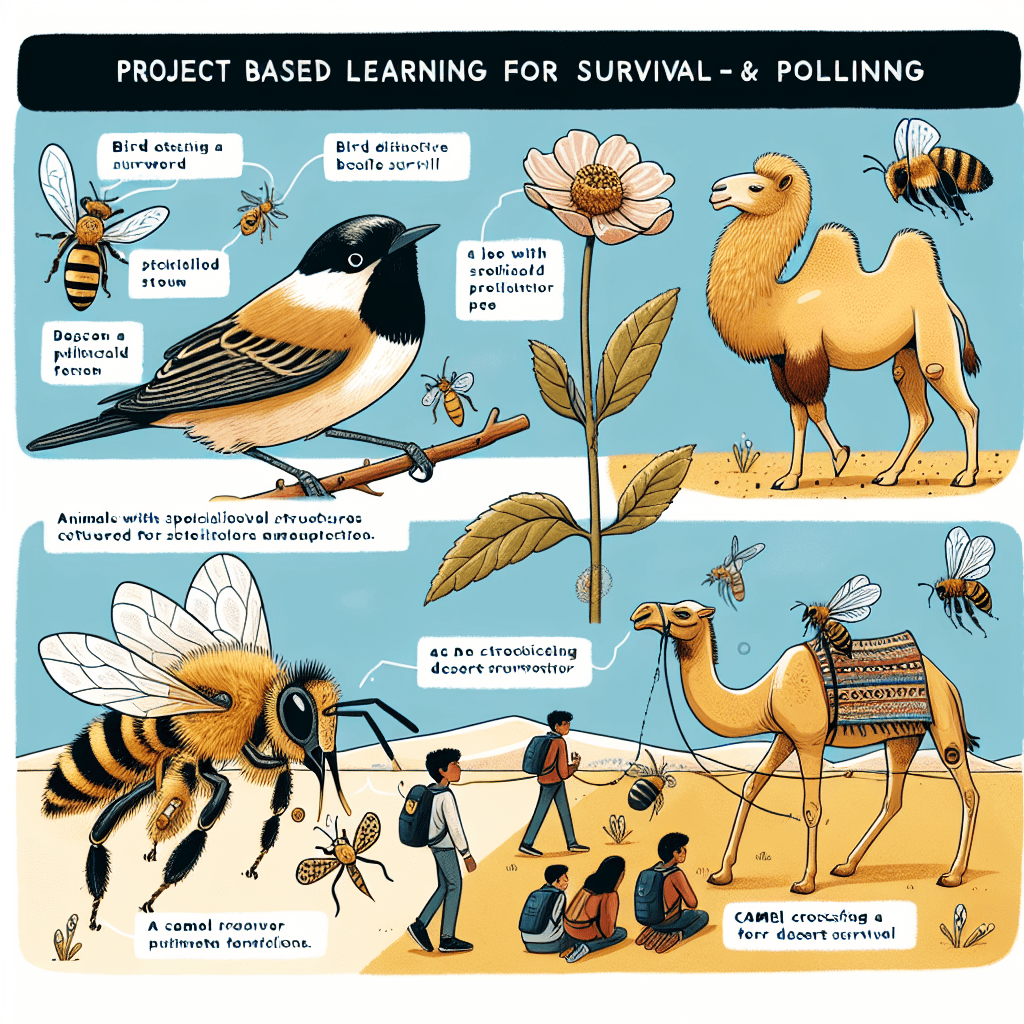
Animal Structures for Survival and Pollination
Inquiry Framework
Question Framework
Driving Question
The overarching question that guides the entire project.How can we observe and model the ways animals use their structures to survive and support plant life in different environments?Essential Questions
Supporting questions that break down major concepts.- What are some examples of animal structures that help them survive in their habitats?
- How do the physical characteristics of animals relate to their ability to find food, shelter, and water?
- In what ways do animals contribute to the life cycle of plants in their environment?
- How do different animal structures help protect them from predators?
- How can we use models to understand the roles of animals in their ecosystems?
Standards & Learning Goals
Learning Goals
By the end of this project, students will be able to:- Students will develop an understanding of how animals' physical characteristics help them survive in specific environments.
- Students will be able to explain the interdependence between animals and plants, emphasizing the role of animals in pollination and seed dispersal.
- Students will learn to create models that represent the functions of animal structures in supporting ecosystems.
- Students will enhance their observational skills by examining various animal adaptations in different habitats.
Next Generation Science Standards
Entry Events
Events that will be used to introduce the project to studentsInteractive Virtual Safari
Students embark on a virtual safari, where they explore different ecosystems and meet animals with varying structures aiding in plant reproduction. They will record their observations and prepare a presentation on their chosen animal’s contribution to seed dispersal and pollination.Portfolio Activities
Portfolio Activities
These activities progressively build towards your learning goals, with each submission contributing to the student's final portfolio.Animal Structure Exploration
Students will explore various animal structures through virtual safari observations, focusing on how these structures assist in seed dispersal and pollination.Steps
Here is some basic scaffolding to help students complete the activity.Final Product
What students will submit as the final product of the activityA set of detailed observation notes highlighting animal structures and their functions.Alignment
How this activity aligns with the learning objectives & standardsAligns with NGSS 2-LS2-2 by observing how animal structures support plant life, emphasizing structure and function.Seed Dispersal Detective
Students become detectives, investigating how specific animal structures aid in seed dispersal across different habitats.Steps
Here is some basic scaffolding to help students complete the activity.Final Product
What students will submit as the final product of the activityA drawing and explanation of how the chosen animal disperses seeds.Alignment
How this activity aligns with the learning objectives & standardsSupports NGSS LS2.A by focusing on interdependent relationships through seed dispersal.Pollination Partners
Students explore the pollination process, identifying how certain animal structures help pollinate plants, thus supporting ecosystems.Steps
Here is some basic scaffolding to help students complete the activity.Final Product
What students will submit as the final product of the activityA model representing the animal's role in pollination.Alignment
How this activity aligns with the learning objectives & standardsRelates to NGSS 2-LS2-2 and ETS1.B by modeling ecological functions using physical representations.Adaptation Artistry
Students will use art to illustrate an animal's adaptation, emphasizing how specific structures help it survive in its environment.Steps
Here is some basic scaffolding to help students complete the activity.Final Product
What students will submit as the final product of the activityAn illustrated art piece with explanatory notes on the animal's adaptation.Alignment
How this activity aligns with the learning objectives & standardsConnects with NGSS by highlighting animal adaptations and their functional significance.Ecosystem Engineers
Students act as engineers to develop a model that mimics how an animal uses its structures to benefit both itself and plants.Steps
Here is some basic scaffolding to help students complete the activity.Final Product
What students will submit as the final product of the activityA constructed model that simulates the animal's real-world ecological role.Alignment
How this activity aligns with the learning objectives & standardsMeets NGSS standards by using design principles to showcase animal-plant interactions.Rubric & Reflection
Portfolio Rubric
Grading criteria for assessing the overall project portfolioAnimal Structures and Ecosystem Interaction Rubric
Understanding of Animal Structures
Evaluates students' comprehension of how animal structures aid in survival and ecosystem support, including pollination and seed dispersal.Identification of Animal Structures
Assesses the ability to accurately identify and describe animal structures that contribute to survival and ecosystem functions.
Exemplary
4 PointsIdentifies and describes multiple animal structures with clear explanations of how each contributes to survival and ecosystem support.
Proficient
3 PointsIdentifies and describes key animal structures with explanations of their contributions to survival and ecosystem support.
Developing
2 PointsIdentifies some animal structures with partial explanations of their contributions to survival and ecosystem support.
Beginning
1 PointsIdentifies few or incomplete animal structures with minimal explanation of their ecological roles.
Explanation of Ecosystem Interactions
Measures the ability to explain interdependent relationships between animals and plants, focusing on pollination and seed dispersal.
Exemplary
4 PointsProvides comprehensive explanations of how animal-plant interactions, like pollination and seed dispersal, enhance ecosystem stability.
Proficient
3 PointsExplains how animal-plant interactions contribute to ecosystem functions with specific examples.
Developing
2 PointsOffers basic explanations of some animal-plant interactions with limited details.
Beginning
1 PointsProvides minimal explanation or incorrect examples of animal-plant interactions.
Model and Representation Creation
Assesses the creativity and accuracy of student-created models or representations demonstrating animal structures' functions.Accuracy and Creativity of Models
Evaluates how accurately and creatively students create models that illustrate animal structures' roles in ecosystems.
Exemplary
4 PointsCreates highly accurate and innovative models that creatively show animal structures' roles in ecosystems.
Proficient
3 PointsDevelops accurate and creative models illustrating key animal structures and functions.
Developing
2 PointsCreates basic models with some accuracy in representing animal structures' functions.
Beginning
1 PointsProduces incomplete or inaccurate models with minimal representation.
Clarity and Detail of Explanation
Assesses the quality and clarity of students' written explanations accompanying models or illustrations.
Exemplary
4 PointsProvides clear, detailed explanations that significantly enhance the understanding of models or illustrations.
Proficient
3 PointsOffers clear and detailed explanations that support understanding of models.
Developing
2 PointsProvides basic explanations with some clarity, supporting models to a limited extent.
Beginning
1 PointsGives incomplete or unclear explanations that diminishe understanding of models.
Collaborative Inquiry and Engagement
Evaluates students' engagement and collaboration skills during discussions and activities related to animal structure inquiry.Participation and Contribution
Measures students' active participation and contribution to group discussions and activities.
Exemplary
4 PointsActively participates and leads discussions, offering insightful contributions that advance group understanding.
Proficient
3 PointsEngages actively in discussions, contributing relevant insights and ideas.
Developing
2 PointsParticipates occasionally with basic contributions in discussions and activities.
Beginning
1 PointsRarely participates or contributes minimally to discussions and activities.