
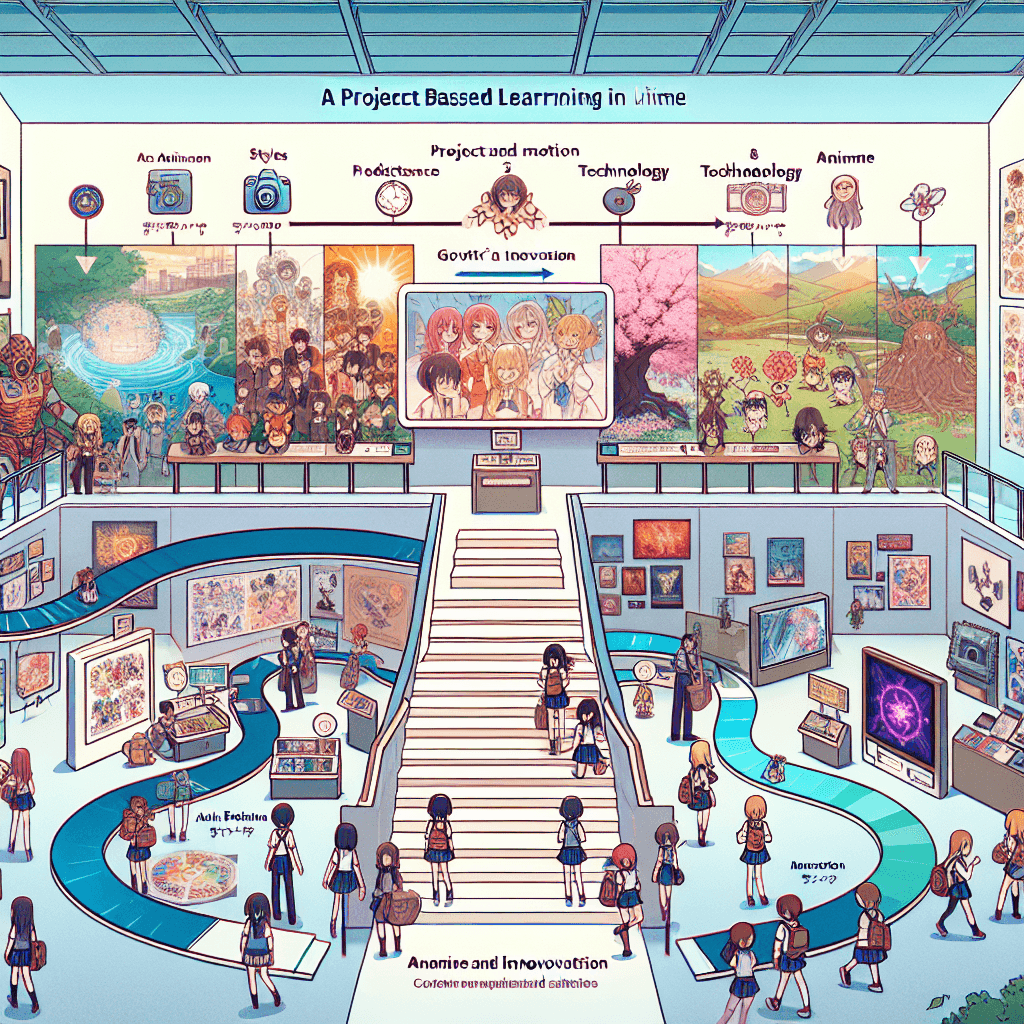
Anime Evolution: Curating a Museum of Art and Innovation
Inquiry Framework
Question Framework
Driving Question
The overarching question that guides the entire project.How can we, as museum curators, design an immersive exhibit that uses math and science to reveal how anime art has evolved and helped people innovate during changing times?Essential Questions
Supporting questions that break down major concepts.- How have the visual elements of anime art (line, shape, color) evolved as technology has changed? (Art/Science)
- What can the history of anime tell us about how people adapt and innovate during difficult times? (History/Social Studies)
- How can we use measurement and geometry to design an exhibit layout that maximizes visitor experience? (Math)
- In what ways does the science of light and motion make static drawings appear to come to life? (Science)
- How do curators use persuasive and informative writing to teach an audience about the significance of an artifact? (ELAR)
- How do we use data and proportions to ensure our character designs are consistent and realistic? (Math/Art)
Standards & Learning Goals
Learning Goals
By the end of this project, students will be able to:- Research and analyze the historical evolution of anime art to identify how cultural and technological shifts influenced artistic styles and innovation.
- Design and draft a scaled museum exhibit layout using geometric concepts (area, perimeter, and angles) to optimize visitor flow and display space.
- Demonstrate an understanding of light and motion by explaining the scientific principles behind how static anime drawings appear to move (persistence of vision).
- Compose clear, informative, and persuasive museum labels and descriptions that effectively communicate the significance of specific anime artifacts to a public audience.
- Create original artwork that demonstrates an application of the elements of art (line, shape, color) and proportional reasoning used in character design.
TEKS Mathematics Grade 4
TEKS ELAR Grade 4
TEKS Art Grade 4
TEKS Science Grade 4
TEKS Social Studies Grade 4
Entry Events
Events that will be used to introduce the project to studentsThe Time-Traveler’s Portfolio: A Visual Evolution
Students enter the room to find a mysterious 'time capsule' portfolio containing sketches of a single iconic character style from the 1960s, the 1990s, and 2024. They must analyze how the character's 'visual DNA' evolved to survive changing audience tastes and technological shifts, prompting an inquiry into the history of artistic innovation.Portfolio Activities
Portfolio Activities
These activities progressively build towards your learning goals, with each submission contributing to the student's final portfolio.The Visual DNA Detective: Tracking Artistic Evolution
Before designing their own exhibit, students must become experts on the history of the art form. In this activity, students act as 'Visual Detectives,' examining the 'Visual DNA' of anime across three distinct eras: the 1960s (Astro Boy era), the 1990s (Sailor Moon/Dragon Ball era), and the 2020s (Modern Digital era). They will identify how lines, shapes, and colors shifted as technology moved from hand-painted cels to digital compositing.Steps
Here is some basic scaffolding to help students complete the activity.Final Product
What students will submit as the final product of the activityA 'Visual Evolution Infographic' that compares two different eras of anime, highlighting at least three specific artistic or technological changes.Alignment
How this activity aligns with the learning objectives & standardsThis activity aligns with TEKS 110.6.b.13.A, as students must interpret information presented graphically to understand artistic trends. It also addresses TEKS 113.15.b.20.C by having students reflect on how technological innovations (from hand-drawn to digital) changed the culture of anime.The Illusionist’s Lab: The Science of Motion
Curators need to explain the 'magic' of their artifacts. Students will explore the science behind animation—how the human eye perceives light and motion. They will experiment with the concept of 'persistence of vision' to understand how static images become 'anime' (animated). This bridges the gap between art and the science of light energy.Steps
Here is some basic scaffolding to help students complete the activity.Final Product
What students will submit as the final product of the activityA 'Science of Sight' Flipbook and a short 'Scientific Curator Note' explaining how light and speed trick the brain into seeing motion.Alignment
How this activity aligns with the learning objectives & standardsThis activity aligns with TEKS 112.15.b.6.B, where students differentiate between forms of energy, specifically focusing on how light energy and the 'persistence of vision' create the illusion of mechanical motion.Proportional Protagonists: The Math of Manga Art
Every museum needs a centerpiece. Students will now apply what they’ve learned about artistic evolution to create an original 'Innovative Hero' character. They must use specific proportions (e.g., the 'head-to-body ratio' common in 4th-grade math and art) to ensure their character looks professional and follows the 'math of manga.'Steps
Here is some basic scaffolding to help students complete the activity.Final Product
What students will submit as the final product of the activityA 'Character Design Sheet' featuring a front and side view of an original character, annotated with the geometric shapes and proportions used to build them.Alignment
How this activity aligns with the learning objectives & standardsThis activity aligns with TEKS 117.114.b.2.C, as students produce original digital or paper-based media. It also supports TEKS 110.6.b.13.A by requiring students to use data and proportions (mathematical visual information) to ensure their character design is consistent.Blueprint for Wonder: Engineering the Exhibit Layout
As curators, students must now design the physical space of their exhibit. They will be given a 'Museum Floor Plan' (a large grid) and must designate specific rectangular zones for 'The 60s Wing,' 'The Tech Lab,' and 'The Modern Gallery.' They must calculate the area to ensure enough people can fit and the perimeter to determine how much 'wall space' they have for hanging art.Steps
Here is some basic scaffolding to help students complete the activity.Final Product
What students will submit as the final product of the activityA Scaled Museum Blueprint with a 'Space Calculations Log' showing the area and perimeter of every room in the exhibit.Alignment
How this activity aligns with the learning objectives & standardsThis activity aligns directly with TEKS 111.6.b.5.D, as students must solve real-world problems involving the perimeter and area of the rectangular gallery spaces they are designing.The Curator’s Voice: Writing for the Public
The final step of the portfolio is the written word. Students will write professional museum 'plaques' for their artifacts. These plaques must be informative, explaining the history, the math (proportions), and the science (light/motion) behind the piece to the museum visitors. This integrates all previous learning into a cohesive, persuasive narrative.Steps
Here is some basic scaffolding to help students complete the activity.Final Product
What students will submit as the final product of the activityA set of three 'Curator Plaques'—one for their character design, one for their flipbook, and one for the exhibit as a whole.Alignment
How this activity aligns with the learning objectives & standardsThis activity aligns with TEKS 110.6.b.12.B, requiring students to compose informational texts with a clear central idea and genre-specific structures (the museum plaque).Rubric & Reflection
Portfolio Rubric
Grading criteria for assessing the overall project portfolioAnime Museum Curator: Innovation & Evolution Rubric
Historical Inquiry & Analysis
Evaluation of the student's research and analysis of how anime has adapted to cultural and technological changes over time.Historical Evolution & Data Interpretation
Measures the student's ability to analyze historical and technological shifts in anime art, specifically comparing eras (1960s, 1990s, 2020s) and interpreting visual data trends.
Exemplary
4 PointsInfographic provides a sophisticated analysis of artistic evolution; expertly connects technological shifts (e.g., CGI, xerography) to specific visual changes; interpretations of visual media are nuanced and highly accurate.
Proficient
3 PointsInfographic clearly identifies three specific artistic or technological changes; accurately compares two different eras; effectively explains the relationship between innovation and artistic style.
Developing
2 PointsInfographic shows emerging understanding of artistic shifts; identifies some technological changes but may lack detail or clarity in the comparison between eras; data interpretation is inconsistent.
Beginning
1 PointsInfographic is incomplete or shows minimal understanding of anime history; fails to identify specific technological or artistic changes; requires significant support to interpret visual trends.
Scientific Modeling & Persistence of Vision
Evaluation of the scientific principles and mathematical calculations used to explain and demonstrate animation.Physics of Motion & Light Energy
Assesses the student's understanding of how light energy and the 'persistence of vision' create the illusion of motion, including the mathematical calculation of frame rates.
Exemplary
4 PointsFlipbook demonstrates a masterful application of light energy concepts; frame rate calculations are flawlessly executed; curator note provides a sophisticated explanation of the science behind human visual perception.
Proficient
3 PointsFlipbook successfully creates the illusion of motion; frame rate calculations are accurate; curator note clearly uses scientific terms like 'light energy' and 'persistence of vision' to explain the process.
Developing
2 PointsFlipbook shows basic motion but may lack smoothness; frame rate calculations contain minor errors; curator note uses scientific terms inconsistently or provides a partial explanation.
Beginning
1 PointsFlipbook fails to create an illusion of motion; frame rate calculations are incorrect or missing; curator note lacks scientific terminology and provides an insufficient explanation of light energy.
Artistic Craft & Proportional Reasoning
Assessment of the student's ability to combine artistic media with mathematical scaling and geometry.Geometric Proportions & Character Design
Measures the application of geometric shapes and mathematical proportions (Rule of Four) in creating an original, technically sound character design.
Exemplary
4 PointsCharacter design exhibits advanced technical skill; scaling and the 'Rule of Four' are applied with perfect consistency; annotations offer deep insight into the geometric construction of the figure.
Proficient
3 PointsCharacter design demonstrates effective use of geometric shapes (circles, cylinders); character is accurately scaled to four heads tall; annotations clearly identify the proportions used.
Developing
2 PointsCharacter design shows basic use of shapes but proportions are inconsistent; 'Rule of Four' is partially applied; annotations are present but may be vague or lack mathematical detail.
Beginning
1 PointsCharacter design is incomplete or lacks geometric structure; no evidence of proportional scaling or 'Rule of Four'; annotations are missing or fail to explain the design process.
Engineering & Spatial Planning
Evaluation of the student's ability to use mathematical processes to design a physical environment.Spatial Geometry & Exhibit Engineering
Evaluates the accuracy and application of area and perimeter calculations in the design of a functional, scaled museum floor plan.
Exemplary
4 PointsBlueprint is professionally scaled and innovatively designed; all area and perimeter calculations are flawlessly executed and used to optimize visitor flow and exhibit space.
Proficient
3 PointsBlueprint accurately displays three themed rooms; perimeter and area calculations (L x W and L+L+W+W) are correct; space is clearly designated for artifacts.
Developing
2 PointsBlueprint is present but contains minor measurement errors; area or perimeter calculations are inconsistent; room boundaries are somewhat unclear or improperly scaled.
Beginning
1 PointsBlueprint is incomplete or lacks clear dimensions; calculations for area and perimeter are incorrect or missing; fails to provide a logical layout for the exhibit artifacts.
Literacy & Professional Communication
Assessment of literacy skills and the ability to synthesize multi-disciplinary learning into professional museum descriptions.Informational Composition & Curatorial Voice
Assesses the student's ability to compose professional informational texts for a public audience, focusing on tone, factual accuracy, and central idea.
Exemplary
4 PointsPlaques are exceptionally persuasive and informative; use a formal 'Curator Tone' perfectly; central ideas are deeply integrated with historical, scientific, and mathematical evidence.
Proficient
3 PointsPlaques use a clear 'Hook, Facts, and Significance' structure; effectively communicate the importance of the artifact; tone is professional and the central idea is well-defined.
Developing
2 PointsPlaques provide basic information but may lack a strong central idea; the 'Curator Tone' is inconsistent (too informal); structure lacks either a hook or a clear statement of significance.
Beginning
1 PointsPlaques are incomplete or lack factual content; writing is disorganized with no clear central idea; fails to follow the genre-specific characteristics of museum signage.