
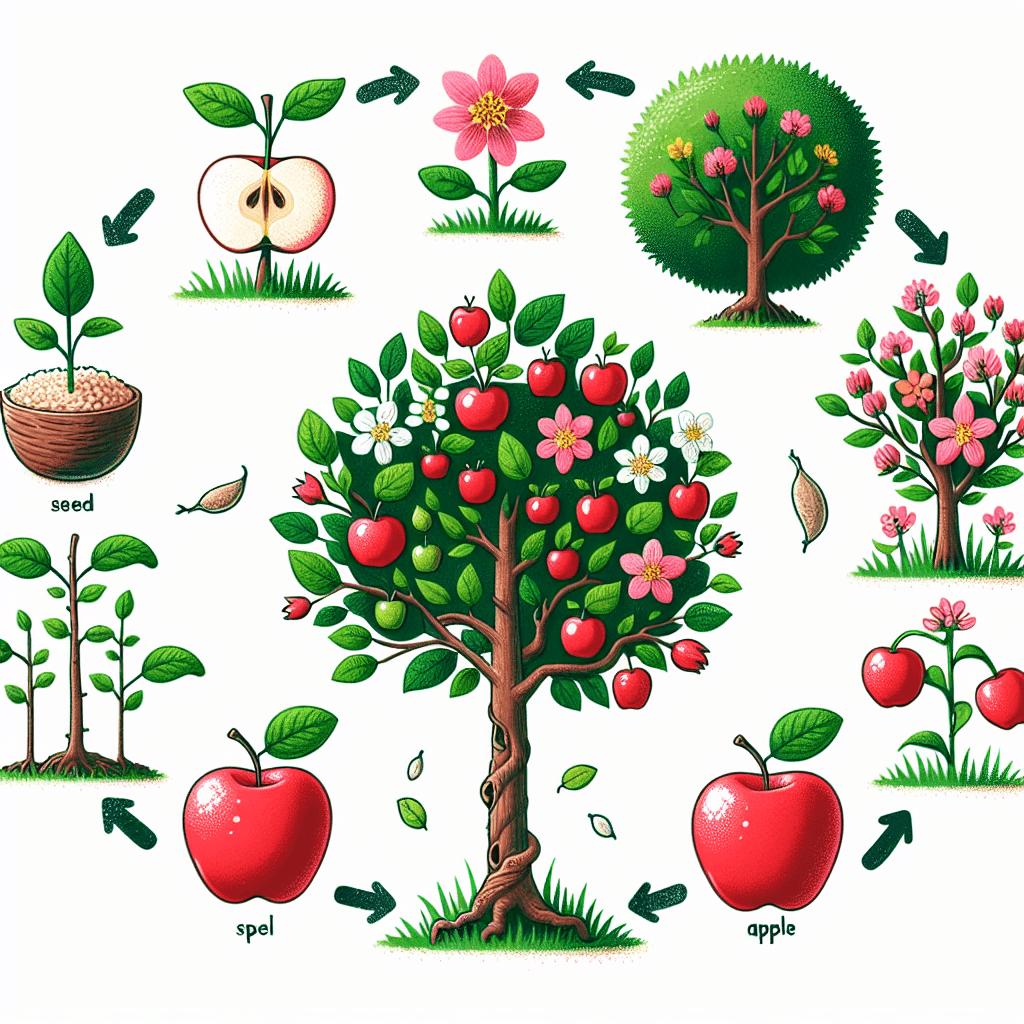
Apple Life Cycle: A Kindergarten Science Project
Inquiry Framework
Question Framework
Driving Question
The overarching question that guides the entire project.How does an apple grow from a tiny seed to become a tasty treat for me?Essential Questions
Supporting questions that break down major concepts.- What are the stages of an apple's life?
- How does an apple tree grow and change?
- What does a seed need to grow into a tree?
- How do we get apples to eat?
Standards & Learning Goals
Learning Goals
By the end of this project, students will be able to:- Identify the stages of an apple's life cycle
- Describe how an apple tree grows and changes
- Explain what a seed needs to grow into a tree
- Understand how apples are produced for consumption
Florida Standards
Entry Events
Events that will be used to introduce the project to studentsThe Apple's Time Capsule
Present students with an old, weathered apple and a series of images showing apples in different stages (blossom, young fruit, ripe apple, decaying apple). Ask them to imagine the apple's journey through time and what it experienced, prompting discussions about the changes it went through.Apple Tasting Challenge: From Seed to Snack
Engage students in an apple tasting activity featuring apples of different varieties and maturity levels. Challenge them to trace each apple back to its source (the tree) and then to imagine its origins as a tiny seed, leading to a discussion of the life cycle.Build an Apple Life Cycle Machine
Introduce the project with a Rube Goldberg-style machine that visually represents the apple life cycle. Each step of the machine triggers the next, demonstrating the sequence of growth, decay, and renewal, prompting students to build their own simplified versions.The Case of the Missing Apples
Present a 'crime scene' where all the apples have disappeared from an apple tree display. Students become detectives, using clues (pictures of apple blossoms, apple cores, etc.) to reconstruct the apple's life cycle and figure out what happened to the missing apples.Portfolio Activities
Portfolio Activities
These activities progressively build towards your learning goals, with each submission contributing to the student's final portfolio.Seed Observation Journal
Students begin by observing apple seeds, documenting their initial appearance and changes over a week as they begin to sprout. This activity introduces the concept of a life cycle's beginning.Steps
Here is some basic scaffolding to help students complete the activity.Final Product
What students will submit as the final product of the activityA journal with daily observations (drawings and written notes) of the apple seeds as they begin to sprout.Alignment
How this activity aligns with the learning objectives & standardsFSI.7f - Observing the initial stage of the life cycle and changes over time.Apple Life Cycle Diagram
Students create a visual representation of the apple life cycle, labeling each stage from seed to tree to apple and back to seed. This reinforces understanding of the cyclical nature of growth and change.Steps
Here is some basic scaffolding to help students complete the activity.Final Product
What students will submit as the final product of the activityA labeled diagram illustrating the complete apple life cycle, with descriptions of each stage.Alignment
How this activity aligns with the learning objectives & standardsFSI.7f - Visually representing the life cycle and demonstrating how living things change over time.Apple Tree Growth Chart
Students track the 'growth' of a classroom apple tree (real or artificial) over several weeks, adding details to a chart or timeline as they learn about each stage. This provides a tangible way to understand the duration and sequence of the life cycle.Steps
Here is some basic scaffolding to help students complete the activity.Final Product
What students will submit as the final product of the activityA detailed growth chart or timeline illustrating the progression of an apple tree's life, linking time with developmental stages.Alignment
How this activity aligns with the learning objectives & standardsFSI.7f - Tracking changes over time and understanding the sequence of the life cycle stages.Comparing Life Cycles
Students compare the apple life cycle to that of another plant or animal, identifying similarities and differences. This encourages broader application of the concept of life cycles and comparative analysis.Steps
Here is some basic scaffolding to help students complete the activity.Final Product
What students will submit as the final product of the activityA Venn diagram or comparison chart highlighting the similarities and differences between the apple life cycle and another chosen life cycle.Alignment
How this activity aligns with the learning objectives & standardsFSI.7f - Comparing different living things and their life cycles to understand changes over time.Rubric & Reflection
Portfolio Rubric
Grading criteria for assessing the overall project portfolioApple Life Cycle Portfolio Rubric
Seed Observation Journal
Assessment of the student's ability to observe, document, and describe changes in apple seeds over time.Observation and Detail
Quality and thoroughness of observations recorded in the journal.
Exemplary
4 PointsProvides detailed and accurate daily observations, including precise descriptions and drawings of seed changes.
Proficient
3 PointsProvides clear and accurate observations of seed changes with relevant details.
Developing
2 PointsProvides some observations, but details are limited or inconsistent.
Beginning
1 PointsProvides minimal or inaccurate observations; lacks detail.
Documentation Quality
Neatness, organization, and clarity of journal entries (drawings and written descriptions).
Exemplary
4 PointsJournal entries are exceptionally neat, organized, and easy to understand, with clear drawings and descriptions.
Proficient
3 PointsJournal entries are neat, organized, and generally easy to understand, with clear drawings and descriptions.
Developing
2 PointsJournal entries are somewhat organized, but may be difficult to understand in places; drawings and descriptions lack clarity.
Beginning
1 PointsJournal entries are disorganized, difficult to understand, and lack clear drawings and descriptions.
Apple Life Cycle Diagram
Assessment of student's ability to visually represent and describe the stages of the apple life cycle.Accuracy of Stages
Correctness and completeness of the apple life cycle stages depicted in the diagram.
Exemplary
4 PointsAccurately depicts all stages of the apple life cycle in the correct sequence, including seed, sprout, tree, blossom, fruit, and decay.
Proficient
3 PointsAccurately depicts most stages of the apple life cycle in the correct sequence.
Developing
2 PointsDepicts some stages of the apple life cycle, but may have inaccuracies or omissions.
Beginning
1 PointsDepicts only a few stages of the apple life cycle and contains significant inaccuracies.
Description Quality
Clarity and accuracy of descriptions for each stage of the life cycle.
Exemplary
4 PointsProvides clear, detailed, and accurate descriptions of what happens at each stage of the apple life cycle.
Proficient
3 PointsProvides clear and accurate descriptions of what happens at most stages of the apple life cycle.
Developing
2 PointsProvides some descriptions, but clarity and accuracy are limited.
Beginning
1 PointsProvides minimal or inaccurate descriptions of the stages.
Visual Presentation
Neatness, organization, and visual appeal of the diagram.
Exemplary
4 PointsThe diagram is visually appealing, neatly organized, and easy to understand, with creative use of colors and labels.
Proficient
3 PointsThe diagram is neat, organized, and easy to understand, with clear labels.
Developing
2 PointsThe diagram is somewhat organized, but may be difficult to understand in places; labels may be missing or unclear.
Beginning
1 PointsThe diagram is disorganized, difficult to understand, and lacks clear labels.
Apple Tree Growth Chart
Assessment of student's ability to track and document the progression of an apple tree's life cycle stages over time.Tracking and Timeline
Accuracy and completeness of the growth chart or timeline, including the sequence of stages and associated details.
Exemplary
4 PointsAccurately tracks all stages of the apple tree's life cycle on a detailed growth chart or timeline, with dates and specific observations.
Proficient
3 PointsAccurately tracks most stages of the apple tree's life cycle on a growth chart or timeline, with dates and observations.
Developing
2 PointsTracks some stages of the apple tree's life cycle, but may have inaccuracies or omissions; dates and observations may be incomplete.
Beginning
1 PointsTracks only a few stages of the apple tree's life cycle and contains significant inaccuracies; lacks dates and observations.
Detail and Description
Richness and accuracy of details added to the chart or timeline for each stage.
Exemplary
4 PointsProvides rich, detailed descriptions and illustrations for each stage of the apple tree's life cycle, demonstrating a thorough understanding.
Proficient
3 PointsProvides clear and accurate descriptions and illustrations for most stages of the apple tree's life cycle.
Developing
2 PointsProvides some descriptions and illustrations, but clarity and accuracy are limited.
Beginning
1 PointsProvides minimal or inaccurate descriptions and illustrations.
Engagement and Participation
Active involvement in updating and maintaining the growth chart throughout the project.
Exemplary
4 PointsDemonstrates consistent engagement and leadership in updating and maintaining the growth chart, contributing thoughtful insights.
Proficient
3 PointsActively participates in updating and maintaining the growth chart.
Developing
2 PointsParticipates in updating the growth chart, but may require prompting or guidance.
Beginning
1 PointsShows limited participation in updating the growth chart.
Comparing Life Cycles
Assessment of student's ability to compare the apple life cycle to that of another living thing, identifying similarities and differences.Identification of Similarities
Accuracy and relevance of similarities identified between the two life cycles.
Exemplary
4 PointsIdentifies multiple accurate and relevant similarities between the two life cycles, demonstrating a deep understanding of common life cycle principles.
Proficient
3 PointsIdentifies accurate and relevant similarities between the two life cycles.
Developing
2 PointsIdentifies some similarities, but relevance or accuracy may be limited.
Beginning
1 PointsIdentifies few or inaccurate similarities.
Identification of Differences
Accuracy and relevance of differences identified between the two life cycles.
Exemplary
4 PointsIdentifies multiple accurate and relevant differences between the two life cycles, demonstrating a comprehensive understanding of life cycle variations.
Proficient
3 PointsIdentifies accurate and relevant differences between the two life cycles.
Developing
2 PointsIdentifies some differences, but relevance or accuracy may be limited.
Beginning
1 PointsIdentifies few or inaccurate differences.
Comparison Representation
Clarity and organization of the Venn diagram or comparison chart.
Exemplary
4 PointsPresents a clear, well-organized, and visually appealing Venn diagram or comparison chart that effectively highlights the similarities and differences between the two life cycles.
Proficient
3 PointsPresents a clear and organized Venn diagram or comparison chart that highlights the similarities and differences between the two life cycles.
Developing
2 PointsPresents a Venn diagram or comparison chart, but organization and clarity may be limited.
Beginning
1 PointsPresents a disorganized or unclear Venn diagram or comparison chart.