
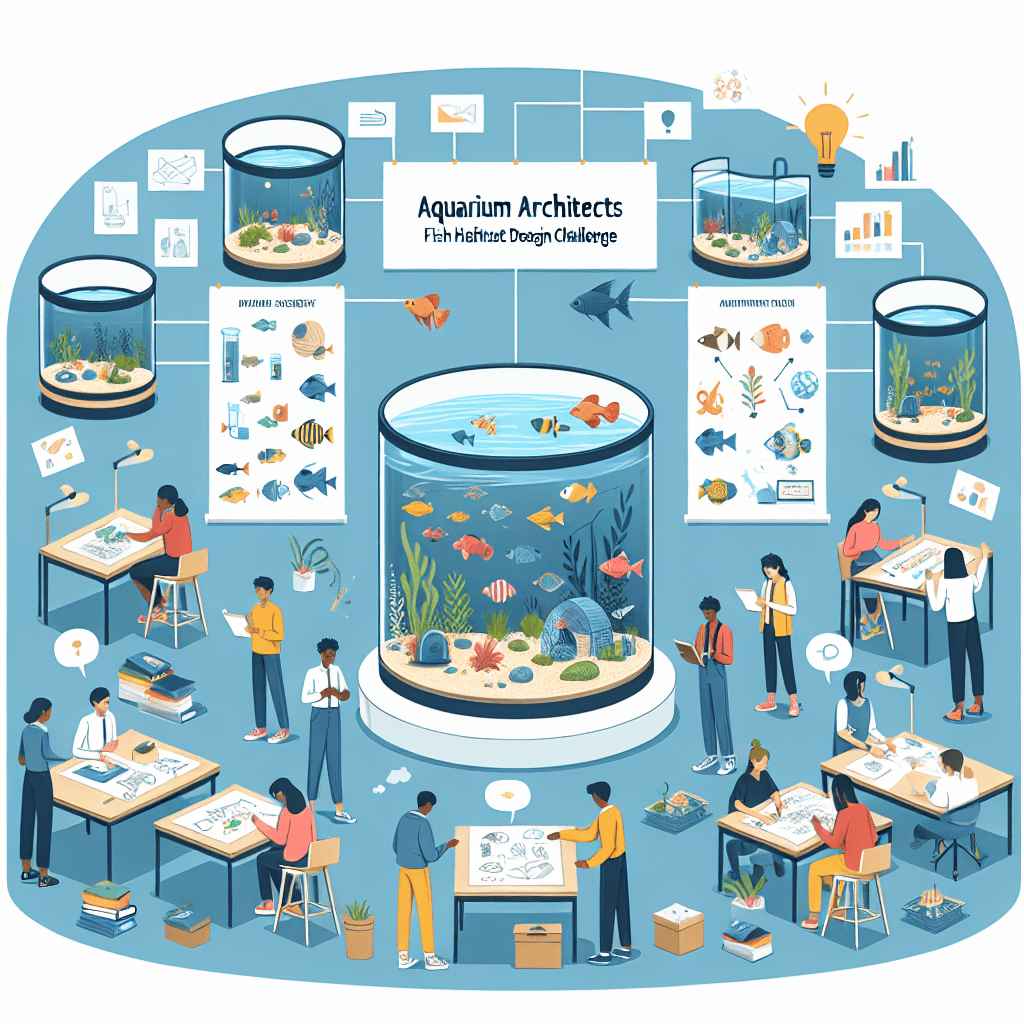
Inquiry Framework
Question Framework
Driving Question
The overarching question that guides the entire project.How can we, as aquarium architects, use our understanding of volume and mathematical calculations to design aquariums that not only meet the specific needs of various fish species but also ensure their health and well-being?Essential Questions
Supporting questions that break down major concepts.- How does understanding volume help in designing practical objects such as aquariums?
- What are the mathematical calculations required to ensure aquariums can sustain specific fish species?
- Why is it important to consider the volume and dimensions of an aquarium when designing for different types of fish?
- How can we apply mathematical concepts to solve real-world problems like designing an aquarium?
- In what ways does the shape of an aquarium affect the amount of water it can hold and the health of the fish?
Standards & Learning Goals
Learning Goals
By the end of this project, students will be able to:- Students will understand the concept of volume and how it is measured in cubic units.
- Students will be able to calculate the volume of rectangular prisms and apply this knowledge to solve real-world problems.
- Students will learn to design aquariums with specific volume requirements for various fish species, considering both mathematical and biological factors.
- Students will comprehend the connection between mathematical calculations and practical applications in designing safe and adequate habitats for aquatic life.
- Students will develop problem-solving skills by applying multiplication and addition to determine the appropriate dimensions and volume of aquariums.
Common Core State Standards
Entry Events
Events that will be used to introduce the project to studentsMystery Fish Rescue
Students enter the classroom to find a mysterious fish tank with a note: 'Help! I need a home!' Students must investigate the needs of the aquatic creature, determining the perfect tank size and design for its comfort and survival.Aquarium Designer Challenge
Present students with a surprise visit from a local aquarium who needs immediate help designing new tanks due to an unexpected fish delivery. Students must calculate and propose designs using their math skills.Aquatic Legends Story Time
Begin with storytelling about ancient underwater cities, inspiring students to become 'Aquarium Architects' who create mini aquatic worlds using their math skills to design the perfect space.Portfolio Activities
Portfolio Activities
These activities progressively build towards your learning goals, with each submission contributing to the student's final portfolio.Volume Exploration Expedition
Students embark on a hands-on exploration to understand the concept of volume through interactive activities that involve measuring and counting unit cubes.Steps
Here is some basic scaffolding to help students complete the activity.Final Product
What students will submit as the final product of the activityA set of three-dimensional shapes with calculated volume, presented to the class.Alignment
How this activity aligns with the learning objectives & standardsAligns with 5.MD.C.4 (Measure volumes by counting unit cubes, using cubic units).Shape Shifter Challenge
In this activity, students apply their understanding of volume to design aquariums with specific dimensions, solving real-world problems using their mathematical skills.Steps
Here is some basic scaffolding to help students complete the activity.Final Product
What students will submit as the final product of the activityDetailed aquarium design with calculated volume and presentation to peers.Alignment
How this activity aligns with the learning objectives & standardsAligns with 5.MD.C.4 and 5.MD.C.5 (Measure volumes and relate volume to operations of multiplication and addition).Aquarium Architect Showcase
Students finalize their aquarium designs and present their work in a gallery walk, demonstrating their mastery of volume calculations and the practical application of math.Steps
Here is some basic scaffolding to help students complete the activity.Final Product
What students will submit as the final product of the activityA three-dimensional model of an aquarium design, complete with volume calculations and a presentation.Alignment
How this activity aligns with the learning objectives & standardsAligns with 5.MD.C.4 and 5.MD.C.5 (Measure volumes, solve real-world problems involving volume, and relate it to multiplication and addition).Rubric & Reflection
Portfolio Rubric
Grading criteria for assessing the overall project portfolioAquarium Design and Volume Mastery Rubric
Volume Understanding
Assessment of students' comprehension of volume concepts and ability to measure volumes using unit cubes.Volume Measurement
Evaluates the ability to measure volume using unit cubes accurately.
Exemplary
4 PointsDemonstrates precise volume measurement using unit cubes, accurately explaining the process and results.
Proficient
3 PointsCorrectly measures volume using unit cubes with minor errors, showing clear understanding of the concept.
Developing
2 PointsMeasures volume with unit cubes inconsistently, displaying partial understanding and occasional errors.
Beginning
1 PointsStruggles with measuring volume using unit cubes, showing minimal understanding and frequent errors.
Volume Calculation
Assesses the application of mathematical operations to calculate volume for various shapes.
Exemplary
4 PointsCalculates volume accurately using multiplication and addition in complex shapes, providing thorough explanations.
Proficient
3 PointsAccurately calculates volume using multiplication and addition in most cases, with some explanation.
Developing
2 PointsAttempts volume calculation with incomplete or inconsistent use of operations, leading to some errors.
Beginning
1 PointsStruggles with calculating volume, showing limited use of multiplication and addition.
Design Application
Evaluates students' ability to apply volume knowledge in designing functional aquariums.Design Appropriateness
Assesses how well the aquarium design meets predetermined volume and biological needs.
Exemplary
4 PointsProduces an innovative aquarium design that perfectly suits the volume and biological requirements.
Proficient
3 PointsCreates a suitable aquarium design that meets volume and biological needs effectively.
Developing
2 PointsDesigns an aquarium with partial alignment to volume and biological needs, needing adjustments.
Beginning
1 PointsStruggles to incorporate volume and biological considerations into the design.
Model Accuracy
Evaluates the precision of 3D models compared to initial volume calculations.
Exemplary
4 Points3D model construction is highly accurate to initial calculations, demonstrating detailed verification.
Proficient
3 Points3D model closely matches initial volume calculations with minor discrepancies.
Developing
2 Points3D model and volume calculations present notable errors and require improvements.
Beginning
1 Points3D model construction lacks accuracy compared to volume calculations, showing minimal verification.
Presentation and Reflection
Assessment of students' ability to communicate their design process, findings, and reflections to peers and teachers.Presentation Clarity
Assesses the clarity and organization of the student's presentation during the gallery walk.
Exemplary
4 PointsPresents clearly and persuasively, with exceptional organization and engagement methods.
Proficient
3 PointsPresents information coherently with good organization and clear communication.
Developing
2 PointsPresentation lacks coherence or confident communication, with room for improvement.
Beginning
1 PointsStruggles to present ideas clearly, with limited organization and engagement.
Reflective Insights
Evaluates students' reflections on their learning process, challenges faced, and how they overcame them.
Exemplary
4 PointsReflects deeply on learning, articulating challenges and growth with insightful observations.
Proficient
3 PointsReflects adequately on learning processes, noting challenges and understanding gained.
Developing
2 PointsProvides limited reflections with general observations on learning challenges.
Beginning
1 PointsStruggles to reflect meaningfully on learning processes and challenges.