
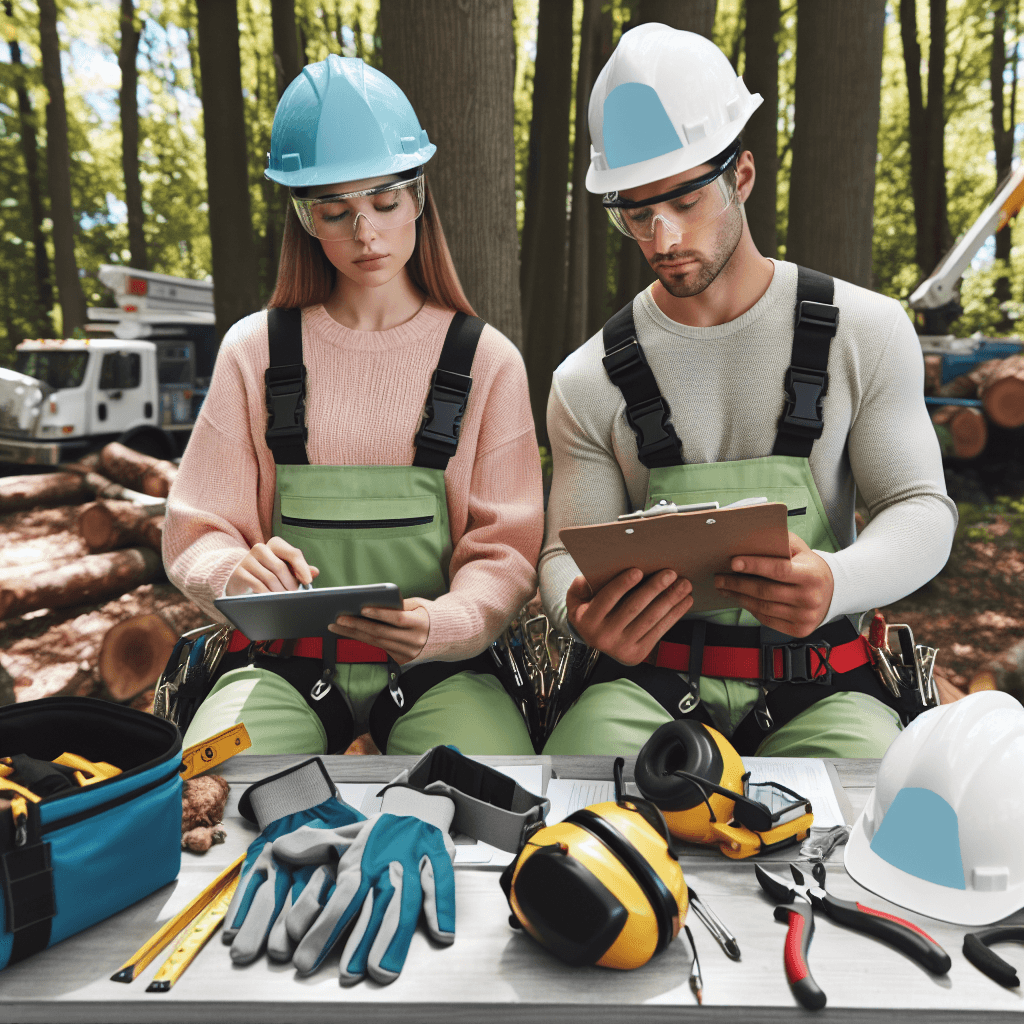
Arboriculture Safety: Conducting PPE Risk Assessments
Inquiry Framework
Question Framework
Driving Question
The overarching question that guides the entire project.How can we, as arboriculture safety officers, effectively conduct comprehensive risk assessments to identify potential hazards and determine the appropriate personal protective equipment (PPE) needed to ensure employee safety, while considering legal, ethical, and environmental factors?Essential Questions
Supporting questions that break down major concepts.- What are the various types of personal protective equipment (PPE) necessary for arboriculture work, and what specific risks do they mitigate?
- How do we assess arboriculture work environments to identify potential hazards that PPE would mitigate?
- In what ways can PPE reduce the risks of injury or health issues in the field of arboriculture, and what are its limitations?
- What are the legal and ethical considerations associated with ensuring employee safety through the proper use of PPE?
- How does the proper selection and use of PPE interact with other safety measures in arboriculture work to provide comprehensive risk management?
Standards & Learning Goals
Learning Goals
By the end of this project, students will be able to:- Identify and evaluate the types of personal protective equipment (PPE) necessary for different arboriculture tasks and the specific risks they mitigate.
- Conduct thorough risk assessments of arboriculture work environments to identify potential hazards and determine appropriate PPE.
- Analyze the effectiveness and limitations of PPE in mitigating risks of injury or health issues in arboriculture.
- Understand and apply legal, ethical, and environmental considerations in the selection and use of PPE for arboriculture work.
- Integrate PPE with other safety measures to implement comprehensive risk management strategies in arboriculture.
Occupational Safety and Health Administration (OSHA) Standards
American National Standards Institute (ANSI) Standards
Next Generation Science Standards (NGSS)
Common Core State Standards (CCSS) for English Language Arts & Literacy
Entry Events
Events that will be used to introduce the project to studentsVirtual Reality Injury Simulation
Create an immersive virtual experience simulating an accident in the arboriculture field where proper PPE was not worn. This experience would prompt learners to analyze what went wrong and encourage interactive discussions about the importance of PPE in preventing workplace accidents.Portfolio Activities
Portfolio Activities
These activities progressively build towards your learning goals, with each submission contributing to the student's final portfolio.Hazard Mapping Exercise
Learners will conduct a detailed risk assessment of an arboriculture work environment, identifying existing and potential hazards and the appropriate PPE to mitigate these risks.Steps
Here is some basic scaffolding to help students complete the activity.Final Product
What students will submit as the final product of the activityA detailed map and report of identified hazards in an arboriculture environment, along with matched PPE solutions.Alignment
How this activity aligns with the learning objectives & standardsSupports NGSS HS-ETS1-3 by evaluating real-world safety solutions and aligns with OSHA standards for risk assessment.PPE Efficacy Debate
Students will engage in a debate on the effectiveness and limitations of PPE. This activity will develop critical thinking about safety solutions in arboriculture, weighting their benefits against real-world constraints.Steps
Here is some basic scaffolding to help students complete the activity.Final Product
What students will submit as the final product of the activityA video recording of the debate, showcasing different viewpoints on PPE effectiveness.Alignment
How this activity aligns with the learning objectives & standardsConnects to CCSS.ELA-LITERACY.RST.11-12.9 by synthesizing and arguing diverse information sources around PPE.Safety Regulation Role-play
In this role-playing activity, students will simulate a meeting with safety officers discussing the legal, ethical, and environmental implications of PPE usage and compliance in arboriculture.Steps
Here is some basic scaffolding to help students complete the activity.Final Product
What students will submit as the final product of the activityA collaborative role-play session and follow-up report detailing the legal and ethical dimensions discussed in class.Alignment
How this activity aligns with the learning objectives & standardsAligns with OSHA, ANSI standards, and emphasizes legal and ethical aspects of PPE use, aiding in comprehensive understanding.Rubric & Reflection
Portfolio Rubric
Grading criteria for assessing the overall project portfolioArboriculture PPE Assessment Rubric
Risk Assessment and PPE Identification
Evaluates ability to identify potential hazards in arboriculture environments and propose appropriate PPE solutions.Hazard Identification
Accuracy and thoroughness in identifying potential hazards.
Exemplary
4 PointsIdentifies all potential hazards with detailed explanations, demonstrating a sophisticated understanding of their implications.
Proficient
3 PointsAccurately identifies most hazards and provides clear explanations.
Developing
2 PointsIdentifies some hazards but lacks thoroughness in explanations.
Beginning
1 PointsStruggles to identify hazards, with minimal explanation.
PPE Solution Proposal
Effectiveness in proposing suitable PPE solutions for identified hazards.
Exemplary
4 PointsProposes innovative and highly effective PPE solutions that reflect a deep understanding of the hazards.
Proficient
3 PointsProposes effective PPE solutions appropriate for most identified hazards.
Developing
2 PointsProposes basic PPE solutions that only partially address the hazards.
Beginning
1 PointsProposes inadequate PPE solutions that fail to address the hazards.
Analytical Skills and Critical Thinking
Assesses ability to critically analyze the effectiveness and limitations of PPE in arboriculture.Efficacy Argumentation
Strength and clarity of arguments regarding PPE effectiveness and limitations.
Exemplary
4 PointsPresents compelling, well-supported arguments with exceptional clarity and depth.
Proficient
3 PointsPresents clear arguments supported by relevant evidence.
Developing
2 PointsPresents arguments with some support, but lacks clarity or depth.
Beginning
1 PointsStruggles to present coherent arguments or lacks supporting evidence.
Legal, Ethical, and Environmental Considerations
Evaluates the understanding and integration of legal and ethical aspects in PPE usage.Compliance Understanding
Understanding of legal requirements and ethical considerations in PPE use.
Exemplary
4 PointsDemonstrates a comprehensive understanding of all legal and ethical issues with thoughtful integration into proposed solutions.
Proficient
3 PointsUnderstands key legal and ethical issues, integrating them appropriately into solutions.
Developing
2 PointsAcknowledges some legal and ethical issues but struggles to integrate them effectively.
Beginning
1 PointsShows minimal understanding of legal and ethical concerns, with little integration into solutions.
Collaboration and Communication
Evaluates participation in collaborative activities and effectiveness in communication.Team Collaboration
Contribution to group discussions and activities in a collaborative context.
Exemplary
4 PointsLeads discussions, fosters inclusive environment, and effectively integrates diverse perspectives.
Proficient
3 PointsActively participates, shares ideas, and respects diverse perspectives.
Developing
2 PointsParticipates in discussions but struggles to engage with diverse perspectives.
Beginning
1 PointsRarely participates or contributes minimally to group discussions.