
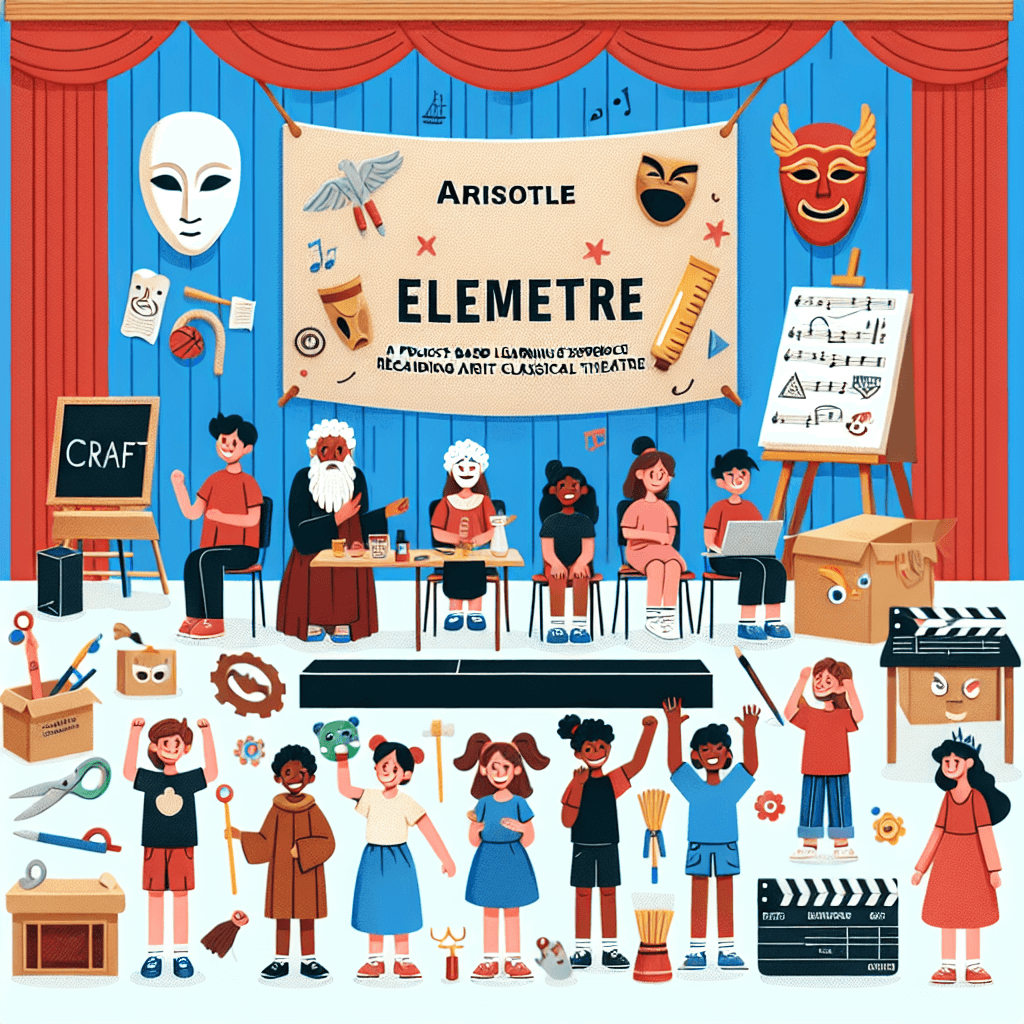
Aristotle's Elements: Crafting & Performing Original Theatre
Inquiry Framework
Question Framework
Driving Question
The overarching question that guides the entire project.How can we use Aristotle's elements of drama to write, stage, and perform a compelling original ten-minute theatre piece that effectively communicates characters' motivations and reactions?Essential Questions
Supporting questions that break down major concepts.- What are Aristotle's elements of drama and how can they be applied in writing a ten-minute theatre piece?
- How do the elements of plot structure influence the development and outcome of a theatrical scene?
Standards & Learning Goals
Learning Goals
By the end of this project, students will be able to:- Understand and apply Aristotle's elements of drama to develop a ten-minute theatre piece.
- Collaborate with peers to write and stage an original scene, demonstrating effective teamwork skills.
- Develop compelling characters with clear motivations and reactions through improvisation and scripted performance.
- Express a playwright’s intent using technical, vocal, and movement skills to enhance the performance.
- Critically analyze both individual and group performances to improve theatrical expression and production quality.
State Theatre Arts Standards
Entry Events
Events that will be used to introduce the project to studentsTime Travel Theatre
Students must travel back in time to consult with famous playwrights from different eras. They are given historical scenarios and artifacts, prompting them to rewrite and stage scenes based on Aristotelian principles that reflect different time periods. This exercise places drama in a historical context while challenging them to think creatively.Shadow Box Storytelling
Students open a large, mysterious shadow box in the center of the classroom, revealing different scenes and characters in shadow form. Each box tells part of a story, requiring students to use Aristotelian drama elements to piece together a cohesive plot and bring the shadows 'alive' through performance. This approach captivates interest through novelty and creativity.The Mysterious Playwright
Students arrive to class and find the room set up as if a detective's office. On the desk is a letter from a 'mysterious playwright' who requests their help to complete an incomplete script, challenging them to uncover the plot using Aristotle's elements of drama. This immersive experience draws students into the world of drama while immediately engaging their curiosity and critical thinking skills.Portfolio Activities
Portfolio Activities
These activities progressively build towards your learning goals, with each submission contributing to the student's final portfolio.Drama Elements Exploration
In this initial activity, students will dive into the foundational concepts of Aristotle's elements of drama. They will explore each element individually and understand how these can influence storytelling and character development.Steps
Here is some basic scaffolding to help students complete the activity.Final Product
What students will submit as the final product of the activityReflective journal entries identifying and explaining each element of drama.Alignment
How this activity aligns with the learning objectives & standardsAligns with HSP.1CR as it lays the foundation for identifying and understanding elements of plot structure.Character Depth Development
Students learn to create layered and engaging characters by examining their motivations and crafting realistic reactions. This encourages deep dives into character psyche, fostering empathy and creativity.Steps
Here is some basic scaffolding to help students complete the activity.Final Product
What students will submit as the final product of the activityDetailed character profiles including motivations and contrasting reactions.Alignment
How this activity aligns with the learning objectives & standardsCovers HSP.2CR through presenting contrasting motivations and reactions of characters.Plot Structure Storyboard
Students will storyboard a scene using Aristotle's elements, focusing on a coherent plot structure. This visual activity helps solidify their understanding of narrative flow and dramatic tension.Steps
Here is some basic scaffolding to help students complete the activity.Final Product
What students will submit as the final product of the activityAnnotated storyboard of an original scene using Aristotelian drama elements.Alignment
How this activity aligns with the learning objectives & standardsDirectly ties to HSP.1CR by integrating plot structure into student-created scenes.Designer Dialogue
This activity helps students to understand the role of various design disciplines in theatre, such as costume, set, and sound design, and how they support a cohesive theatrical production.Steps
Here is some basic scaffolding to help students complete the activity.Final Product
What students will submit as the final product of the activityA collaborative presentation of mood boards illustrating design concepts for a theatrical scene.Alignment
How this activity aligns with the learning objectives & standardsSupports HSP.4CR by distinguishing and discussing the roles of various design disciplines within theatre.Historical Context Investigation
Encouraging students to research and understand the historical and cultural background of different playwrights' works will aid in their interpretation and enhance their productions.Steps
Here is some basic scaffolding to help students complete the activity.Final Product
What students will submit as the final product of the activityPresentation linking historical context to interpretative choices in theatre.Alignment
How this activity aligns with the learning objectives & standardsFulfills HSP.5CR by situating scripts in their historical context as a basis for interpretation.Collaborative Scene Creation
In this activity, students collaborate in writing and performing an original theatrical scene, embodying a blended vision of their creative inputs.Steps
Here is some basic scaffolding to help students complete the activity.Final Product
What students will submit as the final product of the activityA collaboratively written and performed original scene.Alignment
How this activity aligns with the learning objectives & standardsAligns with HSP.6CR and HSP.2PE by fostering collaborative efforts in creating and producing a theatrical piece.Expressive Performance Techniques
Students will practice manipulating vocal qualities, posture, and movement to convey character diversity and emotional depth during performance.Steps
Here is some basic scaffolding to help students complete the activity.Final Product
What students will submit as the final product of the activitySkills demonstration in a short improvised scene emphasizing expressive techniques.Alignment
How this activity aligns with the learning objectives & standardsAddresses HSP.1PE by enhancing students' ability to express character variety through movement and voice.Technical Design and Direction
Students design lights, sounds, and set elements for a scene to understand how technical aspects support both storytelling and performance.Steps
Here is some basic scaffolding to help students complete the activity.Final Product
What students will submit as the final product of the activityDirected scene featuring student-designed technical elements such as lights and sound.Alignment
How this activity aligns with the learning objectives & standardsContributes to HSP.3PE by training students to incorporate technical designs into their dramatic scenes.Rubric & Reflection
Portfolio Rubric
Grading criteria for assessing the overall project portfolioAristotelian Theatre Creation Rubric
Understanding of Dramatic Elements
Evaluates how well students comprehend and apply Aristotle's elements of drama.Identification of Drama Elements
Ability to identify and explain Aristotle's elements of drama in scenes and performances.
Exemplary
4 PointsCorrectly identifies and provides sophisticated explanations of all drama elements with insightful analysis of their application.
Proficient
3 PointsAccurately identifies and explains most drama elements with clear examples in the context of a scene.
Developing
2 PointsIdentifies drama elements but with inconsistent or incomplete explanations.
Beginning
1 PointsStruggles to identify drama elements or provides minimal and inaccurate explanations.
Application of Plot Structure
Assesses how students structure their scenes and storyboards using dramatic elements.
Exemplary
4 PointsConstructs a compelling scene with a sophisticated plot structure that creatively integrates drama elements.
Proficient
3 PointsDevelops a coherent plot structure in scenes with appropriate integration of most drama elements.
Developing
2 PointsShows some plot coherence with limited application of dramatic elements, causing uneven story flow.
Beginning
1 PointsCreates a scene with minimal plot coherence and inadequate integration of drama elements.
Character and Performance Development
Measures how well students create and express characters with motivations and contrasting reactions.Character Development
Ability to develop well-rounded characters with clear motivations and contrasting reactions.
Exemplary
4 PointsCreates diverse characters with distinct, well-developed motivations and expertly crafted contrasting reactions.
Proficient
3 PointsDevelops characters with clear motivations and appropriate contrasting reactions, contributing to scene depth.
Developing
2 PointsCrafts characters with basic motivations and limited contrasting reactions that may lack complexity.
Beginning
1 PointsPresents characters with unclear motivations and minimal development of contrasting reactions.
Performance Techniques
Evaluates the use of vocal qualities, posture, and movement in conveying character and emotion.
Exemplary
4 PointsDemonstrates exceptional control of vocal and physical expression, effectively portraying diverse character emotions.
Proficient
3 PointsEffectively uses vocal and physical techniques to express character emotions and intentions consistently.
Developing
2 PointsDisplays basic vocal and physical expression with inconsistency in conveying character emotions.
Beginning
1 PointsShows minimal vocal and physical expression, struggling to convey character emotions.
Design and Technical Integration
Assesses the ability to integrate design elements into the theatrical production to support storytelling.Design Concept Execution
Ability to create and present design concepts (e.g., set, lighting, sound) that enhance storytelling.
Exemplary
4 PointsDevelops and executes innovative design concepts that significantly enrich the theatrical experience.
Proficient
3 PointsCreates design elements that effectively align with and support the scene and characters.
Developing
2 PointsPresents design concepts with partial alignment to scene goals, leading to inconsistencies.
Beginning
1 PointsOffers basic design concepts with minimal relevance to storytelling needs.
Collaboration and Historical Context
Evaluates the effectiveness of collaborative efforts and the integration of historical context in scene interpretation.Collaborative Scene Creation
Capability to work effectively in groups to create and perform a unified theatre piece.
Exemplary
4 PointsLeads group collaboration, ensuring a unified vision with effectively integrated contributions from all members.
Proficient
3 PointsWorks well in collaborative settings, contributing ideas that support a unified performance.
Developing
2 PointsEngages in basic collaboration with some disconnection in group vision and individual contributions.
Beginning
1 PointsParticipates minimally in group tasks, disrupting scene cohesion and shared vision.
Historical Contextualization
Ability to research and apply historical context to theatrical scene interpretation and presentation.
Exemplary
4 PointsProvides in-depth historical insight that profoundly enriches scene interpretation and performance delivery.
Proficient
3 PointsOffers well-researched historical context that clearly informs and enhances scene understanding.
Developing
2 PointsPresents historical context with limited depth, contributing inconsistently to scene interpretation.
Beginning
1 PointsSupplies vague or superficial historical connections with minimal impact on scene interpretation.