
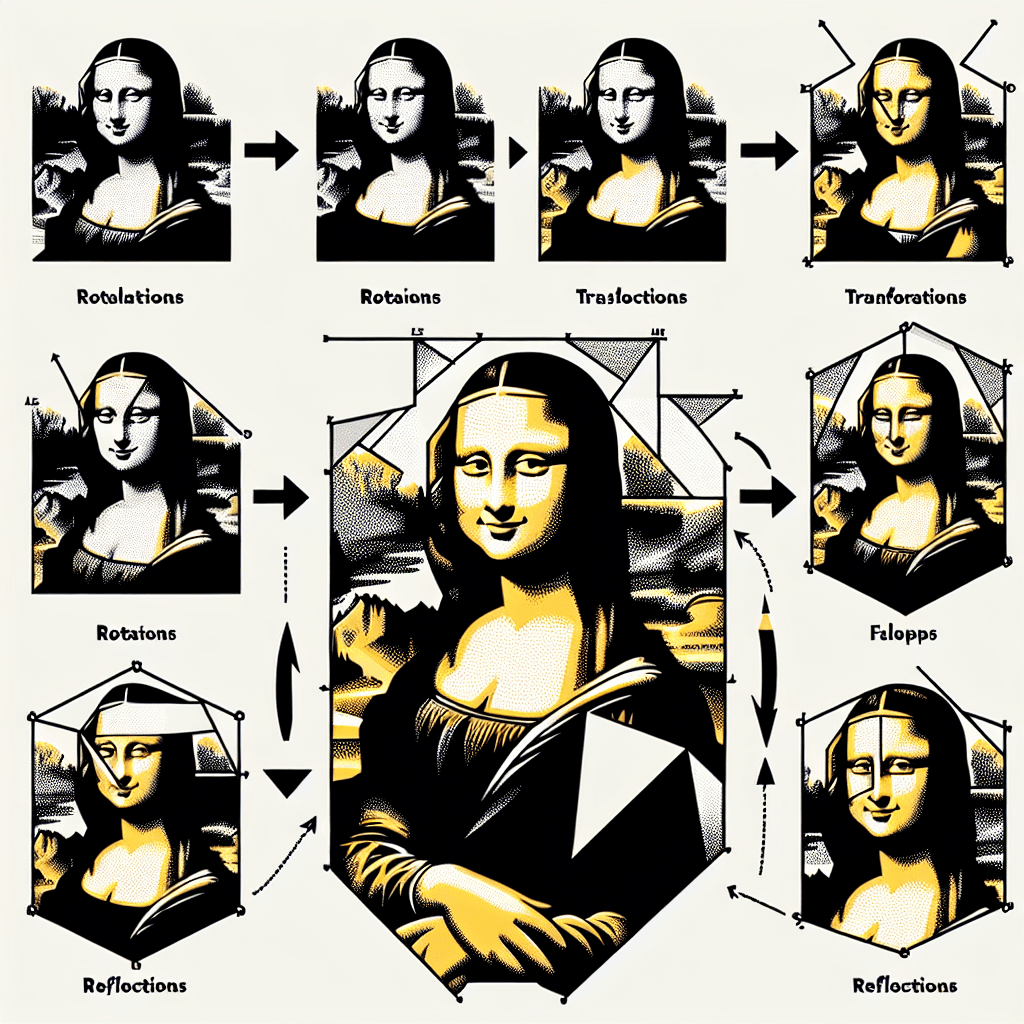
Art Transformation Through Geometric Transformations
Inquiry Framework
Question Framework
Driving Question
The overarching question that guides the entire project.How can students use geometric transformations to creatively recreate and understand the mathematical properties behind famous artworks, while exploring the concepts of similarity and congruence in two-dimensional figures?Essential Questions
Supporting questions that break down major concepts.- How can geometric transformations be applied to recreate and modify famous artworks?
- What is the relationship between congruence and transformations in geometric figures?
- How do transformations such as rotations, reflections, translations, and dilations affect a two-dimensional figure's properties?
- How can understanding transformations help in identifying similarity between two geometric figures?
- In what ways do transformations preserve certain properties of figures while changing others?
Standards & Learning Goals
Learning Goals
By the end of this project, students will be able to:- Students will be able to apply geometric transformations such as rotations, reflections, translations, and dilations to recreate famous artworks, demonstrating understanding of artistic modification using mathematics.
- Students will understand and describe the concept of similarity in geometric figures and how it relates to transformations by creating sequences to demonstrate similarity between figures.
- Students will identify and demonstrate congruence in two-dimensional figures through a series of transformations, providing evidence for congruence in their recreated artworks.
- Students will verify and explain the properties of geometric transformations, such as maintaining angles and parallel lines, through experimental recreation of artworks.
- Students will develop and refine their abilities to use mathematical reasoning to solve creative problems, merging art and math through the process of geometric transformation.
Common Core Standards
Entry Events
Events that will be used to introduce the project to studentsMuseum Heist Challenge
A fictional museum scenario where students must solve 'art heist' puzzles using geometric transformations. Each puzzle solved reveals how transformations can alter artwork dimensions without changing their congruence, leading to interactive learning about the properties of these mathematical concepts.Interactive Art Installations
An outdoor 'math-art park' is set up with installations that students can physically rotate, reflect, and translate. This tactile learning experience empowers students to understand geometric transformations by manipulating life-sized art forms, relating real-world actions to the abstract concepts studied in class.Art Studio Transformation
Students enter a recreated art studio where famous artworks are displayed alongside digital tools that show how these pieces can be altered using geometric transformations. They are tasked with creating their own 'transformed masterpieces' by selecting artworks and applying sequences of transformations to explore congruence and similarity.Portfolio Activities
Portfolio Activities
These activities progressively build towards your learning goals, with each submission contributing to the student's final portfolio.Transformation Verification Gallery
In the final activity, students will verify the properties of their transformations through a gallery exhibition where they explain their transformation process and its mathematical validity.Steps
Here is some basic scaffolding to help students complete the activity.Final Product
What students will submit as the final product of the activityA gallery exhibition and peer-review session of transformed art pieces with verified transformation properties.Alignment
How this activity aligns with the learning objectives & standardsEngages 8.G.A.1 by requiring students to experimentally verify the properties of their geometric transformations.Transformation Exploration Launchpad
Students will initially explore basic geometric transformations such as rotation, reflection, and translation through interactive digital tools. This foundation will enable them to later apply these concepts creatively to famous artworks.Steps
Here is some basic scaffolding to help students complete the activity.Final Product
What students will submit as the final product of the activityA digital portfolio of transformed geometric shapes with annotations explaining the transformation process.Alignment
How this activity aligns with the learning objectives & standardsCovers 8.G.A.1 by verifying properties of transformations through experimentation.Rubric & Reflection
Portfolio Rubric
Grading criteria for assessing the overall project portfolioGeometric Transformation in Art Rubric
Conceptual Understanding
Assesses student's understanding of geometric transformations and their effects on figures.Application of Transformations
Measures student's ability to apply sequences of rotations, reflections, translations, and dilations to demonstrate similarity and congruence in two-dimensional figures.
Exemplary
4 PointsClearly applies complex sequences of transformations consistently and accurately to recreate art pieces, demonstrating a deep understanding of similarity and congruence.
Proficient
3 PointsApplies appropriate sequences of transformations to recreate art pieces, demonstrating a solid understanding of similarity and congruence.
Developing
2 PointsApplies basic sequences of transformations with partial accuracy, showing some understanding of similarity and congruence.
Beginning
1 PointsStruggles to apply transformations accurately, showing minimal understanding of similarity and congruence.
Verification of Properties
Evaluates student's ability to verify and explain the mathematical properties preserved through transformations such as angles, parallelism, and congruency.
Exemplary
4 PointsThoroughly verifies all properties with clear and precise mathematical reasoning, demonstrating expert understanding.
Proficient
3 PointsVerifies key properties with clear mathematical reasoning, demonstrating solid understanding.
Developing
2 PointsVerifies some properties with basic reasoning, showing developing understanding.
Beginning
1 PointsMinimal verification of properties, showing little understanding.
Creative Application
Evaluates originality and creativity in the application of geometric transformations to create unique art pieces.Innovative Creativity
Assesses the extent to which students used geometric transformations creatively to alter and recreate artwork.
Exemplary
4 PointsInnovatively uses transformations to create unique and aesthetically pleasing artworks that effectively showcase mathematical concepts.
Proficient
3 PointsEffectively uses transformations to create appealing artworks with clear mathematical basis.
Developing
2 PointsAttempts to use transformations to create artwork with mixed success.
Beginning
1 PointsMinimal incorporation of transformations into artwork, with limited creativity.
Reflection and Communication
Assesses ability to reflect on and communicate the transformation process and its mathematical validity.Explanation of Process
Measures clarity and depth of student's explanation of their transformation sequences and verification of properties.
Exemplary
4 PointsProvides a detailed and insightful explanation of transformation process and properties, demonstrating deep understanding.
Proficient
3 PointsProvides clear explanation of transformation process and properties, demonstrating solid understanding.
Developing
2 PointsProvides basic explanation of transformation process with limited detail on properties.
Beginning
1 PointsLimited explanation of transformation process and properties, showing minimal understanding.