
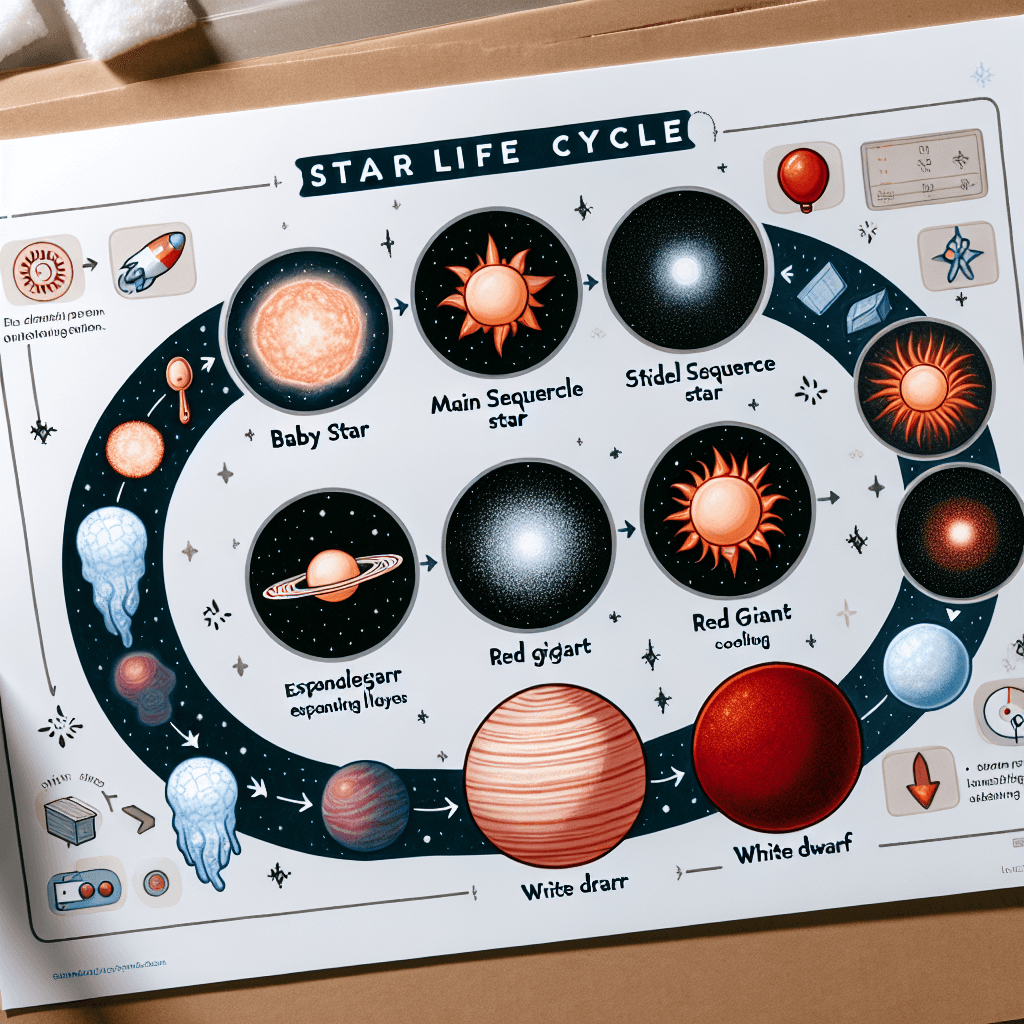
Astro-Puzzle: Star Life Cycle Exploration
Inquiry Framework
Question Framework
Driving Question
The overarching question that guides the entire project.How can we create an astro-puzzle that visually represents the full life cycle of stars while illustrating their classification and evolution based on the Hertzsprung-Russell diagram?Essential Questions
Supporting questions that break down major concepts.- What are the stages in the life cycle of a star?
- How can stars be classified based on their characteristics and position in the Hertzsprung-Russell diagram?
- What role does the mass of a star play in determining its life cycle and characteristics?
- How do different star classifications (e.g., main sequence, giant, dwarf) evolve over time?
- How does the Hertzsprung-Russell diagram help in understanding the evolution and classification of stars?
Standards & Learning Goals
Learning Goals
By the end of this project, students will be able to:- Students will be able to illustrate and explain the stages in the life cycle of a star.
- Students will compare and classify stars using the Hertzsprung-Russell diagram.
- Students will describe how the mass of a star influences its life cycle and characteristics.
- Students will analyze how different star classifications evolve over time.
- Students will interpret the Hertzsprung-Russell diagram to understand star classification and evolution.
Next Generation Science Standards
Entry Events
Events that will be used to introduce the project to studentsMission StarQuest: An Astronomical Escape Room
Students are challenged to solve an escape room featuring galactic scenarios based on the life cycle of stars. Puzzles include identifying different stages of a star’s life, matching stars to their positions on the Hertzsprung-Russell diagram, and unlocking mysteries of stellar evolution.Portfolio Activities
Portfolio Activities
These activities progressively build towards your learning goals, with each submission contributing to the student's final portfolio.Star Evolution Puzzle Creation
Students combine their understanding of star life cycles and the Hertzsprung-Russell diagram to create an informative puzzle for peers. This puzzle should illustrate the detailed evolution path of different star types, emphasizing stages and classifications.Steps
Here is some basic scaffolding to help students complete the activity.Final Product
What students will submit as the final product of the activityAn astro-puzzle that incorporates both a star's life cycle and its classification, ready to be solved by peers for review and feedback.Alignment
How this activity aligns with the learning objectives & standardsAligns with NGSS.MS-ESS1-3, as this model visually represents the link between stellar evolution and classification and supports NGSS.MS-ESS1-2 through model-based learning.Rubric & Reflection
Portfolio Rubric
Grading criteria for assessing the overall project portfolioAstro-Puzzle Star Life Cycle Rubric
Scientific Understanding
Evaluates the student's grasp of star life cycles, classification, and the ability to accurately represent these concepts in the puzzle.Accuracy of Star Life Cycles
Measures how well students detail the stages of a star's life cycle in the puzzle.
Exemplary
4 PointsThe puzzle precisely and comprehensively illustrates all major stages of star life cycles, showing exemplary detail and accuracy.
Proficient
3 PointsThe puzzle accurately illustrates most stages of star life cycles with considerable detail.
Developing
2 PointsThe puzzle illustrates some stages of the star life cycle but lacks significant details or accuracy.
Beginning
1 PointsThe puzzle provides minimal or incorrect illustrations of star life cycles.
Hertzsprung-Russell Diagram Usage
Assesses the student's ability to integrate the Hertzsprung-Russell diagram effectively in classifying and explaining star characteristics and life cycles.
Exemplary
4 PointsSuccessfully integrates the Hertzsprung-Russell diagram to classify stars with exceptional clarity and accuracy in the puzzle.
Proficient
3 PointsAccurately uses the Hertzsprung-Russell diagram to classify most stars, showing clear understanding in the puzzle.
Developing
2 PointsUses the Hertzsprung-Russell diagram with partial accuracy and understanding in classifying stars.
Beginning
1 PointsShows limited or incorrect use of the Hertzsprung-Russell diagram in star classification.
Creativity and Design
Evaluates the originality, creativity, and design quality of the puzzle, including the use and integration of interactive elements.Puzzle Design and Creativity
Assesses the creativity and innovation in the design and presentation of the puzzle.
Exemplary
4 PointsThe puzzle exhibits outstanding creativity and design, with innovative elements and exceptional visual appeal.
Proficient
3 PointsThe puzzle is creatively designed with clear effort in its presentation and visual appeal.
Developing
2 PointsThe puzzle shows some creativity but lacks distinctive features or visual appeal.
Beginning
1 PointsThe puzzle lacks creativity and fails to engage visually or conceptually.
Interactive Elements
Evaluates the inclusion and quality of interactive features to facilitate engagement and understanding.
Exemplary
4 PointsIncludes highly engaging and well-integrated interactive elements that enhance learning and engagement.
Proficient
3 PointsIncorporates interactive elements that effectively enhance the puzzle experience.
Developing
2 PointsIncludes some interactive elements, but they are not well integrated or engaging.
Beginning
1 PointsInteractive elements are underdeveloped or non-existent, offering little to no engagement.
Peer Collaboration and Feedback
Assesses the student's capacity to engage in peer review, exchange feedback, and collaborate effectively with others.Feedback Quality
Evaluates the constructiveness and insightfulness of feedback provided to peers.
Exemplary
4 PointsProvides thoughtful, detailed, and constructive feedback, helping peers improve their puzzles significantly.
Proficient
3 PointsGives clear and helpful feedback, contributing positively to peer improvements.
Developing
2 PointsOffers basic feedback that is somewhat helpful, but lacks depth or detail.
Beginning
1 PointsFeedback is minimal, vague, or non-constructive, with little help to peers.
Collaboration
Measures the effectiveness of student participation and cooperation during peer exchanges.
Exemplary
4 PointsActively collaborates with peers, demonstrating leadership and willingness to engage in problem-solving.
Proficient
3 PointsConsistently participates and collaborates well, contributing positively to peer activities.
Developing
2 PointsParticipates in collaboration but with limited engagement or contribution.
Beginning
1 PointsMinimal involvement in collaboration, relying on others to lead or contribute.