
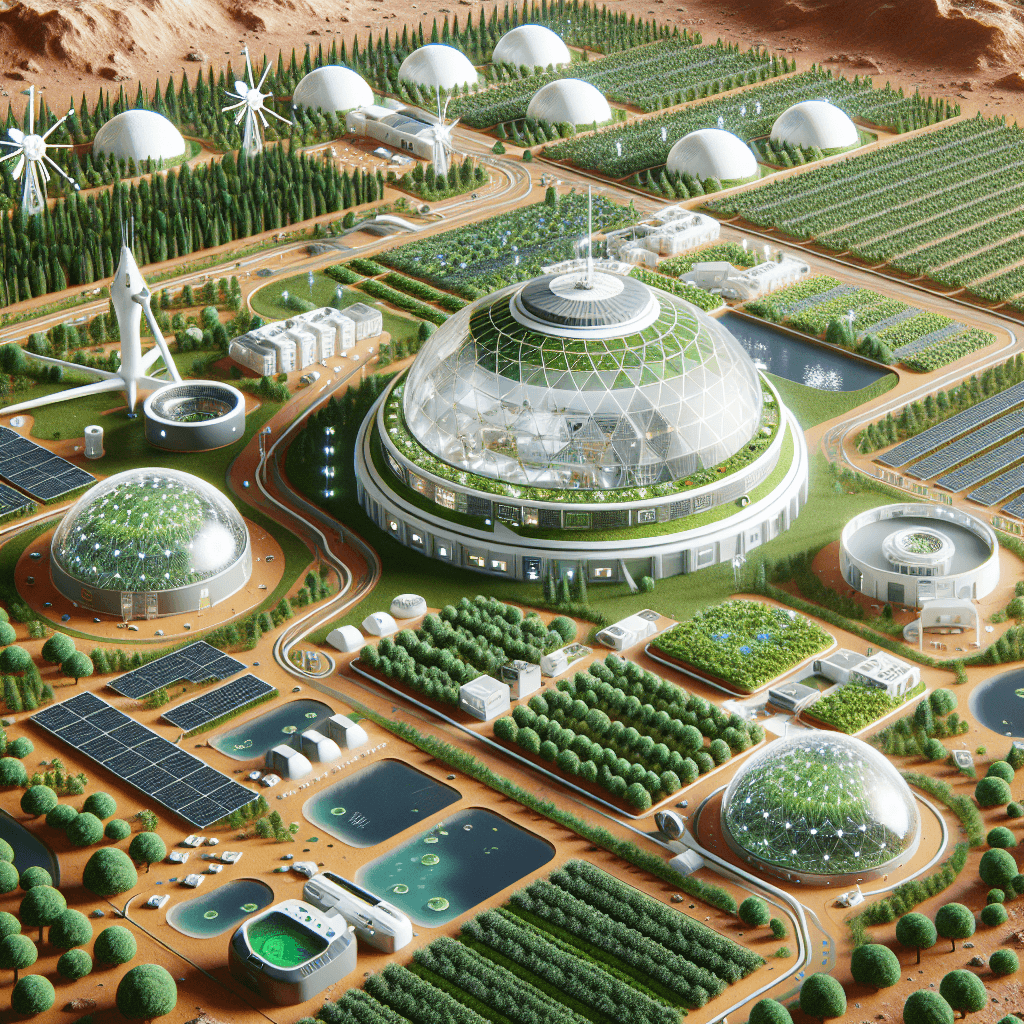
Atomic Architecture: Designing the First Sustainable Martian Colony
Inquiry Framework
Question Framework
Driving Question
The overarching question that guides the entire project.How can we leverage our knowledge of atomic structure and chemical interactions to design a self-sustaining Martian colony that transforms the planet’s raw resources into the materials, energy, and life-support systems needed for human survival?Essential Questions
Supporting questions that break down major concepts.- How does the structure of an atom and its position on the periodic table allow us to predict which elements will be most useful for building and sustaining a Martian colony?
- In what ways do the unique chemical and physical properties of water influence both the geological history of Mars and our strategies for extracting it for human use?
- How can we utilize our knowledge of chemical bonding and molecular structures to engineer materials that can withstand the extreme radiation and temperature fluctuations on Mars?
- How can the principles of the cycling of matter be applied to design a closed-loop system for recycling air, water, and waste in a space habitat?
- How do the nuclear processes that formed the elements in the universe dictate the availability of mineral resources on the Martian surface today?
- How can we predict the outcomes of chemical reactions between Martian soil (regolith) and Earth-based compounds to create essential supplies like oxygen and fuel?
Standards & Learning Goals
Learning Goals
By the end of this project, students will be able to:- Analyze periodic trends (electronegativity, ionization energy, and atomic radius) to predict the reactivity and suitability of specific elements for use in Martian construction, radiation shielding, and life-support electronics.
- Design and simulate chemical reaction pathways (such as the Sabatier process) that utilize Martian regolith and atmospheric CO2 to produce oxygen, water, and methane fuel.
- Evaluate the relationship between molecular-level structures and bulk-scale properties to select or engineer materials capable of withstanding Mars\' extreme temperature fluctuations and high UV radiation.
- Develop a quantitative model for a closed-loop life support system that demonstrates the conservation of mass while recycling carbon, hydrogen, and oxygen for human survival.
- Synthesize astronomical and geological data to explain the distribution of mineral resources on Mars based on stellar nucleosynthesis and the planet\'s unique geological history.
Next Generation Science Standards (NGSS)
Entry Events
Events that will be used to introduce the project to studentsThe Mars Real Estate Expo: Building from Nothing
Students are invited to a virtual 'Martian Real Estate Expo' where they must evaluate three different landing sites based on the geological and chemical data provided (ESS standards). However, they quickly discover that 'Earth-standard' materials (like steel or traditional plastics) are too heavy to transport, forcing them to brainstorm how to manipulate the atomic properties of Martian dust and thin atmosphere to 'grow' their own infrastructure.Portfolio Activities
Portfolio Activities
These activities progressively build towards your learning goals, with each submission contributing to the student's final portfolio.Structural Integrity: Atoms in the Extreme
On Mars, temperatures swing wildly and the vacuum is unforgiving. Students will investigate how different types of chemical bonds (ionic, covalent, metallic) and intermolecular forces (IMFs) dictate how materials behave at 'bulk scale.' They will specifically look at how water—essential for life—interacts with Martian regolith and how its unique hydrogen bonding affects its extraction.Steps
Here is some basic scaffolding to help students complete the activity.Final Product
What students will submit as the final product of the activityA 'Material Stress Test Lab Report' comparing the predicted vs. observed behavior of materials under Martian-simulated conditions.Alignment
How this activity aligns with the learning objectives & standardsAligns with HS-PS1-3 (Plan and conduct an investigation to infer the strength of electrical forces between particles) and HS-ESS2-5 (Properties of water and its effects on materials). It connects microscopic bonding to macroscopic structural integrity.Atomic Architect: The Master Colony Proposal
In the final activity, students synthesize everything they have learned into a formal proposal for the Martian colony. They must defend their choice of materials (for the habitat, the suits, and the electronics) by explicitly linking the molecular structure of those materials to their ability to function in high-radiation, low-pressure, and high-dust environments.Steps
Here is some basic scaffolding to help students complete the activity.Final Product
What students will submit as the final product of the activityThe 'First Martian Colony Master Proposal'—a multimedia presentation or technical document submitted to a mock NASA review board.Alignment
How this activity aligns with the learning objectives & standardsAligns with HS-PS2-6 (Communicate scientific and technical information about why molecular-level structure is important in the functioning of designed materials). This is the summative synthesis of the project.The Alchemist’s Periodic Table: Predicting Martian Reactivity
Students act as chemical engineers, using the periodic table as a 'cheat sheet' to predict which Martian elements will be most effective for specific needs. They will analyze periodic trends to justify why certain elements are better suited for conductors, radiation shielding, or chemical reactants than others.Steps
Here is some basic scaffolding to help students complete the activity.Final Product
What students will submit as the final product of the activityA 'Periodic Trend Procurement Report' that ranks Martian elements for specific engineering tasks (e.g., conductivity, reactivity, and stability).Alignment
How this activity aligns with the learning objectives & standardsDirectly aligns with HS-PS1-1 (Use the periodic table as a model to predict the relative properties of elements based on the patterns of electrons). It focuses on using trends like electronegativity and atomic radius to select materials for specific Martian applications.The Life-Support Lab: Engineering the Air We Breathe
Students must design the chemical heart of their colony: the Life Support System. They will focus on the Sabatier reaction (CO2 + H2 -> CH4 + H2O) and electrolysis (H2O -> H2 + O2) to create oxygen and fuel from the Martian atmosphere. They will explain these reactions at the atomic level, focusing on how valence electrons are rearranged.Steps
Here is some basic scaffolding to help students complete the activity.Final Product
What students will submit as the final product of the activityA 'Chemical Life-Support Blueprint' including balanced chemical equations and a molecular-level explanation of the energy and electron transfers involved.Alignment
How this activity aligns with the learning objectives & standardsAligns with HS-PS1-2 (Construct and revise an explanation for the outcome of a simple chemical reaction based on outermost electron states). This focuses on the practical application of chemical reactions for survival.Cosmic Prospectors: Mapping the Martian Mines
Before building, students must understand what resources are available and why. In this activity, students trace the 'cosmic history' of five key elements found on Mars (e.g., Iron, Silicon, Magnesium, Oxygen, and Carbon). They will research how these elements were created in stars and how Martian geological processes concentrated them in specific landing sites.Steps
Here is some basic scaffolding to help students complete the activity.Final Product
What students will submit as the final product of the activityAn interactive 'Martian Resource Map' and a 'Cosmic Origin Infographic' explaining the nucleosynthesis of their chosen elements.Alignment
How this activity aligns with the learning objectives & standardsAligns with HS-ESS1-2 (Explain the composition of matter in the universe based on stellar nucleosynthesis) and HS-ESS2-1 (Understand surface processes and mineral deposits). It helps students understand why certain elements are available on Mars today based on the life cycle of stars.Rubric & Reflection
Portfolio Rubric
Grading criteria for assessing the overall project portfolioMartian Horizon: Atomic Architecture & Systems Design Rubric
Atomic Properties & Periodicity
Assesses the ability to use the periodic table as a predictive tool for selecting chemical resources.Periodic Trend Analysis (HS-PS1-1)
Students use the periodic table as a model to predict properties and justify element selection for Martian tasks.
Exemplary
4 PointsIndependently analyzes 10+ elements using periodic trends (electronegativity, radius, ionization energy) to provide a sophisticated, evidence-based justification for choosing specific materials (e.g., Al vs. Fe) based on their atomic-level performance.
Proficient
3 PointsCorrectly identifies and compares periodic trends for 10 elements to rank their effectiveness for conductivity, reactivity, and stability in a Martian environment with clear scientific reasoning.
Developing
2 PointsIdentifies electron configurations and basic trends for elements but provides inconsistent or superficial justifications for how these properties influence Martian engineering applications.
Beginning
1 PointsLists basic element properties or electron configurations without connecting them to periodic trends or the practical needs of a Martian colony.
Chemical Transformations
Evaluates student understanding of chemical reactions, electron states, and mass conservation in survival systems.Reaction Modeling & Resource Production (HS-PS1-2)
Students design and explain chemical reactions (Sabatier, electrolysis) necessary for life support at the molecular level.
Exemplary
4 PointsConstructs a flawless chemical blueprint including balanced equations, precise mass calculations for crew survival, and a sophisticated explanation of valence electron rearrangement and energy transfer in reactions.
Proficient
3 PointsDevelops a complete life-support model showing the Sabatier process and electrolysis with correctly balanced equations and a clear explanation of how valence electrons form new covalent bonds.
Developing
2 PointsIdentifies the primary reactants and products for oxygen/fuel production but includes errors in chemical equations or provides a vague explanation of the molecular-level changes.
Beginning
1 PointsLists basic chemical components needed for survival but fails to model the reactions or explain the atomic-level changes involved in resource production.
Materials Science & Forces
Assesses the connection between microscopic bonding and the macroscopic performance of engineered materials.Intermolecular Forces & Bulk Behavior (HS-PS1-3, HS-PS2-6)
Students investigate and explain how molecular structures and intermolecular forces (IMFs) determine the integrity of materials in space.
Exemplary
4 PointsSynthesizes lab evidence to demonstrate how bonding and IMFs dictate material behavior in extreme cold/vacuum, providing an innovative defense of material choices for radiation shielding and structural resilience.
Proficient
3 PointsConducts a clear investigation of IMFs and bonding types, accurately predicting and observing how these forces influence bulk-scale properties like water expansion and thermal resistance on Mars.
Developing
2 PointsAttempts to categorize materials by bonding type and IMFs but struggles to connect these microscopic properties to macroscopic performance in simulated Martian conditions.
Beginning
1 PointsLists different types of chemical bonds but fails to investigate or explain their role in the structural integrity or bulk-scale behavior of Martian materials.
Cosmic & Planetary Systems
Evaluates the understanding of the cosmic origins of matter and the geological processes that shape planetary resources.Nucleosynthesis & Resource Mapping (HS-ESS1-2, HS-ESS2-1, HS-ESS2-5)
Students trace Martian mineral resources back to stellar nucleosynthesis and analyze planetary geology and water properties.
Exemplary
4 PointsCreates a comprehensive resource map and infographic that flawlessly connects the Big Bang and stellar fusion to the specific distribution and availability of mineral deposits and water on Mars today.
Proficient
3 PointsAccurately explains the nucleosynthesis of 5 key elements and identifies optimal landing sites based on geological data and the unique chemical properties of Martian water.
Developing
2 PointsIdentifies the origins of some elements in stars but provides a limited or disconnected analysis of how these elements became concentrated in Martian geological features.
Beginning
1 PointsProvides basic facts about stars or Martian rocks without demonstrating an understanding of how nucleosynthesis or geological processes dictate resource availability.
Synthesis & Engineering Design
Assesses the ability to communicate technical information and synthesize multiple scientific disciplines into a single design solution.Integrated Colony Proposal (Synthesis)
Students synthesize all scientific data into a cohesive, evidence-based proposal for a self-sustaining Martian habitat.
Exemplary
4 PointsPresents a masterful proposal featuring a rigorous closed-loop system and expert-level technical justifications, showing exceptional critical thinking in the integration of atomic science and survival engineering.
Proficient
3 PointsProduces a comprehensive multimedia proposal that clearly justifies material choices and system designs by linking them to the atomic-scale properties of Martian resources.
Developing
2 PointsSubmits a proposal that includes most required components but lacks a consistent or clear connection between scientific data and engineering decisions.
Beginning
1 PointsPresents an incomplete or superficial colony plan that does not use scientific evidence or atomic-scale properties to justify design choices.