
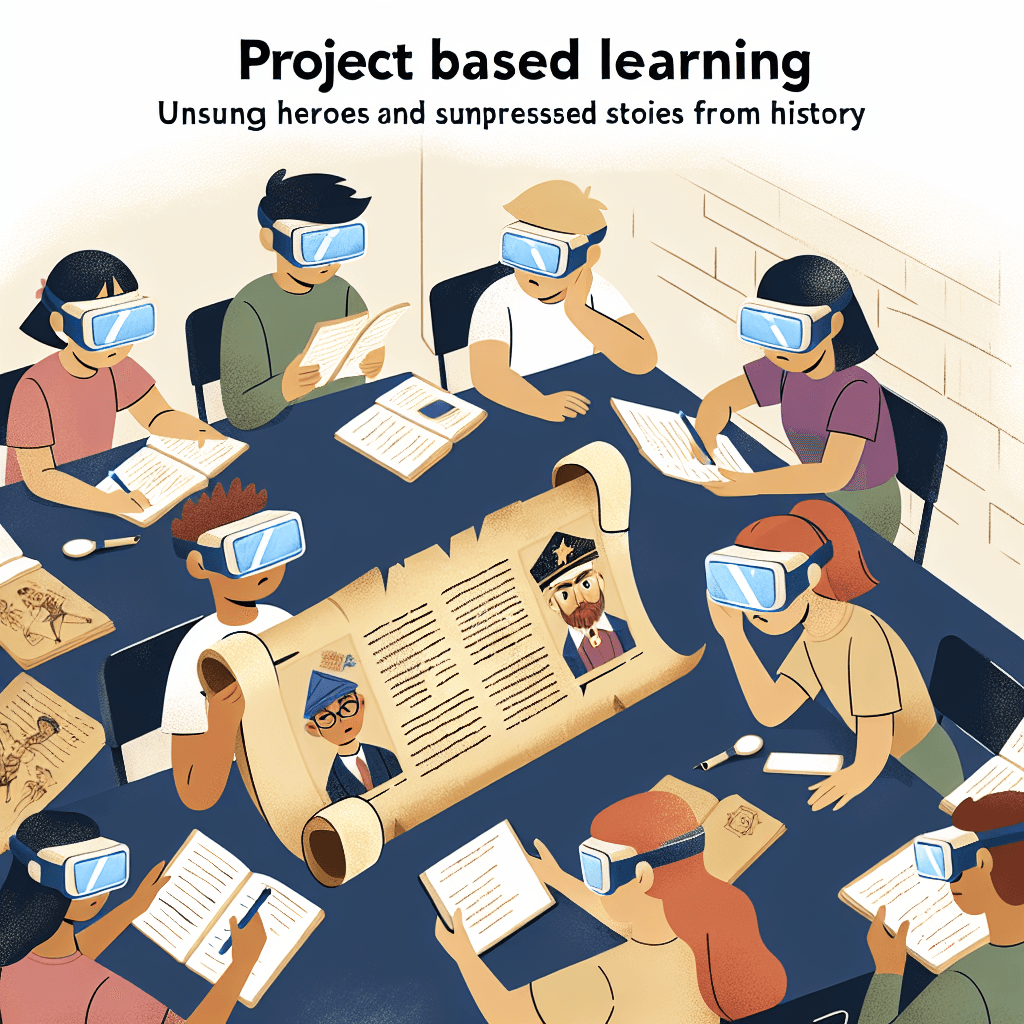
Augmented Voices: Bringing Suppressed Histories to Founding Documents
Inquiry Framework
Question Framework
Driving Question
The overarching question that guides the entire project.How can we design an Augmented Reality experience that uses America's founding documents to reveal the 'hidden' history of how suppressed voices challenged and redefined the meaning of citizenship from 1600 to 1877?Essential Questions
Supporting questions that break down major concepts.- How do the core principles found in documents like the Declaration of Independence and the Constitution (such as popular sovereignty and the rule of law) contrast with the legal restrictions placed on diverse groups between 1600 and 1877?
- In what ways did the 'unheard'—including enslaved people, women, and indigenous groups—challenge or re-interpret the founding documents to demand their rights as citizens?
- How did landmark Supreme Court cases and executive actions (like Marbury v. Madison or the Emancipation Proclamation) redefine who the government protected and who it excluded?
- How did the economic and social philosophies of the time influence which voices were amplified in government and which were suppressed?
- How can we use Augmented Reality to layer historical primary sources over modern contexts to reveal the 'hidden' history of our founding era?
Standards & Learning Goals
Learning Goals
By the end of this project, students will be able to:- Analyze fundamental documents (including the Declaration of Independence and the Constitution) to identify tensions between the principles of popular sovereignty and the legal restrictions placed on marginalized groups.
- Evaluate the strategies used by enslaved people, women, and indigenous groups to challenge constitutional provisions and advocate for expanded citizenship and voting rights between 1600-1877.
- Synthesize historical evidence from primary sources and landmark Supreme Court cases to explain how the definition of 'citizen' was redefined and contested over time.
- Design and develop an Augmented Reality (AR) experience that effectively layers historical primary sources over modern physical contexts to narrate a 'hidden' or 'suppressed' historical perspective.
- Compare and contrast the stated social and ideological philosophies of the founding era with the lived experiences of diverse groups to demonstrate an understanding of historical complexity.
Kentucky Academic Standards for Social Studies
Entry Events
Events that will be used to introduce the project to studentsThe Terms of Service Update
Students are asked to sign a new 'Classroom Constitution' to earn 'citizenship' points, only to find that the 'Terms and Conditions' (printed in tiny font or hidden in a QR code) exclude half the class based on arbitrary traits like shoe brand or eye color. This leads to a heated debate on the 1600-1877 restrictions on voting and citizenship and the 'patches' (amendments) needed to fix the system.Portfolio Activities
Portfolio Activities
These activities progressively build towards your learning goals, with each submission contributing to the student's final portfolio.Decoding the National 'Terms of Service'
In this introductory activity, students analyze the founding documents (Declaration of Independence, Preamble to the Constitution) through the lens of a 'Terms of Service' agreement. They will identify the core promises made (life, liberty, etc.) and then 'read the fine print' to discover who was legally excluded from these promises between 1600-1789.Steps
Here is some basic scaffolding to help students complete the activity.Final Product
What students will submit as the final product of the activityAn 'Annotated Promise Map' that highlights specific phrases in founding documents and links them to the groups of people who were legally denied those specific rights at the time of signing.Alignment
How this activity aligns with the learning objectives & standardsAligns with 8.C.CP.2 (Origins and structure of government) and 8.C.RR.2 (Restriction on citizenship). Students analyze the 'Terms of Service' of the early U.S. by comparing the high ideals of founding documents with the fine-print exclusions that limited citizenship.The Ghost in the Document: Primary Source Rebuttals
Students transition from looking at how groups were excluded to how those groups used the government's own language to demand inclusion. Each student/group selects one 'Unheard Voice' (e.g., Elizabeth Cady Stanton, Frederick Douglass, or a specific Indigenous leader) and analyzes a speech or petition that references a founding document to claim their rights.Steps
Here is some basic scaffolding to help students complete the activity.Final Product
What students will submit as the final product of the activityA 'Counter-Narrative Script' that identifies a specific founding document, the 'unheard' person responding to it, and the specific argument they used to demand citizenship.Alignment
How this activity aligns with the learning objectives & standardsAligns with 8.H.CH.6 (Impact of fundamental documents and speeches) and 8.C.RR.3 (How groups challenged Constitutional provisions). It specifically utilizes the required texts like Frederick Douglass’s speech and the Declaration of Rights of the Women of the United States.Augmented Reality: Framing the Hidden Narrative
Students begin the technical design of their AR experience. They will select a 'Trigger Image' (a physical copy of a founding document) and plan the 'Overlay' (the video, audio, or 3D assets that appear when the document is scanned). This brings the 'Unheard Voice' to life directly on top of the document that excluded them.Steps
Here is some basic scaffolding to help students complete the activity.Final Product
What students will submit as the final product of the activityA 'Production Storyboard' detailing the visual triggers, the audio script for the AR 'Ghost,' and the historical assets (images/maps) that will be layered in the digital experience.Alignment
How this activity aligns with the learning objectives & standardsAligns with 8.G.HE.1 (Technological changes influencing interaction) and 8.H.CH.6. Students use modern AR technology to change how people 'interact' with historical documents, layering the 'hidden history' over the 'official' text.The Unheard Voices Gallery Launch
In the final activity, students use an AR creation platform (like Reality Composer, Blippar, or Halo AR) to build and publish their experience. They will host a 'Living History Gallery' where classmates and community members use tablets/phones to scan 'founding documents' on the walls, revealing the AR voices of the unheard.Steps
Here is some basic scaffolding to help students complete the activity.Final Product
What students will submit as the final product of the activityA fully functional Augmented Reality Experience and a 'Reflective Curator’s Statement' explaining how their project answers the driving question.Alignment
How this activity aligns with the learning objectives & standardsSynthesizes all standards, particularly 8.C.RR.2, 8.C.RR.3, and 8.H.CH.6. It requires students to demonstrate their analysis of citizenship and the impact of fundamental documents through a technological medium.Rubric & Reflection
Portfolio Rubric
Grading criteria for assessing the overall project portfolioAugmented History: The Unheard - Portfolio Assessment Rubric
Historical Literacy and Civic Inquiry
This category assesses the student's ability to analyze historical documents and the evolution of citizenship rights.Analysis of Founding Documents and Citizenship Exclusions
Analyzes the tension between the high ideals of founding documents (Declaration of Independence, Preamble) and the legal restrictions/exclusions placed on diverse groups (enslaved people, women, indigenous groups) between 1600-1877.
Exemplary
4 PointsDemonstrates a sophisticated understanding by identifying nuanced legal 'fine print' and providing complex analysis of how document language specifically excluded groups while claiming universal rights. Analysis is deeply rooted in 8.C.RR.2 and 8.C.CP.2.
Proficient
3 PointsDemonstrates a thorough understanding of the contradictions between founding ideals and the legal realities of the time. Clearly identifies specific exclusions for diverse groups with accurate historical citations.
Developing
2 PointsShows emerging understanding of document exclusions. Identifies some groups who were denied rights but may lack specific legal citations or evidence of how the 'fine print' functioned.
Beginning
1 PointsShows initial understanding but struggles to identify specific legal exclusions. Work is incomplete or contains significant historical inaccuracies regarding the status of suppressed groups.
Counter-Narrative Development and Advocacy Analysis
Evaluates how 'unheard' voices (e.g., Douglass, Stanton, Indigenous leaders) used the language of founding documents to challenge Constitutional provisions and demand inclusion.
Exemplary
4 PointsProvides a powerful, innovative counter-narrative that expertly synthesizes primary source rebuttals with founding principles. The 'Ghost Script' shows deep empathetic and intellectual engagement with the historical figure's argument.
Proficient
3 PointsEffectively analyzes a primary source rebuttal (like Douglass's Fourth of July speech) and identifies the specific founding principle used as leverage for the argument. The script is clear and historically grounded.
Developing
2 PointsIdentifies a historical figure and a relevant document, but the argument for citizenship is basic or inconsistently linked to the founding principles. The script lacks historical depth.
Beginning
1 PointsStruggles to identify how historical groups challenged the law. The script is minimal, lacks a clear historical voice, or fails to reference founding documents.
Technological Synthesis and Communication
This category assesses the student's ability to use modern technology to communicate complex historical narratives.AR Technical Design and Narrative Layering
Plans and executes a digital AR experience that layers historical 'hidden' narratives over physical primary source documents to reveal suppressed perspectives.
Exemplary
4 PointsCreates an outstanding AR experience where the digital overlay (audio/visual) provides a seamless and profound 'hidden' history. The storyboard shows advanced technical planning and creative use of triggers.
Proficient
3 PointsDevelops a functional AR experience that clearly links a 'Trigger Image' to a relevant counter-narrative. The storyboard is complete and details the user experience effectively.
Developing
2 PointsProduces a basic AR experience or storyboard. The link between the 'Trigger Image' and the 'Overlay' may be weak or the technical execution shows partial skill integration.
Beginning
1 PointsThe AR experience or storyboard is incomplete or non-functional. The overlay provides little to no historical context or fails to address the 'hidden' narrative.
Synthesis and Curatorial Reflection
Synthesizes historical evidence and technological design to answer the driving question: How can we use AR to reveal the 'hidden' history of our founding era?
Exemplary
4 PointsThe Curator’s Statement and final product provide a sophisticated synthesis of how technology transforms our interaction with history. It offers a compelling answer to the driving question with exceptional clarity.
Proficient
3 PointsThe Curator’s Statement clearly explains the historical significance of the chosen voice and how the AR project addresses the driving question and historical complexity.
Developing
2 PointsThe Curator’s Statement provides a basic explanation of the project but lacks depth in explaining how the AR technology specifically helps reveal 'hidden' history.
Beginning
1 PointsThe Curator’s Statement is missing or fails to explain the historical significance of the project or its connection to the driving question.