
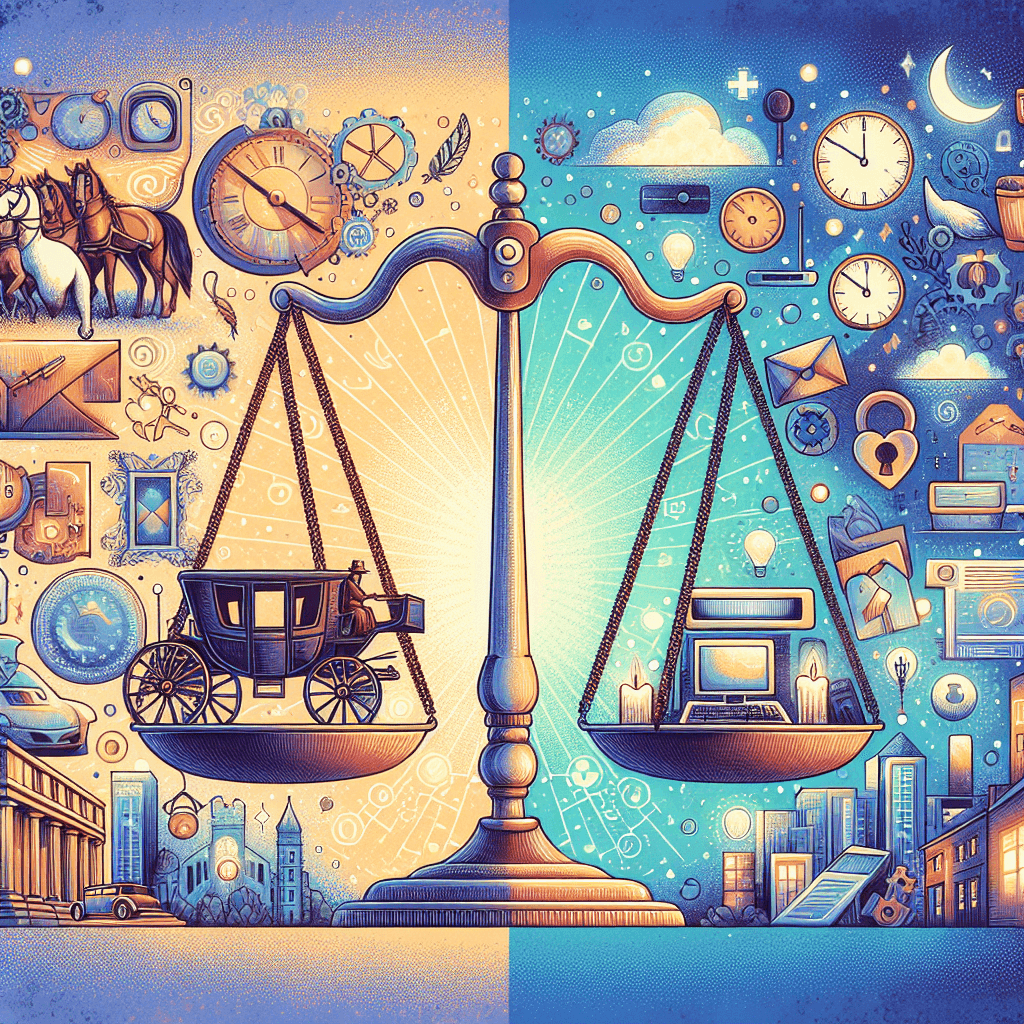
Balancing Tradition and Modernity in Society
Inquiry Framework
Question Framework
Driving Question
The overarching question that guides the entire project.How can a country find a harmonious balance between preserving its cultural traditions and embracing modernity in aspects such as technology, daily life, and the global landscape?Essential Questions
Supporting questions that break down major concepts.- What are the key components that define a culture's tradition?
- How does modernity influence cultural practices?
- In what ways can countries preserve their traditions while embracing modern technology?
- What are some examples of countries successfully balancing tradition and modernity?
- How do historical events shape the relationship between tradition and modernity?
- What role does technology play in shaping modern cultural practices?
- In what ways can literature reflect the balance between tradition and modernity?
Standards & Learning Goals
Learning Goals
By the end of this project, students will be able to:- Analyze the influence of modern technology on traditional cultural practices.
- Evaluate historical events and their impact on the relationship between tradition and modernity.
- Develop arguments to support a position on how a country can balance tradition and modernity.
- Examine examples of countries that have successfully balanced tradition and modernity to gain insights.
- Explore literature as a medium to understand the interplay of tradition and modernity.
Common Core State Standards - English/Language Arts
C3 Framework for Social Studies State Standards
ISTE Standards for Students
Entry Events
Events that will be used to introduce the project to studentsDigital Time Capsule Project
Students will create a 'digital time capsule' to reflect what they believe are essential aspects of today’s culture that blend tradition and modernity. This project invites them to make predictions about the future while considering how current global cultures manage this balance.Portfolio Activities
Portfolio Activities
These activities progressively build towards your learning goals, with each submission contributing to the student's final portfolio.Tradition vs. Modernity Treasure Hunt
Students will go on a cultural exploration to identify aspects of tradition and modernity within their own communities. This will involve gathering examples and evidence of both elements coexisting and noting their observations.Steps
Here is some basic scaffolding to help students complete the activity.Final Product
What students will submit as the final product of the activityA presentation that includes photographs, notes, and a reflection on the balance of tradition and modernity observed in their assigned area.Alignment
How this activity aligns with the learning objectives & standardsAligns with D2.Civ.7.6-8 as it involves exploration of civic virtues and societal elements that balance tradition and modernity.Text Analysis Summit
Students will delve into texts that discuss the balance of tradition and modernity in various cultures, identifying central ideas and analyzing their development.Steps
Here is some basic scaffolding to help students complete the activity.Final Product
What students will submit as the final product of the activityAn annotated bibliography with summaries and identified central ideas about tradition and modernity from each text.Alignment
How this activity aligns with the learning objectives & standardsMeets CCSS.ELA-LITERACY.RI.7.2 by having students analyze texts to find central ideas and summarize them.Tech Impact Investigators
Students will investigate how modern technology influences culture and traditional practices. This activity encourages them to evaluate technology's role in shaping, preserving, or altering traditions.Steps
Here is some basic scaffolding to help students complete the activity.Final Product
What students will submit as the final product of the activityA report detailing the influence of selected technologies on cultural practices, with interviews and data analysis included.Alignment
How this activity aligns with the learning objectives & standardsSupports ISTE.7.d by having students assess technology's role in culture.Country Case Studies
Students will research examples of countries that have successfully balanced tradition and modernity, drawing insights into practical strategies.Steps
Here is some basic scaffolding to help students complete the activity.Final Product
What students will submit as the final product of the activityA comparative analysis of case studies from selected countries, showcasing successful strategies for balancing tradition and modernity.Alignment
How this activity aligns with the learning objectives & standardsReinforces D2.Civ.7.6-8 as it involves exploring civic engagement and governance strategies for balance.Literary Reflections
Students explore literature that captures the themes of tradition and modernity, analyzing how authors present these themes and reflect societal changes.Steps
Here is some basic scaffolding to help students complete the activity.Final Product
What students will submit as the final product of the activityA collection of reflective essays analyzing the portrayal of tradition and modernity in literature.Alignment
How this activity aligns with the learning objectives & standardsConnects to CCSS.ELA-LITERACY.W.7.1 by facilitating argument writing based on literary analysis.Rubric & Reflection
Portfolio Rubric
Grading criteria for assessing the overall project portfolioBalancing Tradition and Modernity Portfolio Activities Rubric
Research and Inquiry
This category evaluates the student's ability to conduct thorough research, use a variety of sources, and inquire into the balance of tradition and modernity.Research Skills
Assesses the ability to gather, analyze, and synthesize information from diverse sources.
Exemplary
4 PointsDemonstrates advanced research skills by effectively gathering, analyzing, and synthesizing information from a wide range of reliable sources.
Proficient
3 PointsDemonstrates thorough research skills by gathering, analyzing, and synthesizing information from various reliable sources.
Developing
2 PointsShows basic research skills by gathering information from limited sources with minimal analysis and synthesis.
Beginning
1 PointsStruggles with gathering and analyzing information, relying primarily on minimal or unreliable sources.
Inquiry Engagement
Assesses engagement in the inquiry process, including question formulation and exploration depth.
Exemplary
4 PointsEngages deeply in the inquiry process, formulating insightful questions and exploring them with depth and creativity.
Proficient
3 PointsEngages satisfactorily in the inquiry process, formulating relevant questions and exploring them adequately.
Developing
2 PointsShows emerging inquiry skills, with limited question formulation and exploration depth.
Beginning
1 PointsStruggles with formulating and exploring questions, lacking depth and creativity.
Content Understanding
This category evaluates the student's understanding of how tradition and modernity interact, impact, and balance each other in various contexts.Understanding of Tradition and Modernity
Assesses the extent and depth of understanding regarding the interaction between tradition and modernity.
Exemplary
4 PointsDemonstrates a sophisticated understanding of the interaction between tradition and modernity, showing nuanced insights and strong evidence of balance.
Proficient
3 PointsDemonstrates thorough understanding of the interaction between tradition and modernity, with clear examples and evidence of balance.
Developing
2 PointsShows basic understanding of the interaction between tradition and modernity, with limited examples and evidence.
Beginning
1 PointsShows limited understanding of the interaction between tradition and modernity, struggling to provide examples or evidence.
Application of Concepts
Assesses how well the student can apply concepts related to tradition and modernity to real-world scenarios.
Exemplary
4 PointsExpertly applies concepts related to tradition and modernity to real-world scenarios with innovative solutions and perspectives.
Proficient
3 PointsApplies concepts related to tradition and modernity to real-world scenarios in a meaningful way.
Developing
2 PointsApplies concepts related to tradition and modernity to real-world scenarios with some inconsistencies.
Beginning
1 PointsStruggles with applying concepts to real-world scenarios, showing limited understanding or insight.
Communication and Presentation
This category evaluates how effectively the student communicates and presents their findings, demonstrating understanding and insight.Clarity and Organization
Assesses clarity and organization in communication and presentation.
Exemplary
4 PointsPresents findings with exceptional clarity and organization, using effective visuals and coherent structures.
Proficient
3 PointsPresents findings clearly and in an organized manner, adequately using visuals and coherent structures.
Developing
2 PointsPresents findings with some clarity and organization, but with occasional lapses or unclear sections.
Beginning
1 PointsStruggles with clarity and organization, making it difficult for the audience to follow.
Use of Evidence
Assesses the use of evidence to support conclusions and arguments.
Exemplary
4 PointsUses compelling and varied evidence to support conclusions and arguments, making insightful connections.
Proficient
3 PointsUses adequate and relevant evidence to support conclusions and arguments.
Developing
2 PointsUses limited evidence to support conclusions, with some connections unclear or underdeveloped.
Beginning
1 PointsStruggles to use evidence to support conclusions, with insufficient or irrelevant connections.