
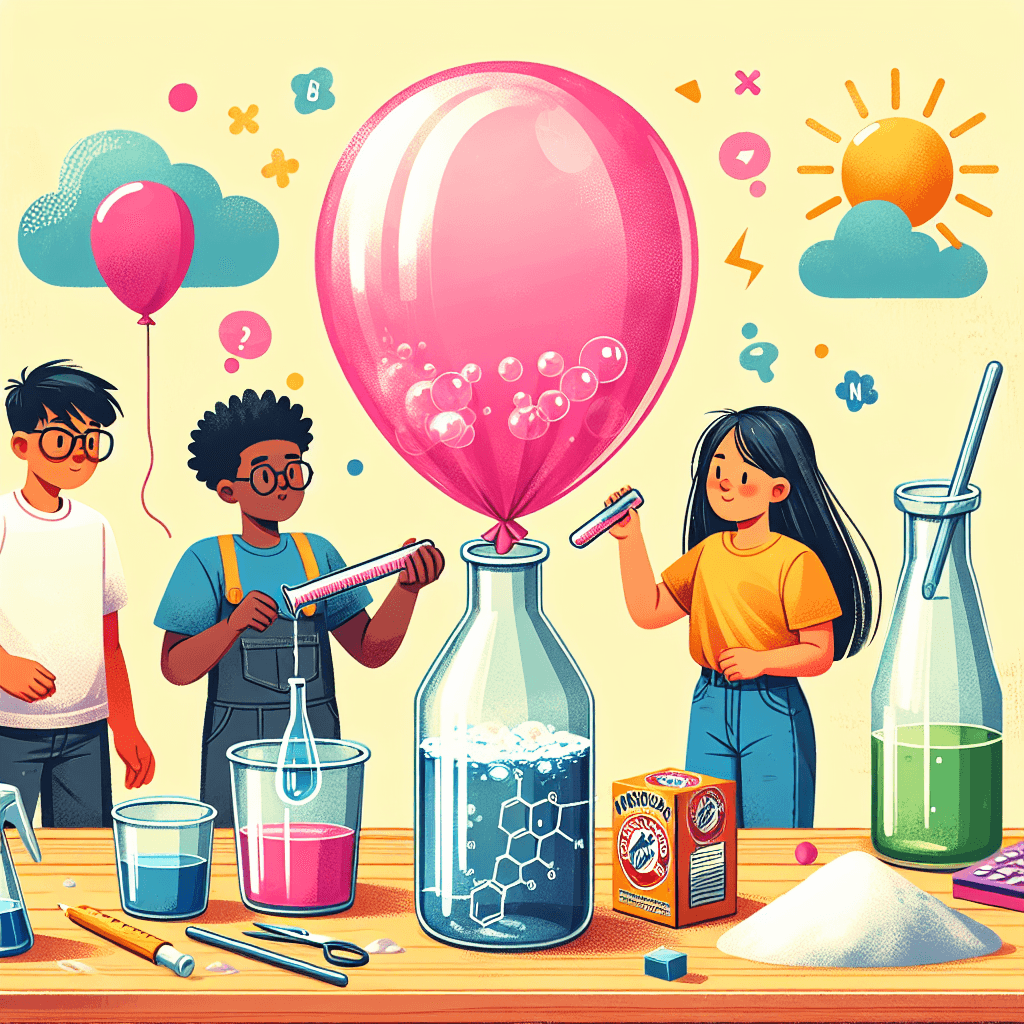
Balloon Inflation: A Chemical Reaction Experiment
Inquiry Framework
Question Framework
Driving Question
The overarching question that guides the entire project.How can we design an experiment to create and measure a gas using different materials, and how will we know when a gas is created?Essential Questions
Supporting questions that break down major concepts.- How do we know when a gas is created?
- What materials can be mixed to create a gas?
- How can we measure the amount of gas that is created?
Standards & Learning Goals
Learning Goals
By the end of this project, students will be able to:- Students will be able to design and conduct an experiment using the scientific method.
- Students will be able to identify a chemical reaction that produces carbon dioxide gas.
- Students will be able to measure the amount of gas produced in a chemical reaction.
Objective
Entry Events
Events that will be used to introduce the project to studentsMystery Balloon Inflation
A deflated balloon mysteriously inflates on its own in front of the students, sparking curiosity. Students investigate the materials used and propose initial hypotheses about the cause, connecting to chemical reactions and gas production.Artful Reactions
Students explore the creation of 'balloon art' using gas-producing chemical reactions to inflate balloons of different shapes and sizes. They investigate how varying the amounts of reactants affects the outcome, blending science with artistic expression and exploring the properties of matter.Portfolio Activities
Portfolio Activities
These activities progressively build towards your learning goals, with each submission contributing to the student's final portfolio.Material Properties Observer
Students begin by exploring various materials, focusing on their observable properties. This activity builds a foundational understanding for designing their gas-producing experiment.Steps
Here is some basic scaffolding to help students complete the activity.Final Product
What students will submit as the final product of the activityA detailed chart classifying materials by their observable properties, including written descriptions and illustrations.Alignment
How this activity aligns with the learning objectives & standardsAligns with PS1-1 by focusing on describing and classifying materials by their observable properties (color, texture, hardness, and flexibility).Gas Creation Station: Initial Experiment Design
Students design their first experiment to produce a gas. They will focus on the scientific method by forming a hypothesis and creating a step-by-step plan.Steps
Here is some basic scaffolding to help students complete the activity.Final Product
What students will submit as the final product of the activityA written experiment design, including a hypothesis, list of materials, and a detailed procedure.Alignment
How this activity aligns with the learning objectives & standardsAligns with PS1-1 by planning an investigation to test different solids and liquids to create a gas and introducing the scientific method.The Carbon Dioxide Chronicle
Students conduct the experiment they designed, focusing on observation and data collection to determine if a chemical reaction occurred, leading to gas production.Steps
Here is some basic scaffolding to help students complete the activity.Final Product
What students will submit as the final product of the activityA scientific journal entry documenting the experiment, including the procedure followed, observations made, and whether a gas was produced. Include drawings of the experiment setup and results.Alignment
How this activity aligns with the learning objectives & standardsAligns with PS1-1 by conducting an investigation to test different solids and liquids to create a gas and observing the results.Measuring the Invisible: Gas Volume Challenge
Students explore ways to measure the amount of gas produced in their experiment. This introduces basic measurement skills within the scientific context.Steps
Here is some basic scaffolding to help students complete the activity.Final Product
What students will submit as the final product of the activityAn updated scientific journal entry including the measurements of the gas produced, with a description of the measurement method used.Alignment
How this activity aligns with the learning objectives & standardsExtends PS1-1 by focusing on measuring the amount of gas produced, adding a quantitative element to their investigation.Rubric & Reflection
Portfolio Rubric
Grading criteria for assessing the overall project portfolioExperiment Design and Gas Creation Rubric
Experiment Design
Focuses on the clarity, completeness, and scientific soundness of the experiment design.Hypothesis Formulation
Assesses the clarity and testability of the student's hypothesis.
Exemplary
4 PointsThe hypothesis is clearly stated, testable, and logically connected to the materials and procedure. It demonstrates a sophisticated understanding of cause and effect.
Proficient
3 PointsThe hypothesis is clearly stated and testable. It is reasonably connected to the materials and procedure.
Developing
2 PointsThe hypothesis is present but may be unclear or difficult to test. The connection to the materials and procedure is weak.
Beginning
1 PointsThe hypothesis is missing or not testable. There is no clear connection to the materials and procedure.
Procedure Clarity
Evaluates the completeness and clarity of the experiment's step-by-step procedure.
Exemplary
4 PointsThe procedure is detailed, clear, and easy to follow. It includes all necessary steps and controls for potential variables. Demonstrates meticulous planning.
Proficient
3 PointsThe procedure is clear and easy to follow. It includes most necessary steps and considers some potential variables.
Developing
2 PointsThe procedure is somewhat unclear or incomplete. Some steps may be missing or difficult to understand. Potential variables are not addressed.
Beginning
1 PointsThe procedure is unclear, incomplete, and difficult to follow. Many steps are missing. There is no consideration of potential variables.
Data Collection and Observation
Assesses the accuracy, detail, and organization of the student's observations and data collection.Observation Detail
Evaluates the depth and richness of the student's recorded observations during the experiment.
Exemplary
4 PointsObservations are detailed, thorough, and include both qualitative and quantitative data. Sensory details (sight, smell, touch) are used effectively. Demonstrates keen observational skills.
Proficient
3 PointsObservations are detailed and include both qualitative and quantitative data.
Developing
2 PointsObservations are basic and may lack detail. Qualitative or quantitative data may be missing.
Beginning
1 PointsObservations are minimal or missing. There is little to no descriptive information provided.
Data Recording
Assesses how effectively the student records and organizes their data.
Exemplary
4 PointsData is recorded accurately, clearly, and systematically. A well-organized table or chart is used to present the data. Units of measurement are clearly labeled. Demonstrates exceptional data management skills.
Proficient
3 PointsData is recorded accurately and clearly. A table or chart is used to present the data.
Developing
2 PointsData is recorded but may contain errors or be difficult to understand. The organization is weak.
Beginning
1 PointsData is missing, inaccurate, or completely disorganized.
Analysis and Conclusion
Focuses on the student's ability to interpret their data and draw meaningful conclusions about gas creation.Evidence of Gas Creation
Evaluates the student's ability to identify and describe evidence that a gas was created during the experiment.
Exemplary
4 PointsClearly and accurately identifies multiple pieces of evidence indicating gas creation (e.g., balloon inflation, bubbles, fizzing). Explains the connection between the evidence and the chemical reaction. Demonstrates a deep understanding of the process.
Proficient
3 PointsClearly identifies evidence indicating gas creation (e.g., balloon inflation, bubbles, fizzing). Explains the connection between the evidence and the chemical reaction.
Developing
2 PointsIdentifies some evidence, but the explanation of how it indicates gas creation is weak or missing.
Beginning
1 PointsFails to identify evidence of gas creation or provides inaccurate information.
Conclusion and Reflection
Assesses the student's ability to draw a conclusion based on their data and reflect on the experiment.
Exemplary
4 PointsDraws a clear and accurate conclusion that is supported by the data. Reflects on the experiment, discusses potential sources of error, and suggests improvements for future experiments. Demonstrates strong critical thinking skills.
Proficient
3 PointsDraws a clear and accurate conclusion that is supported by the data. Reflects on the experiment and discusses potential sources of error.
Developing
2 PointsDraws a conclusion, but it may not be fully supported by the data or may be unclear. Reflection on the experiment is minimal.
Beginning
1 PointsFails to draw a conclusion or provides a conclusion that is not related to the data. There is no reflection on the experiment.
Scientific Communication
Evaluates the clarity and accuracy of the student's scientific communication throughout the portfolio.Clarity of Explanations
Assesses how clearly and effectively the student explains scientific concepts and processes.
Exemplary
4 PointsExplanations are exceptionally clear, concise, and accurate. Scientific vocabulary is used correctly and effectively to enhance understanding. Demonstrates mastery of scientific communication.
Proficient
3 PointsExplanations are clear, concise, and accurate. Scientific vocabulary is used correctly.
Developing
2 PointsExplanations are somewhat unclear or contain some inaccuracies. Scientific vocabulary is used inconsistently.
Beginning
1 PointsExplanations are unclear, inaccurate, and difficult to understand. Scientific vocabulary is misused or absent.
Visual Representation
Evaluates the quality and effectiveness of diagrams, illustrations, and other visual aids used to support the experiment.
Exemplary
4 PointsVisuals are exceptionally clear, accurate, and well-labeled. They enhance understanding and provide additional insights into the experiment. Demonstrates advanced visual communication skills.
Proficient
3 PointsVisuals are clear, accurate, and well-labeled. They support understanding of the experiment.
Developing
2 PointsVisuals are present but may be unclear, inaccurate, or poorly labeled.
Beginning
1 PointsVisuals are missing or completely irrelevant to the experiment.