
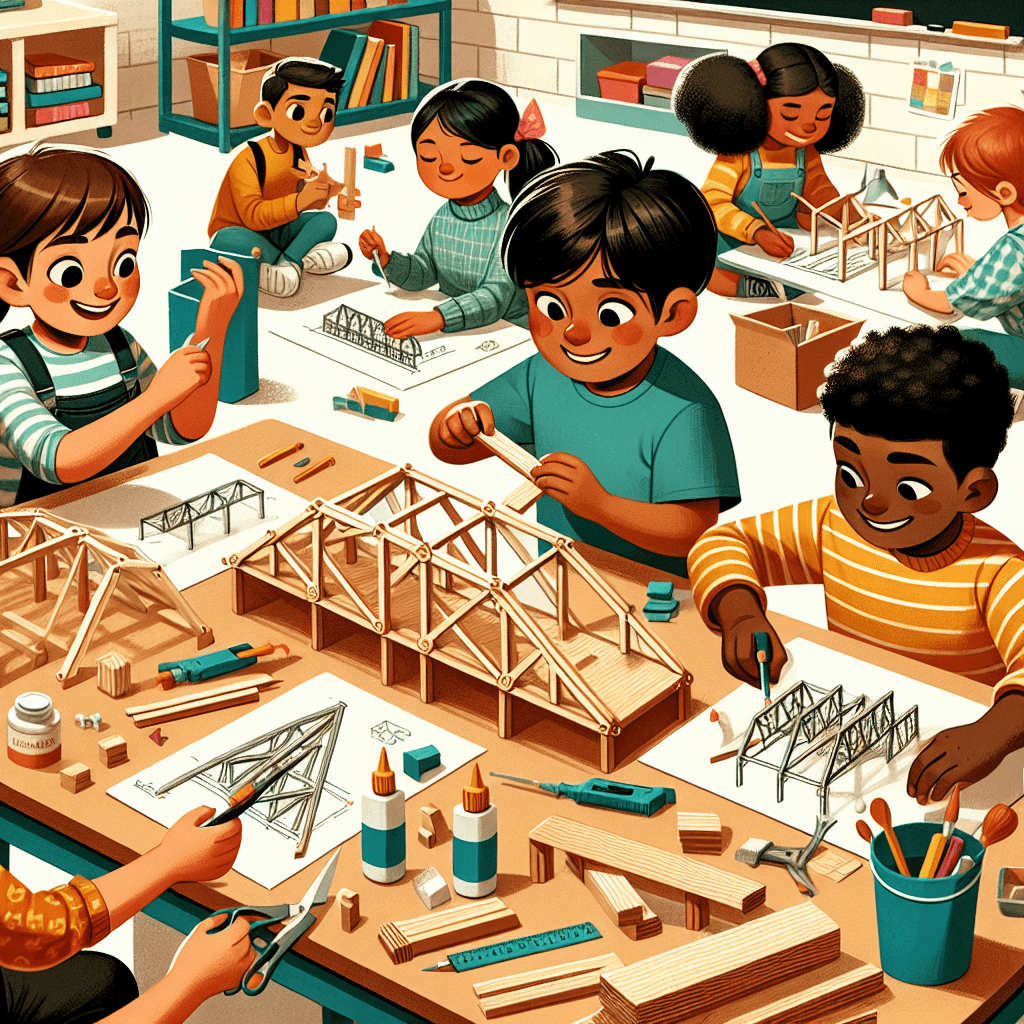
Balsa Wood Bridges
Inquiry Framework
Question Framework
Driving Question
The overarching question that guides the entire project.How can we design a balsa wood bridge that effectively integrates principles of physics and engineering to ensure structural soundness while considering its impact on the community?Essential Questions
Supporting questions that break down major concepts.- What physical forces act on a bridge, and how do these affect its design and stability?
- How can materials like balsa wood be utilized effectively in engineering and design?
- What factors must be considered when creating a structurally sound bridge?
- How does an understanding of geometry and physics contribute to building stronger bridges?
- In what ways can technology and engineering principles be applied to solve real-world problems through bridge design?
- How do bridges impact communities in terms of economics, culture, and transportation?
Standards & Learning Goals
Learning Goals
By the end of this project, students will be able to:- Students will understand and apply principles of physics, such as force, tension, and compression in the design of a bridge.
- Students will explore the properties and engineering applications of balsa wood and other materials.
- Students will utilize geometry and spatial reasoning to design and build a stable and efficient bridge.
- Students will evaluate real-world engineering problems and devise solutions using technology and engineering principles.
- Students will investigate the impact of bridge construction on community dynamics, including economic, cultural, and transportation factors.
NGSS
International Technology and Engineering Educators Association (ITEEA) Standards for Technological Literacy
Common Core Standards for Mathematics
Common Core Standards for English Language Arts
Entry Events
Events that will be used to introduce the project to studentsBreaking News: Bridge Collapse Mystery
A news report reveals a bridge collapse in a simulated locale, and students are tasked as the investigators to figure out what went wrong. They must research bridge failures, experiment with balsa wood constructions, and present solutions to prevent future collapses.Portfolio Activities
Portfolio Activities
These activities progressively build towards your learning goals, with each submission contributing to the student's final portfolio.Bridge Failure Investigation
Students will step into the shoes of engineers to investigate famous bridge failures. This initial activity breaks the ice and provides context for identifying common issues in bridge designs, facilitating understanding of constraints and criteria.Steps
Here is some basic scaffolding to help students complete the activity.Final Product
What students will submit as the final product of the activityA case study presentation detailing a specific bridge failure, its causes, and preventative strategies.Alignment
How this activity aligns with the learning objectives & standardsAligns with MS-ETS1-1 by defining criteria and constraints, and CCSS.ELA-LITERACY.W.7.1 by requiring a reasoned argument.Blueprint Brainstorm
In this creative brainstorming session, students conceptualize and sketch initial designs for their balsa wood bridge, integrating their findings from the Bridge Failure Investigation.Steps
Here is some basic scaffolding to help students complete the activity.Final Product
What students will submit as the final product of the activityInitial blueprint sketches with annotations on design choices and community impact.Alignment
How this activity aligns with the learning objectives & standardsAddresses CCSS.MATH.CONTENT.7.G.B.6 for geometric planning and MS-ETS1-1 with an emphasis on constraints and impacts.Prototype Construction
Students will advance to constructing a balsa wood prototype of their bridge, applying their sketches and exploring the material's properties.Steps
Here is some basic scaffolding to help students complete the activity.Final Product
What students will submit as the final product of the activityA constructed prototype of a balsa wood bridge ready for testing.Alignment
How this activity aligns with the learning objectives & standardsCovers STL.7 for the practical application of the design process and MS-ETS1-1 by implementing a prototype based on constraints and scientific principles.Testing & Analysis
Students test their bridge prototypes by applying simulated weights and document the results to understand design effectiveness.Steps
Here is some basic scaffolding to help students complete the activity.Final Product
What students will submit as the final product of the activityA detailed report with testing data, analysis of the bridge’s performance, and recommendations for improvement.Alignment
How this activity aligns with the learning objectives & standardsRelated to MS-ETS1-3 by analyzing test data and proposing combined solutions, and supported by CCSS.ELA-LITERACY.W.7.1 for crafting an argument based on evidence.Community Impact Presentation
Reflecting on their entire project, students will prepare a comprehensive presentation tying together engineering principles, prototype results, and community considerations.Steps
Here is some basic scaffolding to help students complete the activity.Final Product
What students will submit as the final product of the activityA multimedia presentation presenting an optimized bridge design with justifications, tests results, and community considerations.Alignment
How this activity aligns with the learning objectives & standardsDraws on CCSS.ELA-LITERACY.W.7.1 for well-structured arguments and MS-ETS1-3 to showcase improved solutions.Rubric & Reflection
Portfolio Rubric
Grading criteria for assessing the overall project portfolioBalsa Wood Bridge Design Project Rubric
Understanding of Physical Forces and Engineering Principles
Assesses the student's grasp of physics concepts and engineering principles in the context of bridge design and their application to the project.Analysis of Bridge Failures
Evaluates the ability to research and analyze historic bridge failures, highlighting understanding of physical forces involved.
Exemplary
4 PointsThoroughly analyzes three bridge failures with a detailed understanding of physical forces and effects on the community, offering insightful preventative strategies.
Proficient
3 PointsAdequately analyzes three bridge failures with a clear understanding of physical forces, offering reasonable preventative strategies.
Developing
2 PointsAnalyzes two bridge failures with a basic understanding of physical forces, offering limited preventative strategies.
Beginning
1 PointsAnalyzes one bridge failure with minimal understanding of physical forces, offering vague preventative strategies.
Application of Geometric and Structural Concepts
Assesses the use of geometric and structural knowledge in the design and blueprint stage of the bridge.
Exemplary
4 PointsBlueprint shows complex geometric planning with detailed annotations explaining structural integrity and community impact.
Proficient
3 PointsBlueprint shows clear geometric planning with annotations explaining basic structural integrity and community impact.
Developing
2 PointsBlueprint shows basic geometric planning with limited annotations on structure and impact.
Beginning
1 PointsBlueprint lacks clarity in geometric planning and provides minimal annotations.
Engineering Design and Testing Process
Evaluates the effective application of engineering design, construction, and testing processes in the creation of a balsa wood bridge.Prototype Construction and Evaluation
Assesses the ability to construct a prototype and evaluate its performance through testing and analysis.
Exemplary
4 PointsPrototype construction and evaluation are meticulous, with detailed analysis of strengths, weaknesses, and insightful improvement strategies.
Proficient
3 PointsPrototype is well-constructed with adequate analysis of performance and clear improvement suggestions.
Developing
2 PointsPrototype shows basic construction with limited analysis and improvement suggestions.
Beginning
1 PointsPrototype construction is incomplete with minimal analysis and improvement suggestions.
Communication and Impact Evaluation
Assesses the ability to communicate project findings effectively and evaluate the social, economic, and cultural impact of bridge designs.Presentation of Findings
Evaluates the quality of the multimedia presentation and its content, clarity, and argumentation regarding impact and improvement.
Exemplary
4 PointsPresentation is highly engaging, with a well-structured, clear argument that expertly integrates engineering insights and community impact.
Proficient
3 PointsPresentation is clear, structured, and effectively communicates important findings and impacts.
Developing
2 PointsPresentation conveys basic findings and impact assessment but lacks depth and clarity.
Beginning
1 PointsPresentation lacks structure, coherent argumentation, and clear impact assessment.