
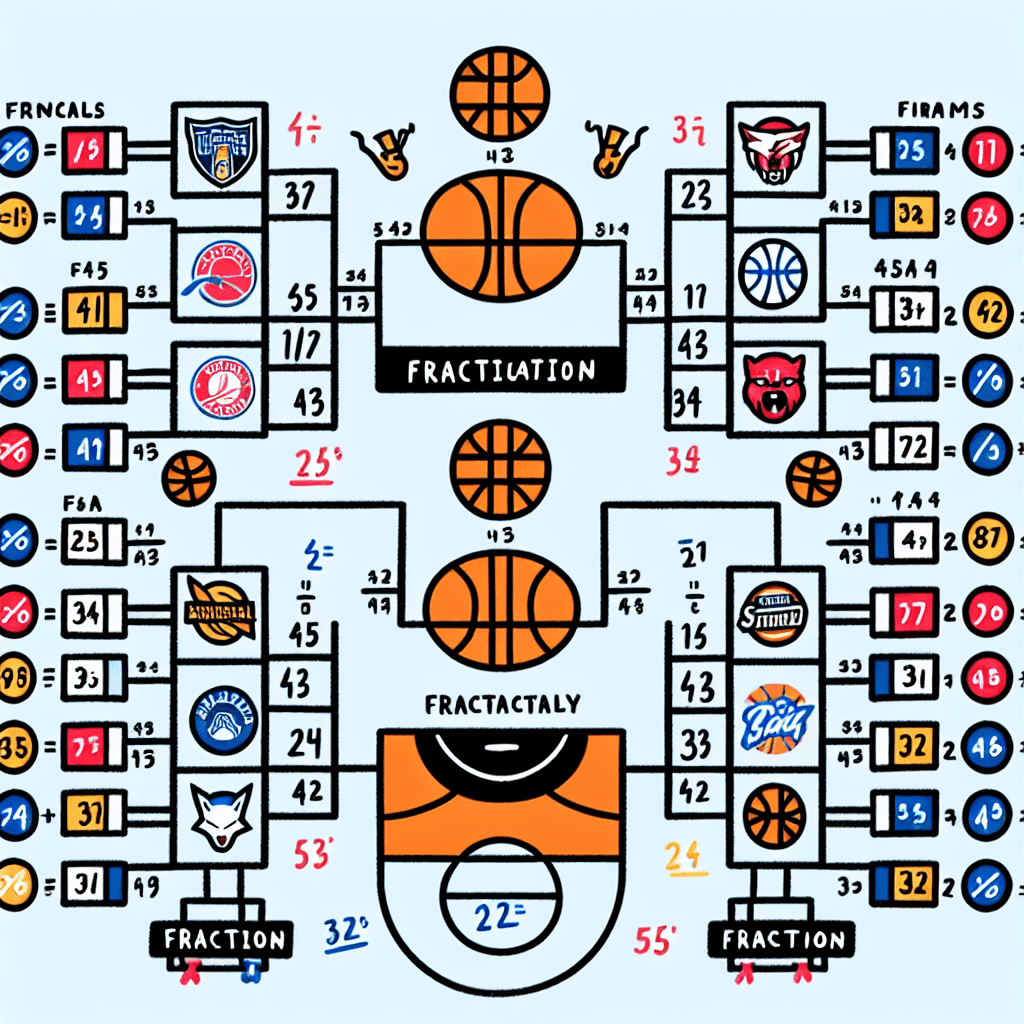
Basketball Bracket Fractions: Tournament Comparison
Inquiry Framework
Question Framework
Driving Question
The overarching question that guides the entire project.How can we use a sports tournament bracket to compare different basketball teams represented by fractions, understand equivalent fractions, and apply this understanding to real-world scenarios?Essential Questions
Supporting questions that break down major concepts.- What does it mean for two fractions to be equivalent?
- How can you compare two fractions that have different denominators?
- In what ways can a visual model, like a sports bracket, help us understand the concept of comparing fractions?
- Why is it useful to compare fractions in real life situations, such as in sports tournaments?
Standards & Learning Goals
Learning Goals
By the end of this project, students will be able to:- Students will understand the concept of equivalent fractions and how to identify them.
- Students will learn to compare two fractions with different numerators and different denominators using visual models.
- Students will apply their understanding of equivalent fractions in real-world contexts, such as a sports tournament.
- Students will develop skills in representing fractions and their comparisons using symbols such as >, <, or =.
- Students will enhance their problem-solving skills by justifying their fraction comparisons through reasoning and models.
Common Core Standards
Entry Events
Events that will be used to introduce the project to studentsFantasy Basketball Draft Day
Present students with a mock fantasy basketball draft where they have to choose players based on their fractional performance statistics over the season. Students will calculate and compare these statistics using fractions to build their ultimate fantasy team.Portfolio Activities
Portfolio Activities
These activities progressively build towards your learning goals, with each submission contributing to the student's final portfolio.Tournament Bracket Challenge
Students will learn to use a sports tournament bracket as a visual fraction model to compare their teams and determine which team has the best fractional statistics across multiple games.Steps
Here is some basic scaffolding to help students complete the activity.Final Product
What students will submit as the final product of the activityA fully charted and analyzed sports tournament bracket where fraction comparisons lead to a winner.Alignment
How this activity aligns with the learning objectives & standardsMeets CCSS.MATH.CONTENT.4.NF.A.2 by applying comparisons through visual fraction models, including recording conclusions using symbols, and justifying with applied reasoning.Rubric & Reflection
Portfolio Rubric
Grading criteria for assessing the overall project portfolioFraction Tournament Bracket Evaluation
Understanding Equivalent Fractions
Evaluates the student's understanding of equivalent fractions and their ability to identify them in different contexts.Identification of Equivalent Fractions
Measures student's ability to accurately identify and use equivalent fractions during the tournament activities.
Exemplary
4 PointsAccurately identifies and uses equivalent fractions consistently throughout the tournament, providing clear and insightful explanations of equivalency.
Proficient
3 PointsIdentifies and uses equivalent fractions accurately in most instances, with clear explanations of the equivalencies when prompted.
Developing
2 PointsOccasionally identifies equivalent fractions but may show inconsistencies and require support, with partial explanations.
Beginning
1 PointsStruggles to identify equivalent fractions without significant assistance and provides inadequate explanations.
Fraction Comparison Skills
Assesses the student's ability to compare fractions with different numerators and denominators using visual models.Use of Visual Models for Comparison
Evaluates effectiveness in utilizing visual aids like pie charts or fraction bars to compare fractions.
Exemplary
4 PointsEffectively uses visual models to compare fractions in all instances, demonstrating advanced understanding and cohesive analysis.
Proficient
3 PointsCompetently uses visual models to compare fractions in most instances, showing a thorough understanding.
Developing
2 PointsUses visual models inconsistently, showing partial understanding of fraction comparisons.
Beginning
1 PointsFails to use visual models effectively, demonstrating minimal understanding of fraction comparisons.
Recording and Justifying Comparisons
Measures the ability to document fraction comparisons and justify conclusions with reasoning and symbols.
Exemplary
4 PointsConsistently records fraction comparisons accurately using appropriate symbols and justifies all conclusions with compelling reasoning.
Proficient
3 PointsRecords most fraction comparisons correctly and provides clear justifications for conclusions.
Developing
2 PointsRecords some fraction comparisons but may include inaccuracies or incomplete justification.
Beginning
1 PointsStruggles to record fraction comparisons and provide justification, with frequent errors.
Application in Real-World Scenarios
Assesses the ability to apply understanding of fractions in the context of a sports tournament and related real-world situations.Integration of Fraction Concepts
Evaluates the ability to apply fraction concepts accurately within the sports tournament bracket context.
Exemplary
4 PointsSkillfully integrates fraction concepts, demonstrating a comprehensive understanding and innovative application to solve tournament challenges.
Proficient
3 PointsSuccessfully applies fraction concepts to solve problems within the tournament in most instances, showing solid understanding.
Developing
2 PointsApplies fraction concepts inconsistently, with occasional correct solutions to tournament problems.
Beginning
1 PointsStruggles to apply fraction concepts to the tournament, showing significant gaps in understanding.