
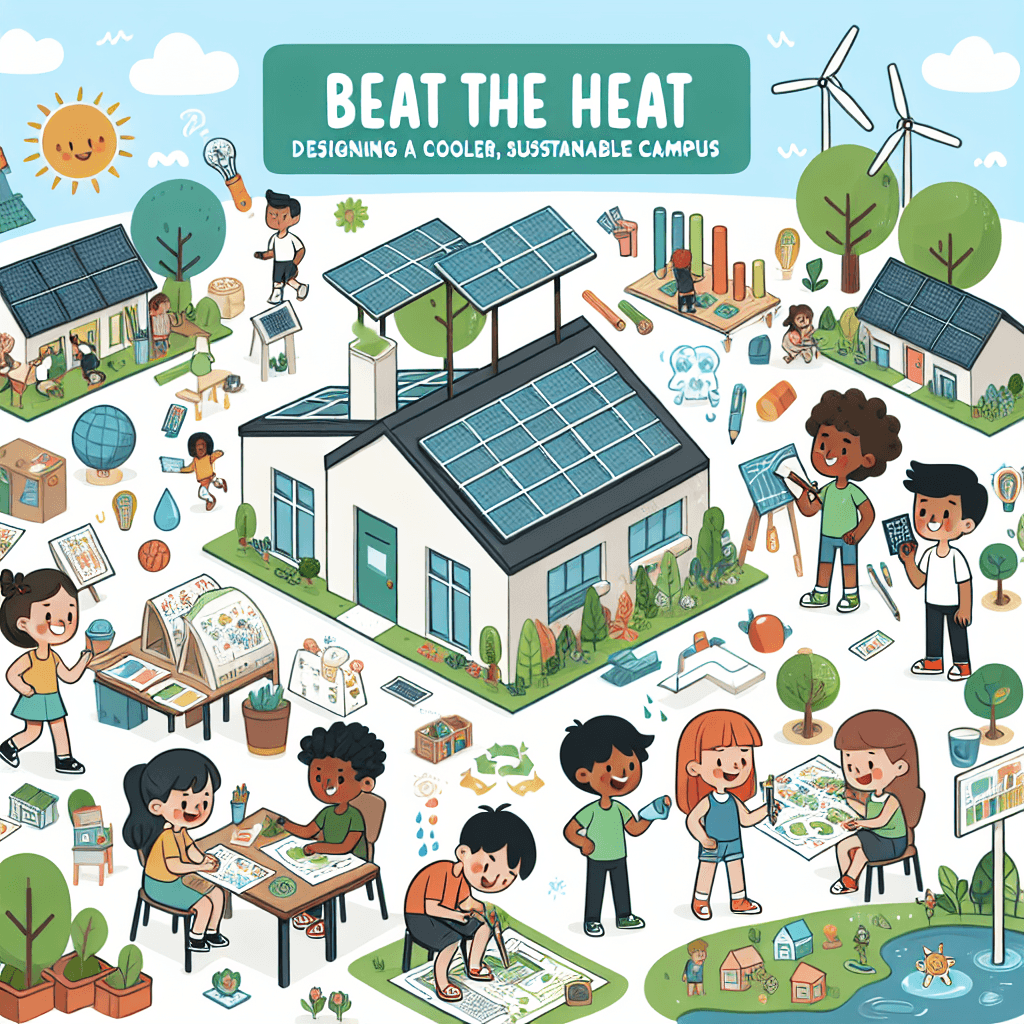
Beat the Heat: Designing a Cooler, Sustainable Campus
Inquiry Framework
Question Framework
Driving Question
The overarching question that guides the entire project.How can we, as solution seekers, use local temperature data and engineering design to transform our school campus into a climate-resilient "Cool-Down" zone that serves as a model for our community?Essential Questions
Supporting questions that break down major concepts.- What is the science behind the "urban heat island effect," and how does it specifically impact our school campus?
- How can we follow precise procedures to collect and analyze local temperature data to pinpoint the most critical areas for cooling?
- What are the specific criteria and constraints we must consider when designing a solution that is both effective and sustainable?
- How do we use a systematic process to evaluate and compare different cooling strategies to choose the best possible design?
- As "solution seekers," how can our campus redesign serve as a model for creating a more climate-resilient community?
Standards & Learning Goals
Learning Goals
By the end of this project, students will be able to:- Analyze and interpret local temperature data collected via precise technical procedures to identify specific areas on campus affected by the urban heat island effect.
- Apply scientific principles of thermal energy transfer to select and justify the use of specific sustainable materials or architectural features in a redesign plan.
- Define a comprehensive set of criteria and constraints for a school cooling solution, accounting for environmental impact, budget, and community needs.
- Develop a systematic evaluation process to compare multiple design solutions, selecting the most effective model based on data and project constraints.
- Demonstrate 'Solution Seeker' competencies by designing a climate-resilient proposal that addresses a real-world environmental challenge within the local community.
Next Generation Science Standards (NGSS)
Common Core State Standards (ELA/Literacy)
Local District Competencies
Entry Events
Events that will be used to introduce the project to studentsThe Asphalt Omelet & Melting Challenge
In this hands-on challenge, students are tasked with protecting a 'delicate cargo' (a chocolate bar or ice cube) placed on various campus surfaces like asphalt, metal slides, and rubber mulch under the midday sun. After watching their cargo melt in minutes on traditional materials, students are challenged to design a 'Micro-Oasis' prototype using sustainable materials that can keep the cargo solid for the entire period.The 'Danger Zone' Heat Audit
Students are greeted by a mock 'Urgent Safety Memo' from the administration stating that certain 'Danger Zones' on campus are now off-limits during recess due to extreme surface temperatures. Armed with infrared thermal cameras and laser thermometers, students conduct a 'Heat Audit' to map these zones, discovering that the blacktop is hot enough to melt a crayon while the shaded grass is 30 degrees cooler.Mission: Cool-Down Master Plan
Students view a drone-perspective thermal map of their own neighborhood and school, revealing their campus as a bright red 'heat island' compared to nearby parks. They are visited by a local urban planner or environmental scientist who presents a 'Design Brief' asking for a student-led master plan to reduce the school’s thermal footprint before the next record-breaking summer.Portfolio Activities
Portfolio Activities
These activities progressively build towards your learning goals, with each submission contributing to the student's final portfolio.Heat Detective: The Campus Thermal Audit
Before redesigning the campus, students must act as 'Heat Detectives' to understand the current state of their environment. In this activity, students follow a strict technical protocol to collect and map temperature data across various surfaces on their school grounds. They will learn to use infrared thermometers and weather sensors to identify the most significant heat islands on campus.Steps
Here is some basic scaffolding to help students complete the activity.Final Product
What students will submit as the final product of the activityA 'Campus Thermal Hot-Spot Map' featuring color-coded data visualizations and a data table documenting temperatures of at least five different surface types (asphalt, grass, rubber, concrete, etc.).Alignment
How this activity aligns with the learning objectives & standardsAligns with CCSS.ELA-LITERACY.RST.6-8.3 (Following precise multistep procedures for technical tasks) and MS-ESS3-3 (Monitoring human impact on the environment).The 'Cool-Down' Design Brief: Setting the Boundaries
Now that students have identified the problem areas, they must define exactly what a successful 'Cool-Down' solution looks like. In this activity, students transition from data collectors to engineers by drafting a formal Design Brief. They must identify the stakeholders (students, teachers, local wildlife), the scientific requirements (target temperature reduction), and the real-world limitations (budget, safety codes, and maintenance).Steps
Here is some basic scaffolding to help students complete the activity.Final Product
What students will submit as the final product of the activityA formal 'Design Mission Statement' and a 'Criteria & Constraints Checklist' that will be used to judge all future redesign ideas.Alignment
How this activity aligns with the learning objectives & standardsAligns with NGSS MS-ETS1-1 (Defining the criteria and constraints of a design problem with precision).Material Labs: Testing the Cool-Down Tech
Before drawing blueprints, students must understand the materials they will use. In this lab-based activity, students experiment with 'Albedo' (reflectivity) and thermal mass. They test various sustainable materials—such as light-colored permeable pavers, green roof vegetation, and reflective coatings—to see which ones best resist heat absorption under a heat lamp or direct sun.Steps
Here is some basic scaffolding to help students complete the activity.Final Product
What students will submit as the final product of the activityA 'Material Performance Report' that ranks at least four different sustainable materials based on their thermal efficiency and environmental impact.Alignment
How this activity aligns with the learning objectives & standardsAligns with NGSS MS-PS3-3 (Testing a device that minimizes thermal energy transfer) and MS-ESS3-3 (Applying scientific principles to minimize human impact).Battle of the Blueprints: The Systematic Showdown
Students now brainstorm two distinct ways to cool their chosen 'Danger Zone.' For example, one design might focus on 'The Forest' (natural shade and vegetation) while the other focuses on 'The Reflective Shield' (engineered surfaces and awnings). Students must then use a weighted Decision Matrix to objectively score their two ideas against the Criteria and Constraints they established in Activity 2.Steps
Here is some basic scaffolding to help students complete the activity.Final Product
What students will submit as the final product of the activityA 'Battle of the Blueprints' Decision Matrix and a 1-page Justification Report explaining why the winning design was chosen over the alternative.Alignment
How this activity aligns with the learning objectives & standardsAligns with NGSS MS-ETS1-2 (Evaluate competing design solutions using a systematic process).The Master Plan: Presenting the Cool-Down Campus
In the final phase, students refine their winning design into a professional proposal. This is where they demonstrate their growth as 'Solution Seekers.' They will create a 3D model or detailed architectural rendering of their 'Cool-Down Zone' and prepare a pitch to the school board or administration, explaining how their design transforms the campus into a climate-resilient model for the city.Steps
Here is some basic scaffolding to help students complete the activity.Final Product
What students will submit as the final product of the activityA 'Climate-Resilient Campus Master Plan' consisting of a 3D model (physical or digital) and a persuasive 'Solution Seeker' presentation for school stakeholders.Alignment
How this activity aligns with the learning objectives & standardsAligns with the 'Solution Seeker' Local Competency (Developing innovative, sustainable solutions to benefit the community) and MS-ETS1-1.Rubric & Reflection
Portfolio Rubric
Grading criteria for assessing the overall project portfolioThe Cool-Down Campus: Climate Resilience Rubric
Scientific Investigation & Data Collection
Evaluates the student's ability to use scientific tools and protocols to collect and analyze data regarding the urban heat island effect.Data Precision & Technical Protocol
Ability to follow technical protocols (3-3-3 Rule) and use tools (infrared thermometers) with precision to map thermal data.
Exemplary
4 PointsFollows all technical procedures with meticulous precision; data is recorded to 3 decimal places consistently; thermal map shows sophisticated visualization of heat patterns with high accuracy.
Proficient
3 PointsFollows technical procedures accurately; measurements are recorded clearly; thermal map accurately represents collected data with distinct color coding.
Developing
2 PointsFollows most procedures but with some inconsistencies in measurement or tool use; map shows general areas of heat but lacks specific data precision.
Beginning
1 PointsStruggles to follow multistep procedures; measurements are incomplete or inaccurate; map does not effectively communicate thermal data.
Thermal Property Analysis
Performance in Material Labs, specifically testing albedo and thermal retention to justify material selection for the redesign.
Exemplary
4 PointsConducts highly controlled experiments; provides deep analysis of thermal energy transfer (absorption vs. reflection); justifies material choice with comprehensive data-driven insights.
Proficient
3 PointsConducts controlled experiments; accurately measures heat soak and retention; provides clear evidence-based ranking of materials.
Developing
2 PointsConducts basic experiments but lacks control of variables; provides partial analysis of why some materials are cooler than others.
Beginning
1 PointsCollects limited data from experiments; ranking of materials is not supported by scientific observations or measurements.
Engineering Design & Evaluation
Focuses on the engineering design process, specifically the ability to define problems and evaluate competing solutions.Precision of Criteria & Constraints
Defining specific, measurable criteria (what it must do) and realistic constraints (limitations like budget and safety) for the redesign.
Exemplary
4 PointsDefines criteria and constraints with exceptional precision, accounting for complex factors like long-term maintenance, ecological impact, and specific community needs.
Proficient
3 PointsClearly defines a comprehensive set of criteria and constraints that directly address the identified heat island problem and project limitations.
Developing
2 PointsIdentifies basic criteria and constraints, but they may be vague or fail to cover all essential project requirements (e.g., missing budget or safety).
Beginning
1 PointsLists very few or irrelevant criteria and constraints; goals for the design are unclear or unrealistic.
Systematic Evaluation Process
Using a systematic matrix to compare two or more design solutions against the established criteria and constraints.
Exemplary
4 PointsUses a sophisticated, weighted decision matrix to objectively evaluate solutions; provides a compelling, data-backed justification for the winning design.
Proficient
3 PointsUses a clear systematic process (matrix) to compare designs; choice of winning design is logically supported by the established criteria.
Developing
2 PointsAttempts a comparison of designs, but the scoring is subjective or inconsistent with the established criteria and constraints.
Beginning
1 PointsDoes not use a systematic process to evaluate designs; choice of solution is based on preference rather than data or criteria.
Solution Seeker Competency & Product
Assesses the student's growth as a 'Solution Seeker' and the quality of their final creative product.Innovation & Community Impact
Developing a solution that is innovative, sustainable, and directly benefits the school and local community.
Exemplary
4 PointsDesign is highly innovative and serves as a scalable model for community resilience; integrates multiple sustainable technologies in a novel way.
Proficient
3 PointsDesign is innovative and effectively uses sustainable materials to solve a local problem; shows clear benefit to the school community.
Developing
2 PointsDesign uses standard solutions with limited innovation; benefit to the community is present but not well-defined or optimized.
Beginning
1 PointsDesign lacks innovation or sustainability; does not effectively address the local heat island problem or community needs.
Prototype Integrity & Science Integration
Quality and detail of the final 3D prototype and the ability to explain the science behind the design choices.
Exemplary
4 PointsCreates a professional-grade prototype (physical or digital) with comprehensive annotations that expertly explain the scientific principles of thermal energy transfer.
Proficient
3 PointsCreates a detailed 3D prototype with clear annotations explaining how the design reduces the urban heat island effect.
Developing
2 PointsCreates a basic model with some annotations, but the connection between the design and the scientific principles is weak or incomplete.
Beginning
1 PointsPrototype is incomplete or lacks detail; annotations are missing or fail to explain the science behind the design.
Communication & Presentation
Evaluates the effectiveness of the final communication of the design proposal to an audience.Technical Pitch & Argumentation
The ability to present a technical proposal to stakeholders using data, logic, and persuasive communication.
Exemplary
4 PointsDelivers a highly persuasive pitch that expertly balances technical data with community impact; handles complex questions from the review board with ease.
Proficient
3 PointsDelivers a clear, organized presentation that uses data from the audit and material labs to support the design choices.
Developing
2 PointsPresentation is organized but relies more on opinion than data; communication of technical aspects is somewhat unclear.
Beginning
1 PointsPresentation is disorganized; fails to use data to support the proposal or address the needs of stakeholders.