
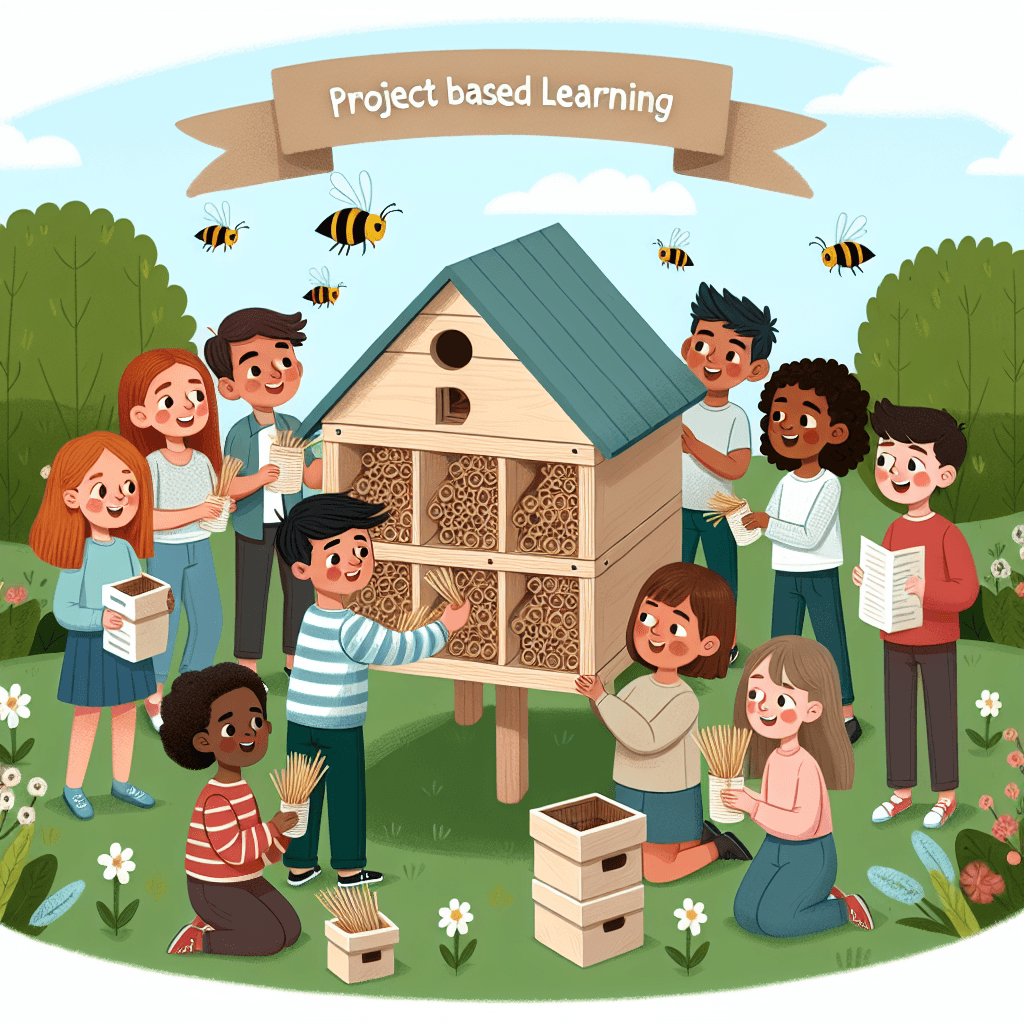
Bee Hotel Building for Solitary Bees
Inquiry Framework
Question Framework
Driving Question
The overarching question that guides the entire project.How can we design and build a bee hotel on campus to support solitary bees, and how can we share what we learn about their role in the ecosystem and the benefits they provide with our community?Essential Questions
Supporting questions that break down major concepts.- What are solitary bees and how do they differ from other types of bees?
- How do solitary bees contribute to the ecosystem?
- What are the necessary components for creating a bee hotel?
- How can we effectively communicate the benefits of bees and bee hotels to our community?
Standards & Learning Goals
Learning Goals
By the end of this project, students will be able to:- Students will understand the life cycle and role of solitary bees within ecosystems.
- Students will develop skills to design and construct a functional bee hotel for solitary bees.
- Students will research and gather information about solitary bees and their ecological importance.
- Students will enhance their written and oral communication skills through presenting their findings and creations.
- Students will learn to work collaboratively to solve real-world problems related to environmental conservation.
Common Core Standards
Next Generation Science Standards
Entry Events
Events that will be used to introduce the project to studentsThe Buzzing Mystery
Kick off the project by presenting a surprising environmental mystery: The disappearance of solitary bees in your local area. Provide students with cryptic clues (like seeds, small pieces of bamboo, and weather data) and challenge them to decode the mystery by investigating the role of bee hotels and how they can save these vital pollinators.Portfolio Activities
Portfolio Activities
These activities progressively build towards your learning goals, with each submission contributing to the student's final portfolio.Bee Hotel Architect Challenge
Students design their own bee hotels, evaluating different materials and methods to create a suitable environment for solitary bees.Steps
Here is some basic scaffolding to help students complete the activity.Final Product
What students will submit as the final product of the activityA refined design sketch and materials list for building a bee hotel.Alignment
How this activity aligns with the learning objectives & standardsAligns with NGSS.MS-ETS1-2 by evaluating and refining design solutions.Bee Community Communicators
Students engage with the community by presenting their research findings and bee hotel designs, explaining the role and benefits of solitary bees.Steps
Here is some basic scaffolding to help students complete the activity.Final Product
What students will submit as the final product of the activityA well-structured presentation delivered to an audience, showcasing bee hotel designs and research insights.Alignment
How this activity aligns with the learning objectives & standardsAligns with CCSS.ELA-LITERACY.SL.8.4 as students present researched information in a coherent manner.Bee Ecosystem Explorers
Students explore the broader ecosystem implications of supporting solitary bees and how their project could impact local biodiversity.Steps
Here is some basic scaffolding to help students complete the activity.Final Product
What students will submit as the final product of the activityA group report predicting the ecological impact of their bee hotel initiative.Alignment
How this activity aligns with the learning objectives & standardsAligns with NGSS.MS-LS2-2 by requiring students to predict interactions in ecosystems based on their bee hotel project.Bee Detective Task
Students begin by investigating the mystery of disappearing bees by collecting clues and data to understand the importance of bee hotels.Steps
Here is some basic scaffolding to help students complete the activity.Final Product
What students will submit as the final product of the activityAn investigative report summarizing clues, potential reasons for bee disappearance, and hypotheses.Alignment
How this activity aligns with the learning objectives & standardsAligns with CCSS.ELA-LITERACY.RI.8.1 by requiring students to gather and cite evidence to support their analysis.Bee Biography Writer
Students create informative posters outlining what solitary bees are and their unique characteristics in comparison to other bees.Steps
Here is some basic scaffolding to help students complete the activity.Final Product
What students will submit as the final product of the activityAn informative and visually engaging poster on solitary bees.Alignment
How this activity aligns with the learning objectives & standardsAligns with CCSS.ELA-LITERACY.W.8.2 as students create informative texts to convey researched details.Rubric & Reflection
Portfolio Rubric
Grading criteria for assessing the overall project portfolioSolitary Bees and Bee Hotel Projects Assessment Rubric
Research and Evidence Gathering
Assesses students' ability to research solitary bees, gather evidence, and support their analyses.Use of Evidence
Measures the ability to gather and cite textual evidence to support analysis of solitary bees and their roles.
Exemplary
4 PointsDemonstrates a sophisticated ability to gather comprehensive evidence with clear citations strongly supporting insightful analysis.
Proficient
3 PointsGathers thorough evidence with appropriate citations supporting a clear analysis.
Developing
2 PointsGathers basic evidence with limited citations; supporting analysis is simplistic.
Beginning
1 PointsStruggles to gather clear evidence; citations are insufficient to support analysis.
Clarity of Report
Evaluates the clarity and organization of investigative reports and findings.
Exemplary
4 PointsReport is exceptionally clear, well-structured, and logically organized, with insightful conclusions.
Proficient
3 PointsReport is clearly structured and organized with logical conclusions.
Developing
2 PointsReport lacks clear organization; conclusions are basic.
Beginning
1 PointsReport is unclear and poorly organized, with conclusions missing.
Design and Innovation
Assesses students' ability to design a functional bee hotel, incorporating feedback and ecological understanding.Design Suitability
Measures whether the design of the bee hotel meets ecological needs and criteria.
Exemplary
4 PointsInnovative design exceeds ecological needs, using creative materials with exceptional attention to detail.
Proficient
3 PointsDesign meets ecological needs with appropriate material choice and good attention to detail.
Developing
2 PointsDesign partially meets ecological needs; material choice is basic.
Beginning
1 PointsDesign fails to meet ecological needs; inappropriate material choice is evident.
Incorporation of Feedback
Evaluates how well students incorporate peer and instructor feedback into design improvements.
Exemplary
4 PointsActively incorporates all feedback and makes substantial positive changes.
Proficient
3 PointsIncorporates most feedback with noticeable improvements.
Developing
2 PointsIncorporates minimal feedback with limited improvements.
Beginning
1 PointsStruggles to incorporate feedback; few improvements observed.
Communication and Presentation
Evaluates the effectiveness and clarity of presenting research and design to an audience.Presentation Skills
Assesses clarity, coherence, and engagement in oral presentations.
Exemplary
4 PointsPresentation is exceptionally clear, coherent, and engaging; ideas are communicated creatively.
Proficient
3 PointsPresentation is clear and coherent, communicating ideas effectively.
Developing
2 PointsPresentation lacks clarity and coherence, with basic communication of ideas.
Beginning
1 PointsPresentation is unclear and incoherent; struggles to communicate ideas.
Use of Visuals
Assesses how well visual aids are integrated into presentations to enhance understanding.
Exemplary
4 PointsVisuals are highly effective, enhancing understanding and engagement significantly.
Proficient
3 PointsVisuals appropriately support and enhance presentation.
Developing
2 PointsVisuals are basic and loosely connected; limited enhancement of presentation.
Beginning
1 PointsVisuals are ineffective and poorly integrated into presentation.
Ecological Analysis
Measures students' ability to predict and articulate the ecosystem impacts of their project.Ecological Understanding
Assesses understanding of bee role in local ecosystems and potential impacts of their project.
Exemplary
4 PointsShows an advanced understanding of ecosystem dynamics and potential impacts, with thorough predictions.
Proficient
3 PointsShows a solid understanding with clear predictions of ecological impact.
Developing
2 PointsShows basic understanding with vague predictions.
Beginning
1 PointsStruggles to articulate understanding; predictions are unclear or missing.