
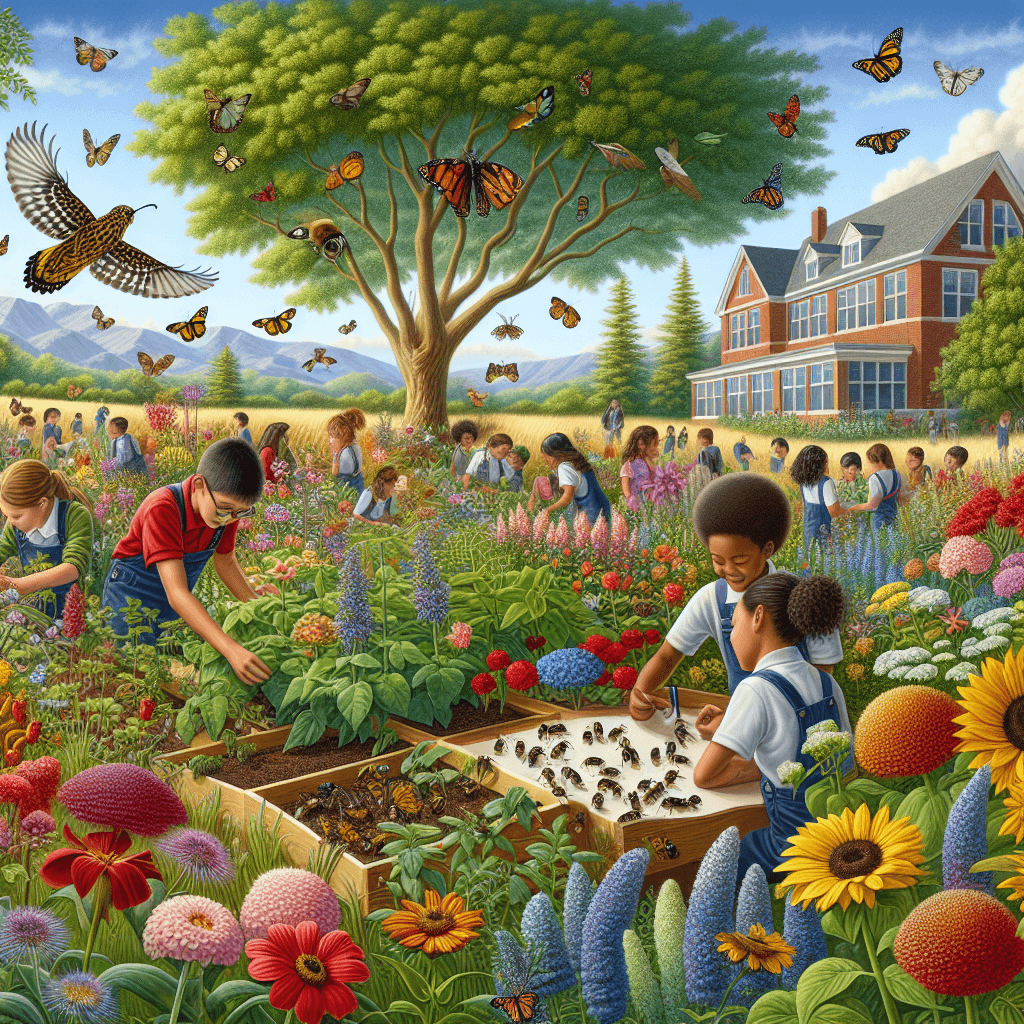
Biodiversity Gardens: Cultivating Future Environmental Stewards
Inquiry Framework
Question Framework
Driving Question
The overarching question that guides the entire project.How can we design and create a unique biodiversity garden that supports local plant species, attracts pollinators, and educates our community about biodiversity’s importance and the impacts of human activities?Essential Questions
Supporting questions that break down major concepts.- What is biodiversity and why is it important?
- How do different plant species interact with their environment?
- What role do pollinators play in ecosystems and how do they affect biodiversity?
- How can we design a garden that supports local biodiversity?
- In what ways do human activities impact biodiversity in both positive and negative ways?
Standards & Learning Goals
Learning Goals
By the end of this project, students will be able to:- Understand the concept of biodiversity and its importance in ecosystems.
- Identify local plant species and describe their roles in their environment.
- Recognize the importance and role of pollinators in maintaining biodiversity.
- Design and create a biodiversity garden that supports local species and attracts pollinators.
- Analyze the impacts of human activities on biodiversity, highlighting both positive and negative effects.
- Communicate the importance of biodiversity to the community and propose actions to support it.
NGSS
Entry Events
Events that will be used to introduce the project to studentsVirtual Tour of Global Biodiversity Hotspots
Kick-off with a virtual reality tour of some of the world's most diverse ecosystems, such as the Amazon Rainforest or the Great Barrier Reef, showcasing the rich variety of plant and animal life. This immersive experience will serve as a springboard for students to relate local biodiversity efforts to global conservation challenges and opportunities.Interactive Plant-Pollinator Simulation Game
Engage students with a simulation game that allows them to create and manage a virtual garden, understanding the symbiotic relationships between plants and pollinators. This gamified approach introduces them to ecological principles in a fun and relatable manner.Portfolio Activities
Portfolio Activities
These activities progressively build towards your learning goals, with each submission contributing to the student's final portfolio.Virtual Biodiversity Exploration
Students will independently explore their local environment virtually to identify and study various plant species. Leveraging digital resources, they will note the biodiversity present and investigate these plants' ecological roles.Steps
Here is some basic scaffolding to help students complete the activity.Final Product
What students will submit as the final product of the activityAn independent digital presentation on local plant species and their ecological roles.Alignment
How this activity aligns with the learning objectives & standardsAligns with SCI.MS.LS2-2 by understanding plant species interactions in local ecosystems.Pollinator Partnership Workshop
Students learn about the critical role of pollinators in maintaining biodiversity by engaging in research and hands-on activities like creating pollinator-friendly plant lists.Steps
Here is some basic scaffolding to help students complete the activity.Final Product
What students will submit as the final product of the activityA community-oriented flyer that educates about the role of pollinators and plant suggestions to attract them.Alignment
How this activity aligns with the learning objectives & standardsSupports SCI.MS.LS2-4 by understanding how biological changes affect populations and ecosystem dynamics.Garden Design Challenge
Students apply their knowledge by collaboratively designing a layout for a biodiversity garden that incorporates native plants to attract pollinators, using diagrams and digital tools.Steps
Here is some basic scaffolding to help students complete the activity.Final Product
What students will submit as the final product of the activityA detailed garden layout designed to maximize local biodiversity and attract pollinators.Alignment
How this activity aligns with the learning objectives & standardsAligns with SCI.MS.LS2-5 by designing solutions for maintaining biodiversity and ecosystem services.Human Impact Symposium
Students research and analyze both positive and negative impacts of human activities on biodiversity, culminating in a symposium to present their findings and proposed solutions.Steps
Here is some basic scaffolding to help students complete the activity.Final Product
What students will submit as the final product of the activityA research report and visual presentation on human impacts on biodiversity.Alignment
How this activity aligns with the learning objectives & standardsAddresses parts of SCI.MS.LS2-4 by constructing arguments supported by evidence regarding ecosystem impacts.Community Outreach Campaign
Students will synthesize their knowledge into a public awareness campaign, aiming to educate the local community about the importance of biodiversity and actions that support it.Steps
Here is some basic scaffolding to help students complete the activity.Final Product
What students will submit as the final product of the activityA comprehensive community campaign to raise awareness about biodiversity and encourage community actions.Alignment
How this activity aligns with the learning objectives & standardsReinforces the understanding and communication of biodiversity's importance, fulfilling learning goals.Rubric & Reflection
Portfolio Rubric
Grading criteria for assessing the overall project portfolioBiodiversity Garden Project Rubric
Understanding Biodiversity
Evaluates the student's grasp of biodiversity concepts and their importance to ecosystems.Comprehension of Biodiversity
Measures the understanding of biodiversity concepts and their application.
Exemplary
4 PointsDemonstrates advanced understanding of biodiversity, articulating connections between plant and pollinator interactions and broader ecosystem services.
Proficient
3 PointsShows thorough understanding of biodiversity, explaining plant and pollinator roles adequately.
Developing
2 PointsDisplays basic understanding of biodiversity concepts, with some inaccuracies in explanation.
Beginning
1 PointsShows limited understanding of biodiversity, unable to correctly explain fundamental concepts.
Impact of Human Activities
Assesses understanding of how human activities affect biodiversity positively and negatively.
Exemplary
4 PointsProvides a nuanced analysis of human interactions with biodiversity, highlighting both impacts and innovative solutions.
Proficient
3 PointsExplains human impacts on biodiversity effectively, with examples of both positive and negative effects.
Developing
2 PointsLists basic human impacts on biodiversity with minimal detail or understanding.
Beginning
1 PointsStruggles to identify human impacts on biodiversity, showing little understanding.
Research and Communication
Measures effectiveness in conducting research and communicating findings.Research Skills
Evaluates ability to gather, interpret, and synthesize information from various sources.
Exemplary
4 PointsConducts comprehensive research, integrating information from multiple high-quality sources effectively.
Proficient
3 PointsPerforms thorough research using quality sources and synthesizes information well.
Developing
2 PointsCompletes basic research with limited sources, showing partial synthesis of information.
Beginning
1 PointsStruggles to gather and interpret information, with little synthesis evident.
Communication of Findings
Assesses the clarity and impact of communicating findings through written and visual means.
Exemplary
4 PointsCommunicates findings clearly and persuasively, using effective visuals and compelling arguments.
Proficient
3 PointsCommunicates findings clearly with appropriate visuals and sound reasoning.
Developing
2 PointsCommunicates findings with some clarity, using visuals that partially support arguments.
Beginning
1 PointsStruggles to communicate findings clearly, with ineffective or absent visuals.
Design and Implementation
Evaluates the creativity and feasibility of garden design and its potential ecosystem impact.Design Creativity
Assesses creativity and innovativeness in the garden design process.
Exemplary
4 PointsDesign shows exceptional creativity and originality, integrating diverse elements to support biodiversity innovatively.
Proficient
3 PointsDesign displays creativity and integrates multiple elements to support biodiversity.
Developing
2 PointsDesign integrates basic elements with limited creativity.
Beginning
1 PointsDesign lacks creativity and fails to integrate necessary elements effectively.
Feasibility and Impact
Measures the practicality of the garden design and its expected impact on local biodiversity.
Exemplary
4 PointsDesign is highly feasible and has a clear, positive impact on local biodiversity, with detailed implementation strategies.
Proficient
3 PointsDesign is feasible and expected to positively impact biodiversity, with clear implementation steps.
Developing
2 PointsDesign is partially feasible with some positive impact expected, though implementation details are lacking.
Beginning
1 PointsDesign is not feasible and offers unclear or minimal impact on biodiversity.