
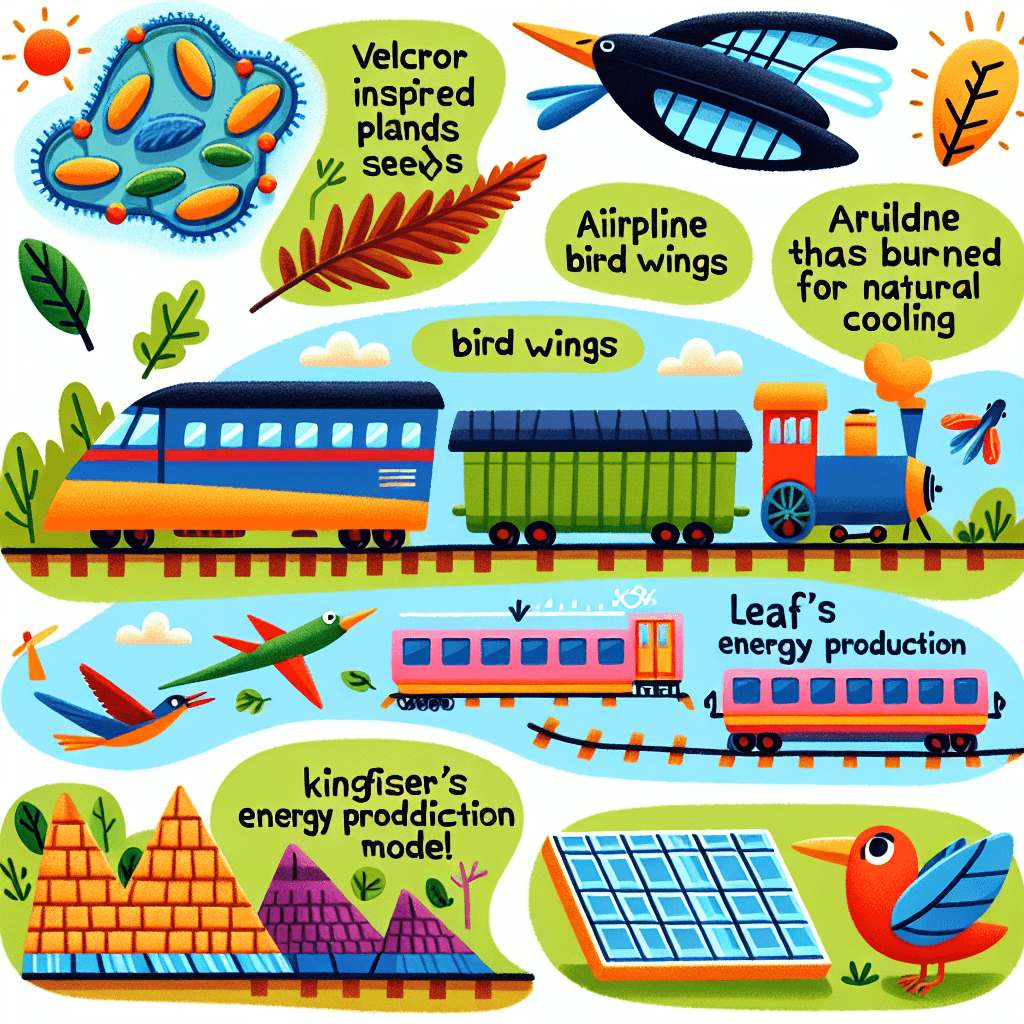
Biomimicry: Nature-Inspired Solutions
Inquiry Framework
Question Framework
Driving Question
The overarching question that guides the entire project.How can we design sustainable solutions for modern challenges by emulating nature's time-tested strategies and considering the ethical implications of biomimicry?Essential Questions
Supporting questions that break down major concepts.- How does nature inspire innovative design solutions?
- What are the ethical considerations of mimicking natural processes?
- What are the potential benefits and drawbacks of biomimicry?
- How can biomimicry contribute to sustainable development?
- How has nature solved problems similar to the ones we face today?
- What biological processes and structures can be emulated for technological advancement?
- What are successful examples of products that are inspired by nature?
- What scientific principles govern the natural phenomena that inspire biomimicry?
- How can we integrate biomimicry principles into existing industries?
- What materials and manufacturing processes can support biomimetic design?
Standards & Learning Goals
Learning Goals
By the end of this project, students will be able to:- Students will be able to identify and describe various natural phenomena and biological processes that can serve as inspiration for biomimetic design.
- Students will be able to analyze the scientific principles underlying these natural phenomena and explain how they can be applied to solve human challenges.
- Students will be able to research and present successful examples of biomimicry in various fields, such as architecture, engineering, and materials science.
- Students will be able to evaluate the ethical implications of biomimicry, considering both potential benefits and drawbacks.
- Students will be able to design a biomimetic solution for a chosen modern challenge, demonstrating their understanding of the principles and considerations involved.
Entry Events
Events that will be used to introduce the project to studentsReverse Engineering Nature
Students encounter a series of bio-inspired designs (e.g., Velcro, Shinkansen bullet train nose) without knowing their natural origins. They analyze the designs' functionalities and then explore natural systems to identify analogous structures/processes, sparking curiosity about the power of biomimicry.Nature's Solutions to Human Challenges
Present students with a complex real-world challenge, such as developing sustainable packaging or designing energy-efficient buildings. Then, introduce biomimicry as a problem-solving approach, showcasing successful examples. Students brainstorm initial ideas inspired by nature.Design Challenge: Mimicking Nature
Students participate in a biomimicry design challenge. Provided with a specific problem (e.g., water purification, noise reduction), they research natural solutions and develop initial design concepts based on their findings. They present their concepts and receive peer feedback.Portfolio Activities
Portfolio Activities
These activities progressively build towards your learning goals, with each submission contributing to the student's final portfolio.Nature's Blueprint: Deconstructing Natural Phenomena
Students will select a natural phenomenon or biological process and research it in detail. They will create a detailed report outlining the key features of the phenomenon, its underlying scientific principles, and its potential for biomimetic application.Steps
Here is some basic scaffolding to help students complete the activity.Final Product
What students will submit as the final product of the activityA research report detailing a natural phenomenon and its potential for biomimetic application.Alignment
How this activity aligns with the learning objectives & standardsAddresses learning goals 1 and 5.Biomimicry in Action: Analyzing Existing Designs
Students will analyze existing biomimetic designs and evaluate their effectiveness and sustainability. They will present their analysis in a structured format.Steps
Here is some basic scaffolding to help students complete the activity.Final Product
What students will submit as the final product of the activityA comparative analysis of existing biomimetic designs.Alignment
How this activity aligns with the learning objectives & standardsAddresses learning goals 2, 3, and 5.Innovate with Nature: Designing Biomimetic Solutions
Students will develop a biomimetic design concept for a chosen challenge. They will create a detailed proposal outlining the design, its inspiration, and its potential impact.Steps
Here is some basic scaffolding to help students complete the activity.Final Product
What students will submit as the final product of the activityA design proposal for a biomimetic solution.Alignment
How this activity aligns with the learning objectives & standardsAddresses learning goals 4 and 5.Rubric & Reflection
Portfolio Rubric
Grading criteria for assessing the overall project portfolioBiomimicry Portfolio Assessment Rubric
Research and Understanding
Evaluates the depth of research and understanding of natural phenomena and related scientific principles.Comprehensiveness of Research
Measures the depth and thoroughness of the conducted research on natural phenomena.
Exemplary
4 PointsConducts comprehensive and detailed research from a wide range of reputable sources, showing an exceptional depth of understanding and synthesis of information.
Proficient
3 PointsConducts thorough research with clear understanding from multiple reputable sources, integrating key information effectively.
Developing
2 PointsConducts basic research using limited sources, demonstrating emerging understanding with some synthesis of information.
Beginning
1 PointsConducts minimal research with inadequate sources, showing limited understanding and synthesis of information.
Identification of Scientific Principles
Assesses the ability to accurately identify and describe scientific principles underlying natural phenomena.
Exemplary
4 PointsIdentifies and explains scientific principles with exceptional clarity and detail, demonstrating advanced analysis and understanding.
Proficient
3 PointsAccurately identifies and describes scientific principles with clarity and appropriate depth.
Developing
2 PointsShows partial identification and basic description of scientific principles with some inaccuracies.
Beginning
1 PointsFails to clearly identify or explain relevant scientific principles, showing minimal understanding and accuracy.
Analytical Skills and Design Evaluation
Assesses the ability to analyze existing biomimetic designs and evaluate their sustainability, effectiveness, and implications.Evaluation of Existing Designs
Evaluates the ability to critically analyze and assess existing biomimetic designs.
Exemplary
4 PointsPresents a critical, insightful evaluation of biomimetic designs, addressing effectiveness, sustainability, and ethical implications with thorough evidence.
Proficient
3 PointsPresents a clear evaluation examining effectiveness, sustainability, and ethical implications with relevant evidence.
Developing
2 PointsOffers a basic evaluation of design effectiveness, sustainability, or ethical considerations with limited evidence.
Beginning
1 PointsProvides minimal evaluation with superficial analysis and inadequate consideration of relevant factors.
Innovation and Design Proposal
Measures the creativity, innovation, and practical application of biomimetic principles in proposed designs.
Exemplary
4 PointsProposes an innovative and highly creative biomimetic design that is feasible and well-supported by research, addressing the challenge effectively.
Proficient
3 PointsProposes a creative and practical biomimetic design, supported by research and addressing the challenge adequately.
Developing
2 PointsProposes a basic design concept with some application of biomimetic principles and limited originality.
Beginning
1 PointsProposes an underdeveloped design with minimal innovation and application of biomimetic principles.
Communication and Presentation
Evaluates the clarity, organization, and effectiveness of presenting research findings and design proposals.Clarity and Organization of Presentation
Assesses the clarity, organization, and visual appeal of the final report or presentation.
Exemplary
4 PointsDelivers a highly organized, clear, and engaging presentation with excellent visual appeal, effectively communicating findings and proposals.
Proficient
3 PointsDelivers a clear and well-organized presentation with good visual support, effectively communicating key points.
Developing
2 PointsDelivers a presentation with basic clarity and logical flow, but with some organizational or visual support issues.
Beginning
1 PointsDelivers a presentation with poor organization and minimal clarity, lacking visual support.