
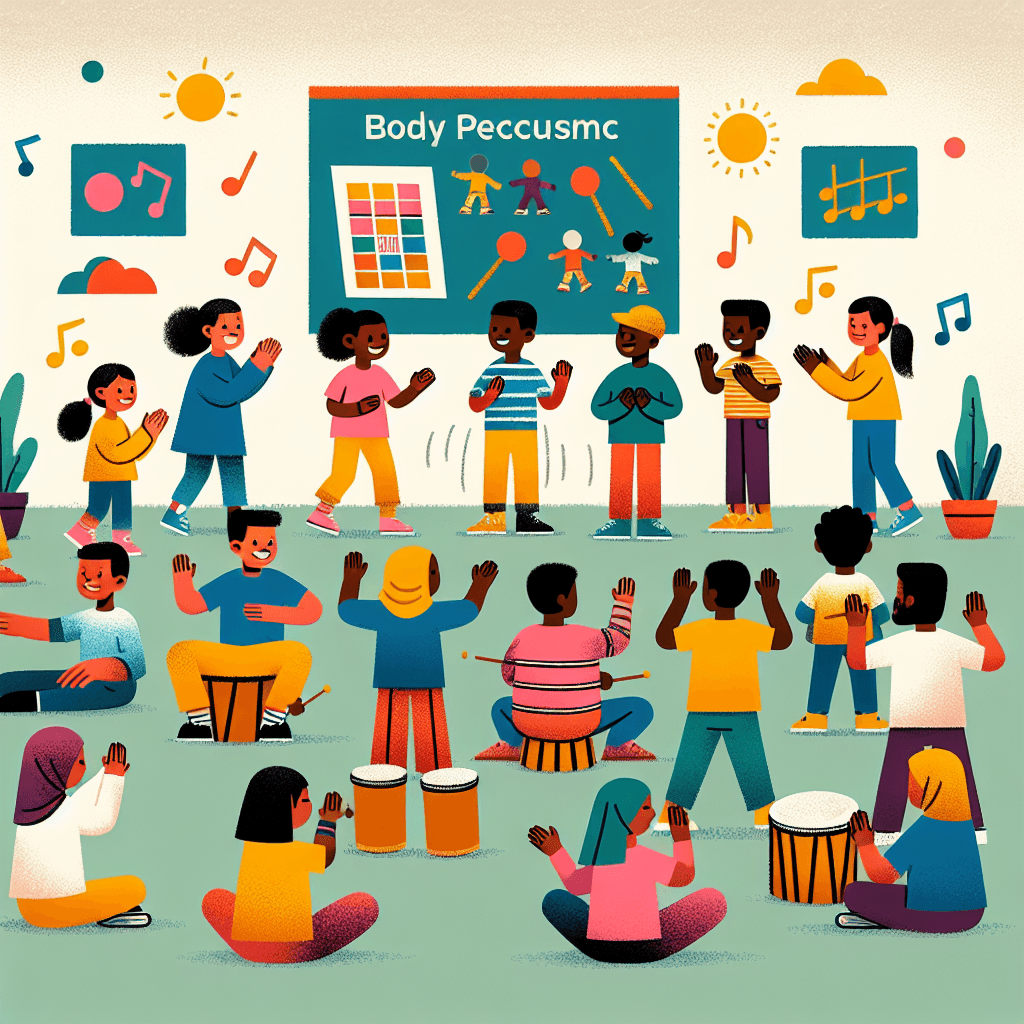
Body Percussion Game Challenge: Rhythm and Teamwork
Inquiry Framework
Question Framework
Driving Question
The overarching question that guides the entire project.How can we collaboratively design, notate, and evaluate a body percussion rhythm game that effectively teaches rhythm skills and promotes teamwork?Essential Questions
Supporting questions that break down major concepts.- How can we create different rhythmic patterns using body percussion?
- How does teamwork contribute to the success of a musical performance?
- How can we notate body percussion rhythms in a way that others can understand?
- How can we evaluate the effectiveness of our rhythm game in teaching rhythm skills?
Standards & Learning Goals
Learning Goals
By the end of this project, students will be able to:- Students will be able to create different rhythmic patterns using body percussion.
- Students will be able to notate body percussion rhythms in a way that others can understand.
- Students will be able to evaluate the effectiveness of our rhythm game in teaching rhythm skills.
- Students will be able to demonstrate how teamwork contributes to the success of a musical performance.
Entry Events
Events that will be used to introduce the project to studentsSecret Rhythm Mission
The class receives a 'secret mission' from a fictional organization dedicated to preserving rhythm. The mission: to create a body percussion game that teaches others about different rhythmic patterns and promotes teamwork, presented through a fun, engaging video message.Flash Mob Inspiration
Students watch a video of a flash mob using body percussion in a public space. This sparks a discussion about the power of rhythm and collaboration, leading to the challenge of designing their own flash mob performance to promote a school event.Body Percussion Performance
A famous body percussion group visits the class and performs an amazing show. After the performance, they challenge the students to create their own body percussion piece to be performed at the school assembly, connecting to student interests in performance and teamwork.Portfolio Activities
Portfolio Activities
These activities progressively build towards your learning goals, with each submission contributing to the student's final portfolio.Rhythm Explorers
Students experiment with various body percussion sounds and combine them to create simple rhythmic patterns. They record these patterns and share them with the class.Steps
Here is some basic scaffolding to help students complete the activity.Final Product
What students will submit as the final product of the activityA recording and written notation of three original rhythmic patterns.Alignment
How this activity aligns with the learning objectives & standardsLearning Goal: Students will be able to create different rhythmic patterns using body percussion.Rubric & Reflection
Portfolio Rubric
Grading criteria for assessing the overall project portfolioRhythm Explorers Rubric
Rhythmic Composition
Assessment of rhythmic accuracy, creativity, and notation skillsRhythmic Accuracy
Accuracy of rhythmic patterns and notation
Exemplary
4 PointsRhythmic patterns are accurately notated and performed with precision, showing sophisticated understanding of rhythmic values and relationships.
Proficient
3 PointsRhythmic patterns are mostly accurately notated and performed, demonstrating a solid understanding of basic rhythmic values.
Developing
2 PointsRhythmic patterns show some inaccuracies in notation and performance, indicating a developing understanding of rhythmic values.
Beginning
1 PointsRhythmic patterns contain significant inaccuracies in notation and performance, showing a beginning understanding of rhythmic values.
Creativity and Originality
Creativity and originality in rhythmic pattern design
Exemplary
4 PointsRhythmic patterns demonstrate exceptional creativity and originality, with unique combinations of body percussion sounds and rhythmic ideas.
Proficient
3 PointsRhythmic patterns demonstrate creativity and originality, showing thoughtful combinations of body percussion sounds and rhythmic ideas.
Developing
2 PointsRhythmic patterns show some creativity, with basic combinations of body percussion sounds and rhythmic ideas.
Beginning
1 PointsRhythmic patterns lack creativity and consist of simple, unoriginal combinations of body percussion sounds.
Notational Clarity
Clarity and effectiveness of written notation
Exemplary
4 PointsWritten notation is exceptionally clear, organized, and easy to understand, effectively communicating the rhythmic patterns to others.
Proficient
3 PointsWritten notation is clear, organized, and easy to understand, successfully communicating the rhythmic patterns to others.
Developing
2 PointsWritten notation is somewhat unclear or disorganized, making it challenging to understand the rhythmic patterns.
Beginning
1 PointsWritten notation is unclear, disorganized, and difficult to understand, failing to effectively communicate the rhythmic patterns.