
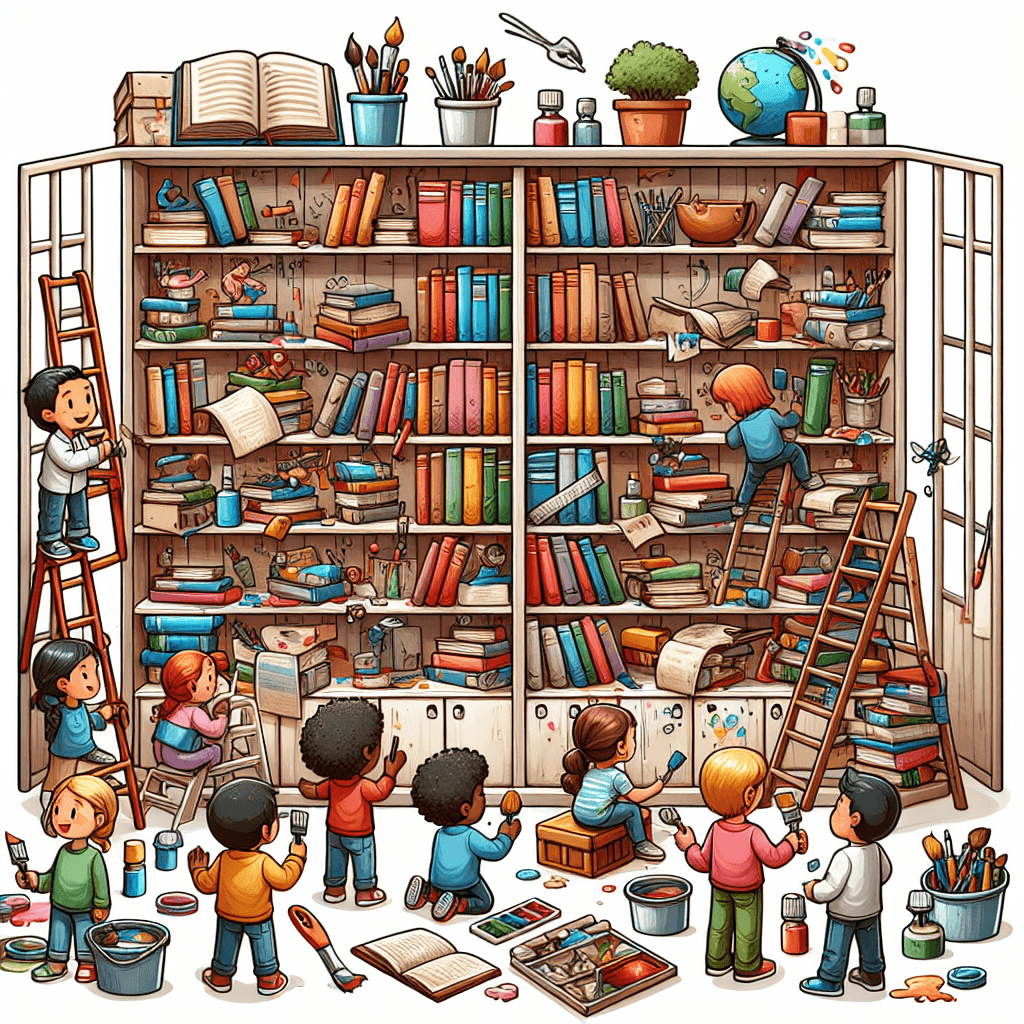
Bookcase Renovation Challenge
Inquiry Framework
Question Framework
Driving Question
The overarching question that guides the entire project.How can we collaboratively restore a broken bookcase to ensure its structural integrity, aesthetic appeal, and environmental sustainability while considering the economic and biological materials involved?Essential Questions
Supporting questions that break down major concepts.- How can we use math to ensure the structural integrity of a bookcase?
- What techniques can be used to critique and improve written communication about a project?
- How do physical forces affect the stability and durability of structures?
- What are the economic considerations in repairing and restoring furniture?
- How can we incorporate environmentally friendly practices in furniture restoration?
- How do biological materials used in furniture impact environmental sustainability?
Standards & Learning Goals
Learning Goals
By the end of this project, students will be able to:- Students will understand and apply mathematical concepts to calculate dimensions, area, and volume necessary for repairing the bookcase.
- Students will practice writing and verbal communication skills to articulate their process and findings in a structured and persuasive manner.
- Students will explore the physical and biological materials involved in furniture construction and restoration, analyzing their environmental impact.
- Students will learn to consider economic implications in decision-making processes related to materials and tools for the bookcase project.
- Students will engage in critical thinking and collaborative problem-solving to restore the bookcase with a focus on sustainability and aesthetics.
Next Generation Science Standards
Common Core Standards for English Language Arts
Common Core Standards for Mathematics
Next Generation Science Standards for Engineering Design
C3 Framework for Social Studies State Standards
Entry Events
Events that will be used to introduce the project to studentsMystery Pieces Challenge
Students enter the classroom to find a pile of seemingly random 'broken' bookcase pieces scattered around. Each piece has a unique code or QR that leads to a puzzle about climate change effects, challenging them to 'unlock' each piece by solving writing and math challenges focused on sustainability.Architects of Tomorrow
Students team up as architects tasked with redesigning the bookcase to not only be functional but environmentally friendly. They will study principles of eco-friendly architecture and design, using their findings to create a comprehensive plan incorporating math, science, and sustainable economics.Portfolio Activities
Portfolio Activities
These activities progressively build towards your learning goals, with each submission contributing to the student's final portfolio.Architectural Blueprint Creations
Students design a blueprint for the restored bookcase, incorporating eco-friendly architecture principles. They calculate dimensions, area, and material requirements.Steps
Here is some basic scaffolding to help students complete the activity.Final Product
What students will submit as the final product of the activityA comprehensive blueprint that includes all calculations and eco-friendly elements.Alignment
How this activity aligns with the learning objectives & standardsAligns with CCSS.MATH.CONTENT.6.G.A.1 by solving practical geometry problems, and MS-ETS1-1 by defining design criteria and constraints.Force and Stability Lab
Students experiment with physical forces to understand how they impact the stability and durability of the bookcase. They apply scientific principles to ensure structural integrity.Steps
Here is some basic scaffolding to help students complete the activity.Final Product
What students will submit as the final product of the activityA lab report detailing experiments, observations, and conclusions about force impacts on bookcase stability.Alignment
How this activity aligns with the learning objectives & standardsAligns with MS-ETS1-1 by considering scientific principles in design problem solving for structural integrity.Critical Writing Workshop
Students write a persuasive essay detailing their bookcase restoration plan, using evidence and clear reasoning to support their methods and choices. This engages their ability to critique perspectives.Steps
Here is some basic scaffolding to help students complete the activity.Final Product
What students will submit as the final product of the activityA persuasive essay presenting the restoration plan with methodologies and supporting evidence.Alignment
How this activity aligns with the learning objectives & standardsAligns with CCSS.ELA-LITERACY.W.6.1 by writing arguments supported by evidence, showcasing clear reasoning.Rubric & Reflection
Portfolio Rubric
Grading criteria for assessing the overall project portfolioSustainable Bookcase Restoration Project Rubric
Design and Math Application
Assesses students' ability to apply mathematical concepts to design and calculate dimensions for a functional and aesthetically pleasing bookcase.Design Blueprint
Evaluates the completeness and accuracy of the bookcase blueprint, including the use of geometry to calculate dimensions and materials.
Exemplary
4 PointsBlueprint is exceptionally detailed and accurate, demonstrating a sophisticated understanding of geometry to ensure structural integrity and aesthetic appeal. All calculations are correct and thoroughly documented.
Proficient
3 PointsBlueprint is detailed and accurate, showing a thorough understanding of geometric calculations. Most calculations are correct and well-documented.
Developing
2 PointsBlueprint shows a basic understanding of geometry. Some calculations are correct, but there may be minor errors or omissions in documentation.
Beginning
1 PointsBlueprint is incomplete or inaccurate, showing limited understanding of geometric principles. Calculations are mostly incorrect or missing.
Incorporation of Eco-friendly Elements
Assesses the extent to which students have integrated sustainable materials and practices into their design.
Exemplary
4 PointsDesign includes innovative and comprehensive use of eco-friendly materials and practices, clearly reflecting a deep understanding of sustainability.
Proficient
3 PointsDesign includes substantial use of eco-friendly materials and practices, demonstrating a good understanding of sustainability.
Developing
2 PointsDesign includes some eco-friendly elements but lacks thorough application or understanding of sustainability principles.
Beginning
1 PointsMinimal or no eco-friendly elements are included in the design, showing little understanding of sustainability.
Scientific Inquiry and Analysis
Evaluates students' understanding of physical forces affecting structure stability and their application of scientific methods in the Force and Stability Lab.Experimentation and Observations
Assesses the student's ability to conduct experiments accurately, record observations, and derive conclusions about structural impacts.
Exemplary
4 PointsDemonstrates a thorough and accurate experimental process with well-documented observations and insightful conclusions about structural stability.
Proficient
3 PointsConducts a complete experimental process with accurate observations and clear conclusions about structural stability.
Developing
2 PointsExperimental process is basic with some accurate observations but limited conclusions about structural impacts.
Beginning
1 PointsExperimental process is incomplete with inaccurate observations and minimal conclusions about structural stability.
Writing and Argumentation
Assesses students’ ability to write a structured persuasive essay with evidence-based arguments supporting the restoration plan.Essay Structure and Coherence
Evaluates the organization, clarity, and coherence of the essay, focusing on the logical flow of information and arguments.
Exemplary
4 PointsEssay is exceptionally well-organized, with clear, logical arguments and a sophisticated integration of evidence supporting the restoration plan.
Proficient
3 PointsEssay is well-organized, with coherent arguments and clear evidence supporting the restoration plan.
Developing
2 PointsEssay shows some organization, but arguments may lack coherence or be weakly supported by evidence.
Beginning
1 PointsEssay is poorly organized, with unclear arguments and insufficient evidence.
Use of Evidence
Evaluates how well students use evidence to support their arguments, including the integration of feedback and research.
Exemplary
4 PointsUses diverse and relevant evidence effectively, integrating feedback and research to create a compelling argument for the restoration plan.
Proficient
3 PointsUses relevant evidence to support arguments, integrating feedback and research appropriately.
Developing
2 PointsUses some evidence to support arguments, with limited integration of feedback or research.
Beginning
1 PointsUses minimal evidence, with little to no integration of feedback or research.