
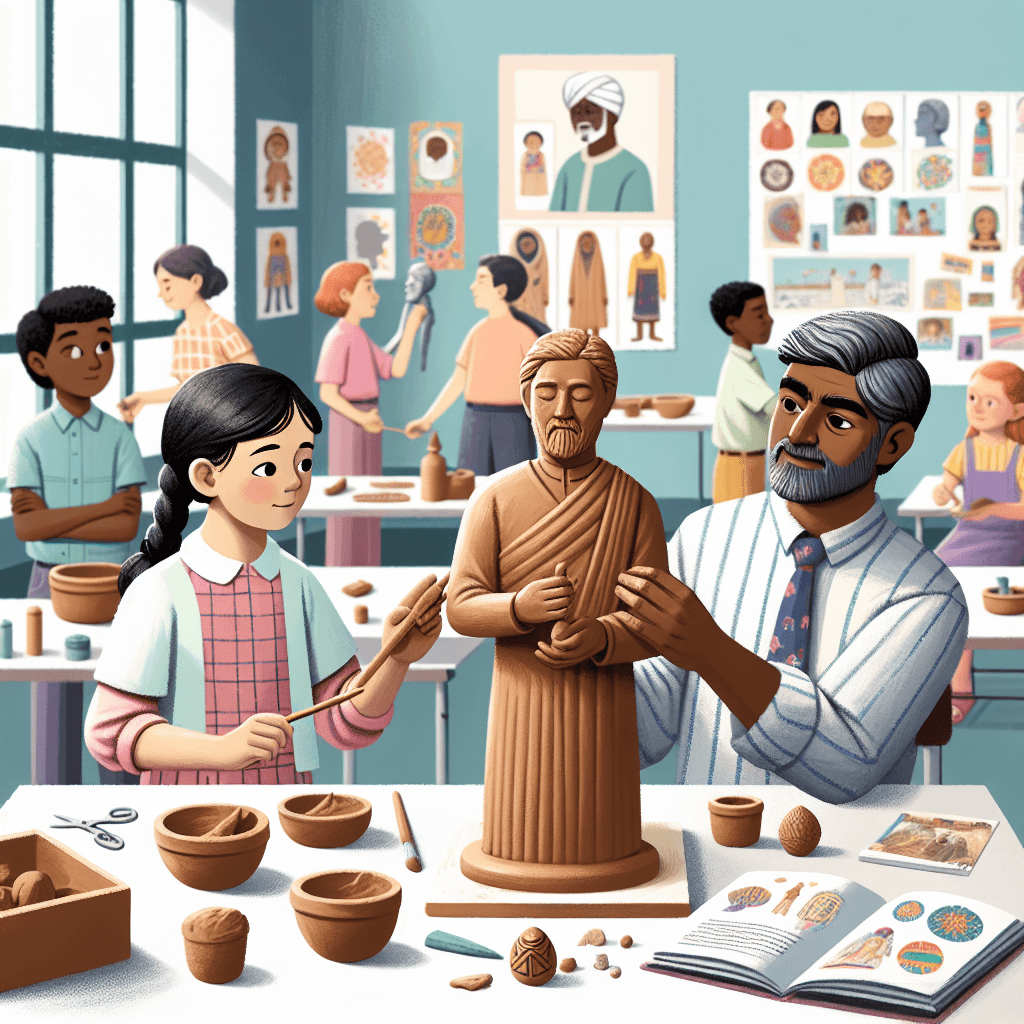
Bringing a Historical Figure to Life
Inquiry Framework
Question Framework
Driving Question
The overarching question that guides the entire project.How can we combine research, narrative techniques, and artistic creativity to create an engaging, accurate, and authentic portrayal of a historical figure for 'A Night at the Museum' that effectively conveys their achievements and context in a compelling way?Essential Questions
Supporting questions that break down major concepts.- What are the major achievements and contributions of the selected historical figure to their society and the world?
- How can we use narrative techniques to effectively tell the story of a historical figure?
- In what ways can the context of the time period in which the historical figure lived influence our portrayal of their life and achievements?
- What organizational strategies can we employ to present the historical figure's story in a compelling and engaging way?
- How do the arts (architecture, visual arts, performance) contribute to an authentic portrayal of a historical figure in a museum setting?
- What role does research play in understanding and portraying the complexities of a historical figure's life and legacy?
Standards & Learning Goals
Learning Goals
By the end of this project, students will be able to:- Students will research a historical figure, focusing on their major achievements and contributions, and present their findings in a narrative format.
- Students will apply narrative techniques to create engaging and accurate portrayals of historical figures.
- Students will organize information logically to tell the historical figure's story effectively.
- Students will incorporate artistic elements to enhance the authenticity of their portrayal in a museum setting.
- Students will develop presentation skills by showcasing their work to an audience.
Common Core Standards
Next Generation Science Standards
Entry Events
Events that will be used to introduce the project to studentsVirtual Reality Portal
A virtual reality setup transforms the classroom into a different era, allowing students to 'meet' their historical figure. As they interact with the environment, they pick up clues about the individual's life and context, prompting them to explore deeper and craft their museum narrative.Time Capsule Discovery
Students receive a mysterious time capsule, supposedly buried by one of the historical figures they will be studying. Inside, they discover artifacts, personal notes, and 'unfinished business' tasks left by the figure, challenging them to solve these puzzles and complete the story for the museum event.Portfolio Activities
Portfolio Activities
These activities progressively build towards your learning goals, with each submission contributing to the student's final portfolio.Historical Figure Treasure Hunt
Students embark on a creative and investigative activity to gather initial clues about their chosen historical figure. This activity is designed to initiate interest and provide a foundational understanding of the historical figure's life, setting the stage for deeper research.Steps
Here is some basic scaffolding to help students complete the activity.Final Product
What students will submit as the final product of the activityAn initial research outline highlighting potential areas of exploration about the historical figure.Alignment
How this activity aligns with the learning objectives & standardsAligns with CCSS.ELA-LITERACY.RI.6.1 by encouraging initial research and evidence collection to support subsequent analyses.Character Context Chronicle
Students dive deeper into the life and setting of their historical figure, developing a rich, context-based narrative framework for their portrayal. This exercise focuses on understanding the historical and geographical context of their figure’s life.Steps
Here is some basic scaffolding to help students complete the activity.Final Product
What students will submit as the final product of the activityA comprehensive contextual essay and timeline that sets the backdrop for each student’s narrative portrayal.Alignment
How this activity aligns with the learning objectives & standardsContributes to CCSS.ELA-LITERACY.W.6.2 by promoting the creation of informative texts conveying ideas through organized content.Narrative Techniques Workshop
In this collaborative workshop, students learn narrative techniques to develop engaging stories about their historical figures. This activity aims to transform raw historical facts into compelling narratives.Steps
Here is some basic scaffolding to help students complete the activity.Final Product
What students will submit as the final product of the activityA collection of short narrative drafts utilizing various storytelling techniques for each historical figure.Alignment
How this activity aligns with the learning objectives & standardsSupports CCSS.ELA-LITERACY.W.6.3 by guiding students in using narrative skills to detail imagined events based on historical facts.Artistic Interpretation Studio
Students explore artistic elements to enhance their portrayal, bridging history with creative expression. This session emphasizes the integration of visual arts to manifest aspects of the figure’s story into tangible displays.Steps
Here is some basic scaffolding to help students complete the activity.Final Product
What students will submit as the final product of the activityA visual art piece reflecting the life or achievements of the historical figure, to be displayed in the museum event.Alignment
How this activity aligns with the learning objectives & standardsConnects with NGSS.MS-ESS3-3 by applying creative principles to design expressive artistic methods.Museum Exhibit Presentation Prep
This final preparatory activity focuses on refining presentation skills to effectively communicate research findings and narratives. Students will prepare to present their exhibits as though they are curators at a museum.Steps
Here is some basic scaffolding to help students complete the activity.Final Product
What students will submit as the final product of the activityA fully-prepared museum exhibit presentation showcasing the student’s research, narrative, and artistic interpretations.Alignment
How this activity aligns with the learning objectives & standardsMeets CCSS.ELA-LITERACY.SL.6.4 by developing skills needed for effective public presentation of claims and findings.Rubric & Reflection
Portfolio Rubric
Grading criteria for assessing the overall project portfolioHistorical Figure Portrayal Project Rubric
Research Quality
Assesses the depth and accuracy of research conducted on the historical figure, including the use of primary and secondary sources to support analysis and portrayal.Depth of Research
Evaluates how thoroughly the student researched the historical figure, examining both breadth and depth of information gathered.
Exemplary
4 PointsStudent thoroughly investigates numerous credible sources, providing comprehensive insights into the historical figure's life and context, supported by rich detail.
Proficient
3 PointsStudent researches multiple credible sources, presenting detailed and accurate information about the historical figure.
Developing
2 PointsStudent investigates several sources but may rely heavily on a few, resulting in uneven coverage of the historical figure's life and context.
Beginning
1 PointsStudent uses minimal sources, and the information collected offers only a basic overview of the historical figure's life.
Use of Primary and Secondary Sources
Evaluates the selection and integration of primary and secondary sources to support the portrayal of the historical figure.
Exemplary
4 PointsStudent expertly selects and integrates a balanced mix of primary and secondary sources, enhancing the portrayal with powerful evidence.
Proficient
3 PointsStudent effectively uses a combination of primary and secondary sources to support the portrayal with substantial evidence.
Developing
2 PointsStudent uses sources but tends to focus on one type over the other, providing some evidence but with noticeable gaps.
Beginning
1 PointsStudent relies mostly on general secondary sources with little attention to primary evidence, limiting the richness of the narrative.
Narrative Development
Assesses the use of narrative techniques to create an engaging and authentic portrayal of the historical figure's life and achievements.Use of Narrative Techniques
Evaluates the application of narrative elements such as descriptive language, sequence events, and storytelling techniques.
Exemplary
4 PointsStudent skillfully employs narrative techniques to create a vivid, engaging, and coherent story that accurately reflects the historical figure's life.
Proficient
3 PointsStudent uses narrative techniques effectively to create an engaging and coherent story of the historical figure.
Developing
2 PointsStudent attempts to use narrative techniques but with inconsistent effectiveness, resulting in a partially coherent portrayal.
Beginning
1 PointsStudent minimally employs narrative techniques, leading to a disjointed or incomplete portrayal.
Artistic Integration
Assesses the student's ability to creatively incorporate artistic elements that enhance the portrayal of the historical figure.Artistic Creativity
Evaluates the creativity and relevance of artistic media chosen to represent the historical figure's context or achievements.
Exemplary
4 PointsStudent creates a highly creative and relevant art piece that enhances the portrayal and engages the viewer.
Proficient
3 PointsStudent produces a creative and relevant art piece that complements the portrayal effectively.
Developing
2 PointsStudent generates an art piece with some creative elements but inconsistent relevance to the portrayal.
Beginning
1 PointsStudent produces an art piece with minimal creativity or relevance, limiting its impact on the portrayal.
Presentation Skills
Assesses the effectiveness and clarity of the presentation, including organization, public speaking techniques, and engagement with the audience.Public Speaking Effectiveness
Evaluates the use of public speaking skills such as eye contact, volume, clarity, and engagement during the presentation.
Exemplary
4 PointsStudent commands the audience with clear, well-paced speech, excellent eye contact, and engaging delivery throughout the presentation.
Proficient
3 PointsStudent delivers a clear and engaging presentation using effective public speaking techniques.
Developing
2 PointsStudent attempts public speaking skills with mixed effectiveness, resulting in variable engagement.
Beginning
1 PointsStudent's presentation lacks clear articulation and engagement, often requiring support to maintain audience interest.