
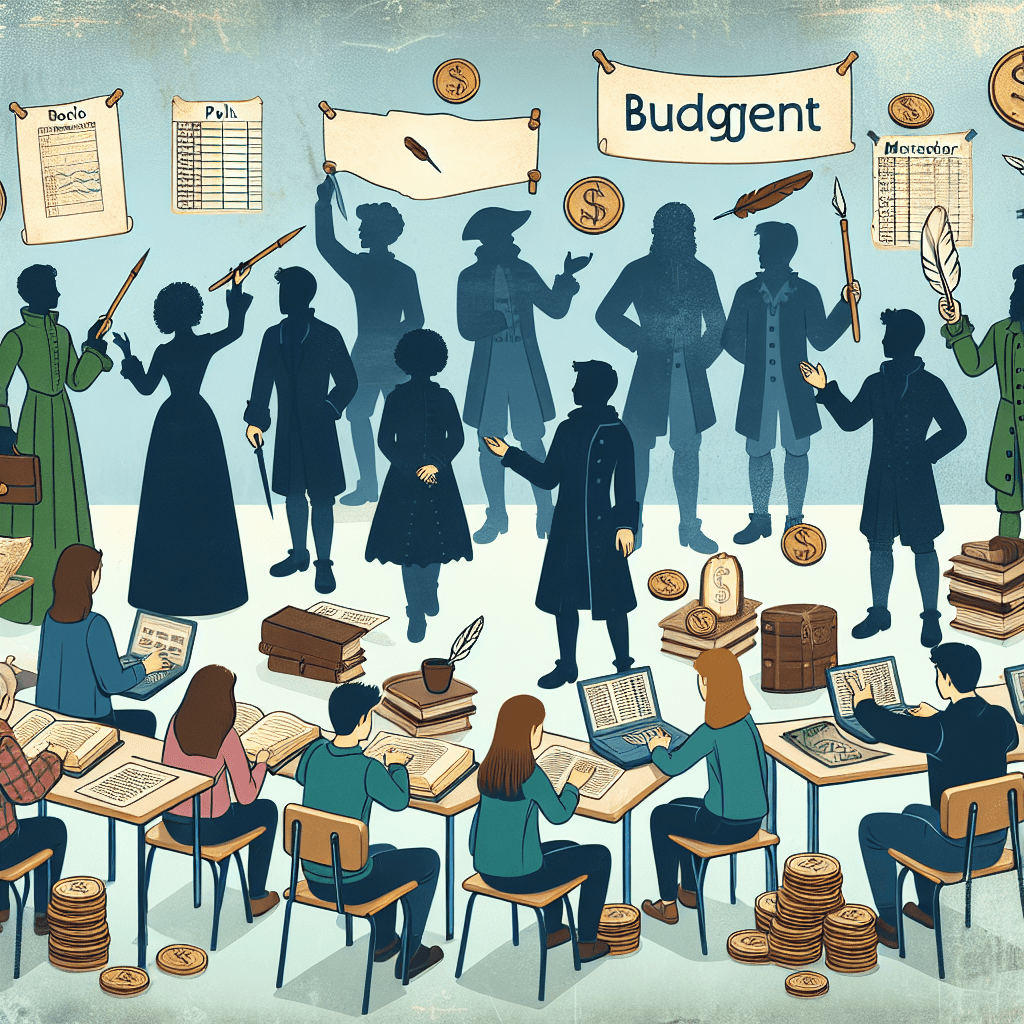
Budgeting for Fictional Characters: A Historical Approach
Inquiry Framework
Question Framework
Driving Question
The overarching question that guides the entire project.How can we create a realistic monthly budget for a fictional character by exploring their historical context and the economic realities of their time?Essential Questions
Supporting questions that break down major concepts.- How do historical events influence economic practices and personal budgeting decisions?
- What role does budgeting play in managing personal finances during historical events or periods?
- How can understanding of a fictional character's historical context help in creating a realistic budget?
- In what ways do historical perspectives in fiction reflect economic realities of their time?
Standards & Learning Goals
Learning Goals
By the end of this project, students will be able to:- Students will learn to create a realistic monthly budget based on historical economic contexts and their implications on personal finances.
- Students will analyze the historical context of a fictional character to inform budgeting decisions and economic practices.
- Students will develop an understanding of how historical events and periods influence economic behaviors and personal budgeting strategies.
- Students will gain insights into the relationship between historical perspectives in fiction and the economic realities of their time.
Teacher-specified standards
Entry Events
Events that will be used to introduce the project to studentsBudget Survival Game
Engage students in an interactive game where their character must survive a month using a fixed budget while dealing with unexpected 'life events' that affect their finances. This introduces concepts of budgeting and financial planning dynamically.Portfolio Activities
Portfolio Activities
These activities progressively build towards your learning goals, with each submission contributing to the student's final portfolio.Character Budget Research Expedition
Students initiate the budgeting journey by selecting a favorite fictional character and researching their historical context, including economic conditions and lifestyle. This sets the stage for a realistic budget creation based on evidence.Steps
Here is some basic scaffolding to help students complete the activity.Final Product
What students will submit as the final product of the activityA research dossier detailing the historical and economic background of the chosen character.Alignment
How this activity aligns with the learning objectives & standardsAligns with understanding historical context and economic influences for informed budgeting decisions (8.E1.5).Budget Blueprint: Sketching the Finances
Students translate their research findings into an initial budget plan, outlining anticipated income, essential expenses, and luxury items for their fictional character.Steps
Here is some basic scaffolding to help students complete the activity.Final Product
What students will submit as the final product of the activityA drafted budget plan featuring income and detailed expenses for the fictional character.Alignment
How this activity aligns with the learning objectives & standardsFulfills the requirement of creating a budget with a solid foundation drawn from historical insights (8.E1.5).Balancing Act: Budget Refinement Challenge
Students refine their budget by adjusting figures in response to hypothetical 'life events' that could have affected their character, teaching adaptability in budgeting.Steps
Here is some basic scaffolding to help students complete the activity.Final Product
What students will submit as the final product of the activityAn adjusted budget that accommodates historical events, reflecting the dynamic nature of financial planning.Alignment
How this activity aligns with the learning objectives & standardsEnhances critical thinking and adaptability skills in budget management, as per the standards (8.E1.5).Budget Presentation: Historical Financial Narratives
Culminating the project, students present their budget findings and reflections on the process, linking their insights to historical economic realities and the narrative of their character.Steps
Here is some basic scaffolding to help students complete the activity.Final Product
What students will submit as the final product of the activityA comprehensive presentation narrating the character's financial journey, rooted in historical context and economic analysis.Alignment
How this activity aligns with the learning objectives & standardsMeets the goals of analyzing and reflecting on the budgeting process and its historical implications, satisfying the teaching standards (8.E1.5).Rubric & Reflection
Portfolio Rubric
Grading criteria for assessing the overall project portfolioHistorical Financial Context and Budgeting Rubric
Historical Research and Context Understanding
Evaluates the ability to research and understand the historical context and economic conditions relevant to the chosen fictional character.Depth of Historical Research
Measures the thoroughness and insightfulness of research conducted on the historical period and context of the chosen character.
Exemplary
4 PointsConducts extensive and insightful research, providing a comprehensive understanding of the historical era and economic conditions.
Proficient
3 PointsConducts thorough research with a clear understanding of the historical era and economic conditions.
Developing
2 PointsConducts basic research with some understanding of historical era and economic conditions.
Beginning
1 PointsConducts minimal research with limited understanding of historical era and economic conditions.
Use of Historical Context in Budget Creation
Evaluates how well the historical context is integrated into the budgeting process and the character's financial decisions.
Exemplary
4 PointsSeamlessly integrates historical context into all aspects of budget creation, demonstrating sophisticated connections.
Proficient
3 PointsEffectively integrates historical context into most aspects of budget creation, demonstrating sound connections.
Developing
2 PointsSome integration of historical context into budget creation, demonstrating partial connections.
Beginning
1 PointsLimited integration of historical context into budget creation, demonstrating few connections.
Budget Planning and Financial Analysis
Assesses the completeness, realism, and analysis skill in creating and refining the budget based on the character's historical and economic context.Budget Completeness and Realism
Measures the extent to which the budget covers necessary income, expenses, and historical realism.
Exemplary
4 PointsProduces a highly detailed, realistic budget that thoroughly covers income and expenses with historical accuracy.
Proficient
3 PointsProduces a comprehensive budget that adequately covers income and expenses with reasonable historical accuracy.
Developing
2 PointsProduces a basic budget with some details on income and expenses with limited historical accuracy.
Beginning
1 PointsProduces an incomplete budget with minimal income and expense details and lacks historical accuracy.
Adaptability to Financial Challenges
Evaluates how students adjust budgets in response to hypothetical events, demonstrating flexibility and critical thinking.
Exemplary
4 PointsExemplifies exceptional adaptability and critical thinking by effectively managing budget changes due to multiple financial scenarios.
Proficient
3 PointsShows proficient adaptability by managing budget changes effectively in response to financial scenarios.
Developing
2 PointsExhibits some adaptability, with partial adjustment to budget changes from financial scenarios.
Beginning
1 PointsStruggles with adapting budget to changes or managing financial scenarios.
Presentation and Reflection
Evaluates the presentation of the budgeting process, historical insights, and personal reflections on learning.Clarity and Organization
Assesses the clarity and structured organization of the presentation demonstrating the budgeting process.
Exemplary
4 PointsPresents information in a highly organized, clear, and engaging manner, thoroughly detailing the budgeting process.
Proficient
3 PointsPresents information clearly and logically, effectively detailing the budgeting process.
Developing
2 PointsPresents information with some clarity and organization, detailing some parts of the budgeting process.
Beginning
1 PointsPresents information in a disorganized or unclear manner, with little detail of the budgeting process.
Insightful Reflection on Learning
Measures the depth of learning reflection and connection to historical and economic understanding.
Exemplary
4 PointsProvides profound and insightful reflection on learning, connecting deeply with historical and economic contexts.
Proficient
3 PointsProvides thoughtful reflection on learning, connecting appropriately with historical and economic contexts.
Developing
2 PointsProvides basic reflection on learning, with some connection to historical and economic contexts.
Beginning
1 PointsProvides minimal reflection on learning, with little connection to historical and economic contexts.