
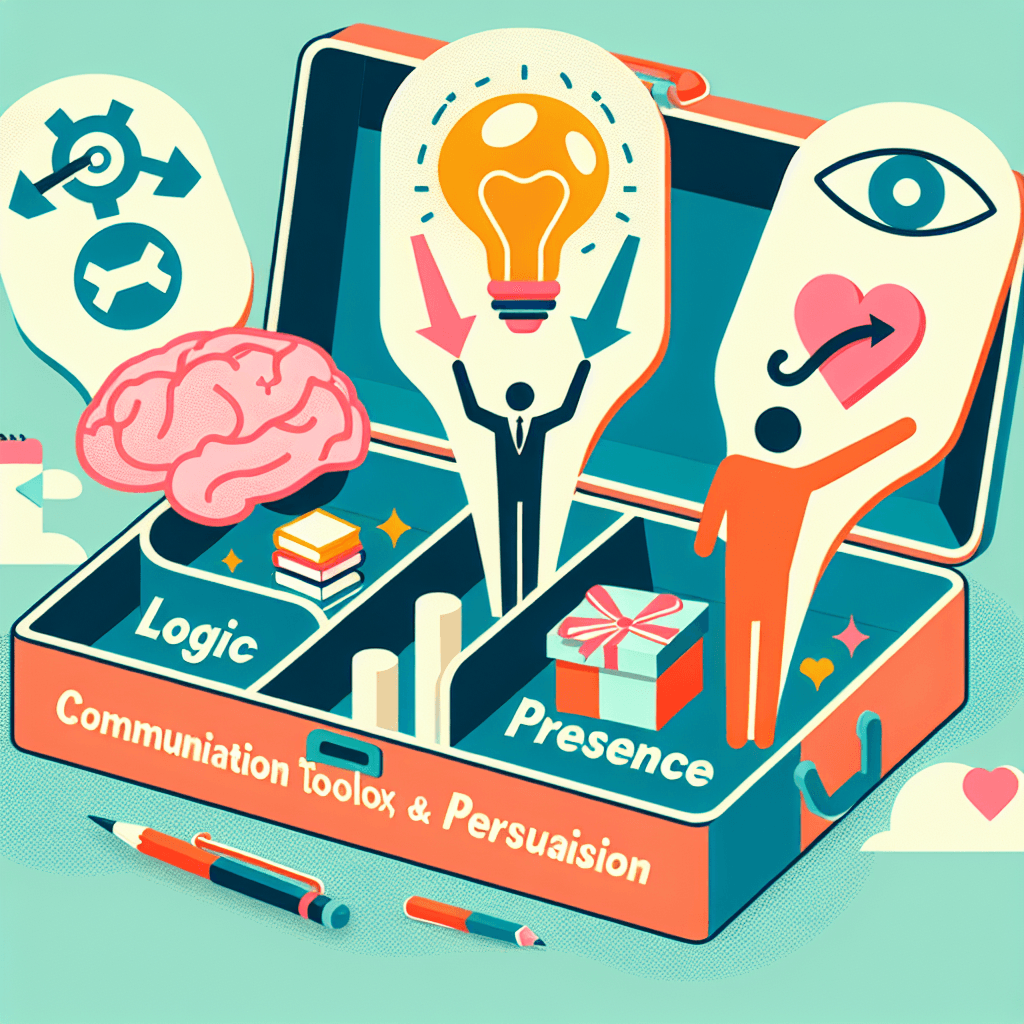
Building the Communication Toolbox: Logic, Presence, and Persuasion
Inquiry Framework
Question Framework
Driving Question
The overarching question that guides the entire project.How can I engineer a personalized communication "toolbox"—blending logic, storytelling, and presence—to bridge the gap between my analytical mind and assertive verbal expression?Essential Questions
Supporting questions that break down major concepts.- How can I bridge the gap between logical thinking (my "math brain") and verbal expression to ensure my ideas are clearly communicated?
- What techniques can I use to identify and challenge false claims or logical fallacies without feeling overwhelmed by an opponent's confidence?
- How does the integration of storytelling and evidence transform an abstract argument into a persuasive and memorable message?
- In what ways can I develop 'presence' and 'reading the room' to manage my introversion and stay grounded during high-pressure or confrontational interactions?
- How can I practice active word retrieval so that the 'right words' are accessible when I need them most?
- How do I structure a 'communication toolbox' that allows me to transition from a passive listener to an assertive and effective communicator?
Standards & Learning Goals
Learning Goals
By the end of this project, students will be able to:- Identify and deconstruct logical fallacies and emotional manipulation in real-time conversation to remain grounded and objective during disagreements.
- Synthesize analytical data (math-oriented logic) with narrative storytelling to create persuasive arguments that resonate with diverse audiences.
- Develop and utilize a personalized 'verbal toolkit' comprising transitional phrases and high-impact vocabulary to overcome word-retrieval challenges during spontaneous speech.
- Apply 'presence' techniques—such as controlled pacing, active listening, and body language awareness—to manage introversion and maintain assertiveness in confrontational settings.
- Construct a structured 'Communication Toolbox' digital or physical resource that outlines strategies for bridging the gap between internal thought and verbal expression.
Common Core State Standards (ELA)
Entry Events
Events that will be used to introduce the project to studentsThe 'Bullshit' Audit: Dismantling Charisma
You are presented with a series of 60-second video clips of charismatic public figures making factually incorrect or logically flawed claims. Your task is to ignore their confidence and 'math out' the logical fallacies, creating a 'Logic Map' that exposes the structural gaps hidden behind their storytelling.The Argumentation Equation: Logic as a Formula
Since you are math-inclined, we treat communication as a series of equations (e.g., Evidence + Narrative = Persuasion). You will identify a personal value you’ve struggled to defend and build a 'Logical Proof' for it, then practice 'solving' a mock conversation where an opponent tries to introduce a variable of misinformation.The Historical Remix: Redesigning the Past
You are hired as a 'Shadow Consultant' for a historical figure who lost a major argument (e.g., a scientist whose warnings were ignored). You must draft a 3-step 'Communication Intervention' that combines your data-driven logic with a compelling narrative to change the outcome of that historical event.The Minimalist Rebuttal: Reclaiming the Room
We analyze a high-stakes workplace scenario (like a salary negotiation or project pitch) where the loudest person usually wins. You will design a 'Minimalist Rebuttal'—a toolkit of 5 powerful, low-confrontation phrases that force a 'loud' speaker to pause and provide evidence, returning the control of the room to you.The Translation Lab: Unlocking the Head-Space
You select a complex topic you understand deeply but struggle to explain. Using Marc’s 'Logic, Presence, Narrative' framework, you will 'translate' this topic into a 2-minute pitch for a non-expert, focusing specifically on using 'anchoring' words to ensure your thoughts don't stay locked in your head.Portfolio Activities
Portfolio Activities
These activities progressively build towards your learning goals, with each submission contributing to the student's final portfolio.The Logic Circuit Breaker: Deconstructing Charisma
To bridge the gap between a math-inclined mind and verbal argumentation, this activity treats a spoken argument like a mathematical proof. You will analyze a 'charismatic' but logically flawed speech to identify where the 'variables' (evidence) and 'operators' (logic) fail to add up to the 'solution' (claim).Steps
Here is some basic scaffolding to help students complete the activity.Final Product
What students will submit as the final product of the activityA 'Logical Proof Map'—a visual flowchart or equation that deconstructs a flawed argument and highlights exactly where the reasoning breaks down.Alignment
How this activity aligns with the learning objectives & standardsAligns with CCSS.ELA-LITERACY.SL.11-12.3: Evaluate a speaker's point of view, reasoning, and use of evidence and rhetoric. This activity leverages the student's mathematical background to objectively analyze verbal arguments, focusing on structural integrity rather than charisma.The Translation Lab: Bridging Data and Story
Using the 'Logic, Presence, Narrative' framework, you will take a complex, data-heavy topic you know well (math, tech, or a hobby) and 'translate' it for a non-expert. The goal is to use storytelling to make your logic 'land' without losing the substance.Steps
Here is some basic scaffolding to help students complete the activity.Final Product
What students will submit as the final product of the activityA 'Narrative Pitch Script'—a 2-minute speech that uses a specific historical analogy or personal story to explain a technical logical concept.Alignment
How this activity aligns with the learning objectives & standardsAligns with CCSS.ELA-LITERACY.SL.11-12.4: Present information and supporting evidence such that listeners can follow the line of reasoning. This activity focuses on Marc's pillar of 'Narrative,' helping the student move from abstract data to relatable storytelling.The Word Valve: Unlocking the Head-Space
To solve the 'locked in the head' problem, you will build a physical or digital 'Word Valve'—a collection of anchor phrases and transitional words that act as the 'plumbing' for your thoughts during high-pressure moments.Steps
Here is some basic scaffolding to help students complete the activity.Final Product
What students will submit as the final product of the activityA 'Personalized Phrase Deck'—a set of digital or physical flashcards containing 'go-to' phrases for common argumentative situations (e.g., clarifying, disagreeing, or asking for evidence).Alignment
How this activity aligns with the learning objectives & standardsAligns with CCSS.ELA-LITERACY.L.11-12.6: Acquire and use accurately general academic and domain-specific words and phrases. This specifically targets the student's struggle with word-retrieval by creating 'pre-loaded' verbal assets.The Minimalist Rebuttal: Reclaiming the Room
In this activity, you will apply your logic and phrases to a real-world scenario: dealing with a 'loud' or overconfident speaker. You will design a 'Minimalist Rebuttal' strategy that allows you to stay grounded and assertive without needing to be 'confrontational.'Steps
Here is some basic scaffolding to help students complete the activity.Final Product
What students will submit as the final product of the activityThe 'Assertive Playbook'—a one-page tactical guide for a specific upcoming conversation (like a meeting or discussion) detailing how to use 'Presence' and 'Minimalism' to maintain control.Alignment
How this activity aligns with the learning objectives & standardsAligns with CCSS.ELA-LITERACY.SL.11-12.1: Initiate and participate effectively in collaborative discussions, building on others' ideas and expressing their own clearly. This focuses on the 'Presence' pillar and managing introversion in confrontational settings.The Architect of Argumentation: Your Final Toolbox
This final activity involves compiling all your tools—Logic Maps, Narrative Scripts, Word Valves, and Rebuttal Playbooks—into a permanent 'Communication Toolbox.' This resource will serve as your lifelong reference for bridging the gap between your analytical mind and your verbal expression.Steps
Here is some basic scaffolding to help students complete the activity.Final Product
What students will submit as the final product of the activityThe 'Architect of Argumentation' Portfolio—a comprehensive digital dashboard (using Notion, a PDF, or a physical binder) that houses your personalized strategies, phrases, and logic frameworks.Alignment
How this activity aligns with the learning objectives & standardsAligns with all project standards, specifically CCSS.ELA-LITERACY.SL.11-12.4 and L.11-12.6. This is the cumulative synthesis of the student's personalized 'Communication Toolbox.'Rubric & Reflection
Portfolio Rubric
Grading criteria for assessing the overall project portfolioThe Architect of Argumentation Rubric
Argumentative Logic & Structure
Focuses on the cognitive ability to dismantle flawed reasoning and reconstruct it using the 'Logic, Presence, Narrative' framework.Logical Circuit Breaking & Analysis
Ability to deconstruct verbal arguments into logical components (variables and operators) and identify structural fallacies and rhetorical leaks.
Exemplary
4 PointsExemplary deconstruction of complex arguments; identifies subtle logical fallacies with mathematical precision and maps clear structural 'leaks' in persuasive rhetoric.
Proficient
3 PointsAccurately breaks down arguments into claims and evidence; identifies common logical fallacies and successfully maps the relationship between variables.
Developing
2 PointsIdentifies basic claims and evidence but struggles to map the logical operations; may overlook common fallacies or misidentify the 'leak' in the argument.
Beginning
1 PointsStruggles to distinguish between claims and evidence; unable to identify logical fallacies or provide a coherent map of the argument's structure.
Narrative-Logical Synthesis
Effectiveness in combining data-driven facts (Anchors) with compelling narrative (Hooks) to make abstract or technical concepts persuasive and accessible.
Exemplary
4 PointsSeamlessly integrates high-level data with sophisticated storytelling; uses historical or personal analogies to create a compelling, undeniable impact for the listener.
Proficient
3 PointsSuccessfully pairs a data anchor with a relevant narrative hook; script follows a logical 'Anchor-Story-Impact' structure that is clear to a non-expert.
Developing
2 PointsIncludes both data and a story, but the connection between them is weak or the transition is clunky, making the logic difficult for a non-expert to follow.
Beginning
1 PointsFocuses exclusively on data or story without integration; fails to use the 'Anchor-Story-Impact' framework to bridge the gap for the audience.
Interactive Execution & Presence
Evaluates the student's ability to access their internal 'toolbox' in real-time interactions, focusing on fluency and self-regulation.Verbal Retrieval & Fluency
Development and retrieval of pre-loaded 'Valve' phrases to overcome word-retrieval blocks and maintain flow during spontaneous speech.
Exemplary
4 PointsDemonstrates instant, natural retrieval of diverse 'Valve' phrases across all categories (Inquiry, Buffer, Rebuttal) even under high pressure or 'quick-fire' scenarios.
Proficient
3 PointsCan retrieve and apply relevant 'Valve' phrases within 3 seconds of a prompt; categories are well-defined and phrases are used accurately in context.
Developing
2 PointsRequires more than 5 seconds to retrieve 'Valve' phrases or relies heavily on a single category; application in spontaneous speech is inconsistent.
Beginning
1 PointsStruggles to identify or retrieve pre-loaded phrases; 'Word Valve' lacks diversity or is not accessible during mock communication sessions.
Presence & Assertive Engagement
Application of minimalist communication strategies and physical presence to manage introversion and hold space against confident or 'loud' speakers.
Exemplary
4 PointsExhibits masterful presence through controlled pacing, steady breathing, and the strategic use of 5-word minimalist rebuttals to command the room.
Proficient
3 PointsMaintains a steady pace and uses minimalist rebuttals effectively to force pauses in a conversation; shows clear awareness of physical presence goals.
Developing
2 PointsAttempts minimalist rebuttals but is easily thrown off by a confident opponent; presence techniques (breathing/pacing) are used inconsistently.
Beginning
1 PointsBecomes overwhelmed or passive in confrontational scenarios; fails to use minimalist rebuttals or self-regulation techniques to maintain control.
Metacognition & Resource Design
Assesses the comprehensive integration of all learned skills into a final, actionable product.Synthesis & Toolbox Development
The organization and utility of the final 'Architect of Argumentation' portfolio as a personalized, long-term communication reference.
Exemplary
4 PointsPortfolio is a sophisticated, highly organized professional resource; includes insightful reflection on the 'communication-as-equation' mindset and visionary rules of engagement.
Proficient
3 PointsPortfolio is well-organized and includes all key sections (Logic, Narrative, Presence, Valve); reflection clearly connects mathematical thinking to communication.
Developing
2 PointsPortfolio is missing one or more key sections or the organization is disorganized; reflection provides only a surface-level connection to personal growth.
Beginning
1 PointsPortfolio is incomplete or lacks a cohesive structure; fails to demonstrate a synthesis of the skills learned throughout the 14-day duration.