
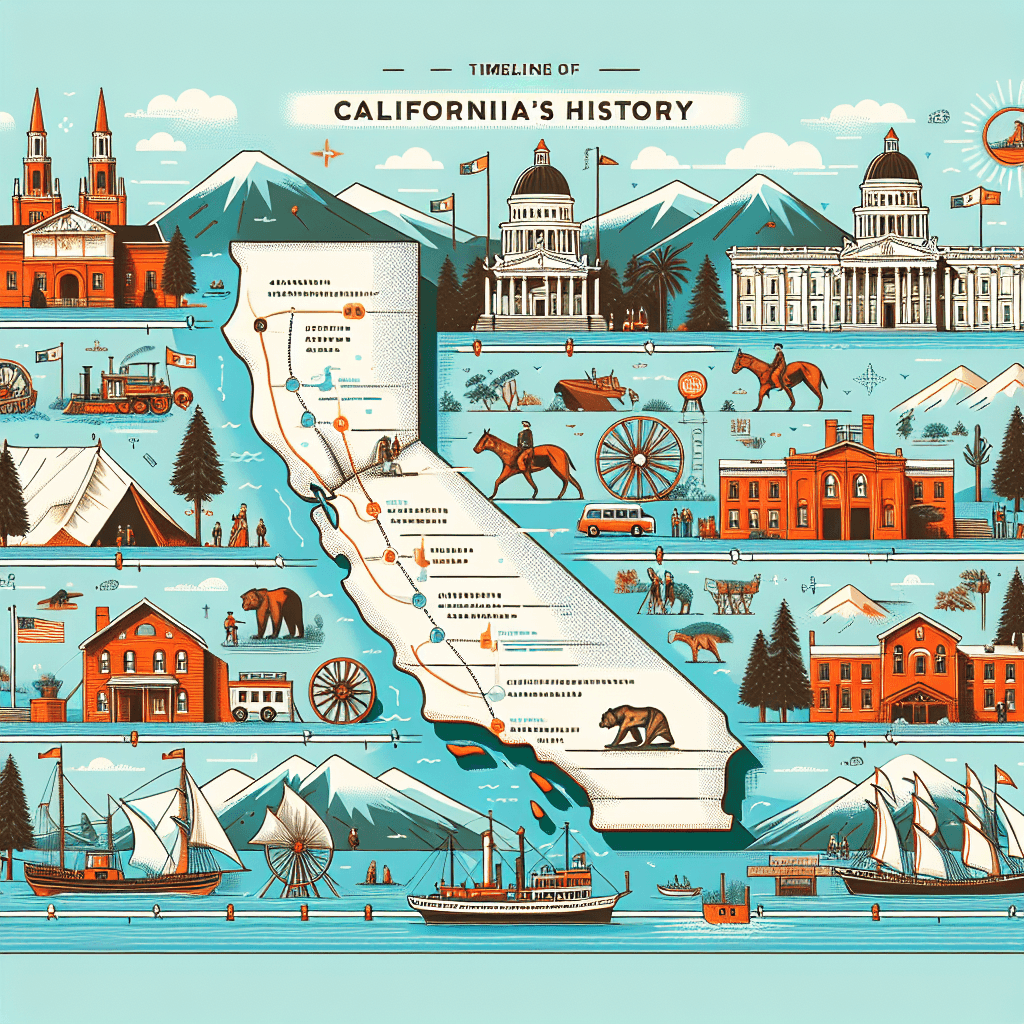
California History Timeline: Research, Write, and Design!
Inquiry Framework
Question Framework
Driving Question
The overarching question that guides the entire project.How can we create an illustrated timeline that captures the most significant events in California history, using reliable sources and engaging visuals to tell a compelling story?Essential Questions
Supporting questions that break down major concepts.- What makes a timeline effective and engaging?
- How do we determine which events are most important to include in our timeline?
- How can we find reliable information about California history?
- How do you paraphrase information and avoid plagiarism?
- How can illustrations enhance a timeline and make it more interesting?
Standards & Learning Goals
Learning Goals
By the end of this project, students will be able to:- Research key events and dates in California history.
- Design and create an illustrated timeline.
- Write informative descriptions of timeline events.
- Use reliable sources and cite them properly.
- Paraphrase information and avoid plagiarism.
- Apply proper sentence structure, grammar, and writing conventions.
- Edit and revise writing for clarity and accuracy.
- Incorporate engaging and colorful visuals to enhance the timeline.
- Present the timeline in a clear and compelling manner.
- Collaborate effectively with peers (if applicable).
Entry Events
Events that will be used to introduce the project to studentsFill the Timeline Challenge
The teacher presents a timeline of California history with several key dates and events missing. Students are challenged to fill in the gaps by researching and presenting their findings.Portfolio Activities
Portfolio Activities
These activities progressively build towards your learning goals, with each submission contributing to the student's final portfolio.California History Brain Dump: KWL Chart
Students begin by brainstorming what they already know about California history and what they want to learn. This activity sets the stage for deeper research and helps students identify key areas of interest.Steps
Here is some basic scaffolding to help students complete the activity.Final Product
What students will submit as the final product of the activityA KWL chart (Know, Want to Know, Learned) or a mind map outlining existing knowledge and questions about California history.Alignment
How this activity aligns with the learning objectives & standardsAddresses research skills, introduction to timeline creation, and collaborative discussion (if working in groups).California History Detective: Researching Key Events
Students delve into researching California history, focusing on identifying significant events and gathering information from reliable sources. This activity emphasizes the importance of source evaluation and accurate note-taking.Steps
Here is some basic scaffolding to help students complete the activity.Final Product
What students will submit as the final product of the activityA list of at least 10 significant events in California history, with brief notes and source citations for each event.Alignment
How this activity aligns with the learning objectives & standardsFocuses on research skills (Learning Goal), using reliable sources (Learning Goal), and identifying key events (Learning Goal).California Storyteller: Paraphrasing and Writing Descriptions
Students learn to paraphrase information and write their own descriptions of the events they researched. This activity reinforces proper sentence structure, grammar, and writing conventions.Steps
Here is some basic scaffolding to help students complete the activity.Final Product
What students will submit as the final product of the activityA short, original paragraph describing each of the 10 events, paraphrased from their research notes, with proper grammar and sentence structure.Alignment
How this activity aligns with the learning objectives & standardsAddresses paraphrasing (Learning Goal), avoiding plagiarism (Learning Goal), and writing informative descriptions (Learning Goal).California Timeline Artist: Designing and Illustrating History
Students design and create their illustrated timeline, incorporating the events they researched and the descriptions they wrote. This activity focuses on visual communication and creative expression.Steps
Here is some basic scaffolding to help students complete the activity.Final Product
What students will submit as the final product of the activityA beautifully illustrated timeline of California history, including at least 10 key events with dates, descriptions, and visuals.Alignment
How this activity aligns with the learning objectives & standardsFocuses on timeline design (Learning Goal), incorporating visuals (Learning Goal), and presenting the timeline (Learning Goal).Rubric & Reflection
Portfolio Rubric
Grading criteria for assessing the overall project portfolioCalifornia History Timeline Rubric
Content and Design
Focuses on the accuracy, clarity, and creativity of the timeline content and design.Historical Accuracy
Accuracy of historical information and dates.
Exemplary
4 PointsDemonstrates sophisticated understanding of California history with precise dates and details; information is consistently accurate and thoroughly researched.
Proficient
3 PointsDemonstrates thorough understanding of California history with accurate dates and details; information is well-researched and generally accurate.
Developing
2 PointsShows emerging understanding of California history, but some dates or details may be inaccurate or missing; research shows some gaps.
Beginning
1 PointsShows initial understanding of California history, but many dates or details are inaccurate or missing; research is minimal or lacking.
Description Quality
Clarity and quality of event descriptions, demonstrating effective paraphrasing and writing skills.
Exemplary
4 PointsEvent descriptions are exceptionally clear, concise, and engaging; paraphrasing is seamless and demonstrates advanced writing skills with varied sentence structure and vocabulary.
Proficient
3 PointsEvent descriptions are clear, concise, and informative; paraphrasing is effective and demonstrates good writing skills with proper grammar and sentence structure.
Developing
2 PointsEvent descriptions are somewhat clear but may lack detail or conciseness; paraphrasing is attempted but may not always be effective or accurate.
Beginning
1 PointsEvent descriptions are unclear, incomplete, or directly copied from sources; paraphrasing is minimal or nonexistent, with frequent grammatical errors.
Visual Representation
Appropriateness and effectiveness of illustrations in representing events.
Exemplary
4 PointsIllustrations are highly creative, relevant, and enhance the understanding of each event; they demonstrate exceptional artistic skill and attention to detail.
Proficient
3 PointsIllustrations are appropriate, relevant, and contribute to the understanding of each event; they demonstrate good artistic skill and effort.
Developing
2 PointsIllustrations are somewhat relevant but may be simplistic or lack detail; some illustrations may not accurately represent the events.
Beginning
1 PointsIllustrations are minimal, irrelevant, or missing; they do not contribute to the understanding of the events.
Timeline Design
Organization and visual appeal of the timeline, including layout, use of color, and overall presentation.
Exemplary
4 PointsTimeline is exceptionally well-organized, visually appealing, and easy to follow; layout is creative and effective, with excellent use of color and design elements.
Proficient
3 PointsTimeline is well-organized, visually appealing, and easy to follow; layout is clear and logical, with good use of color and design elements.
Developing
2 PointsTimeline is somewhat organized but may be difficult to follow; layout is basic, with limited use of color or design elements.
Beginning
1 PointsTimeline is disorganized, cluttered, and difficult to follow; layout is confusing, with poor use of color and design elements.
Source Citation
Proper citation of sources and avoidance of plagiarism.
Exemplary
4 PointsAll sources are meticulously cited using a consistent and appropriate format; demonstrates a thorough understanding of plagiarism and academic honesty.
Proficient
3 PointsAll sources are properly cited using a consistent format; demonstrates a clear understanding of plagiarism and academic honesty.
Developing
2 PointsMost sources are cited, but some citations may be missing or incomplete; demonstrates some understanding of plagiarism but may have minor errors.
Beginning
1 PointsSources are not cited, or citations are consistently missing or incorrect; demonstrates a lack of understanding of plagiarism and academic honesty.