
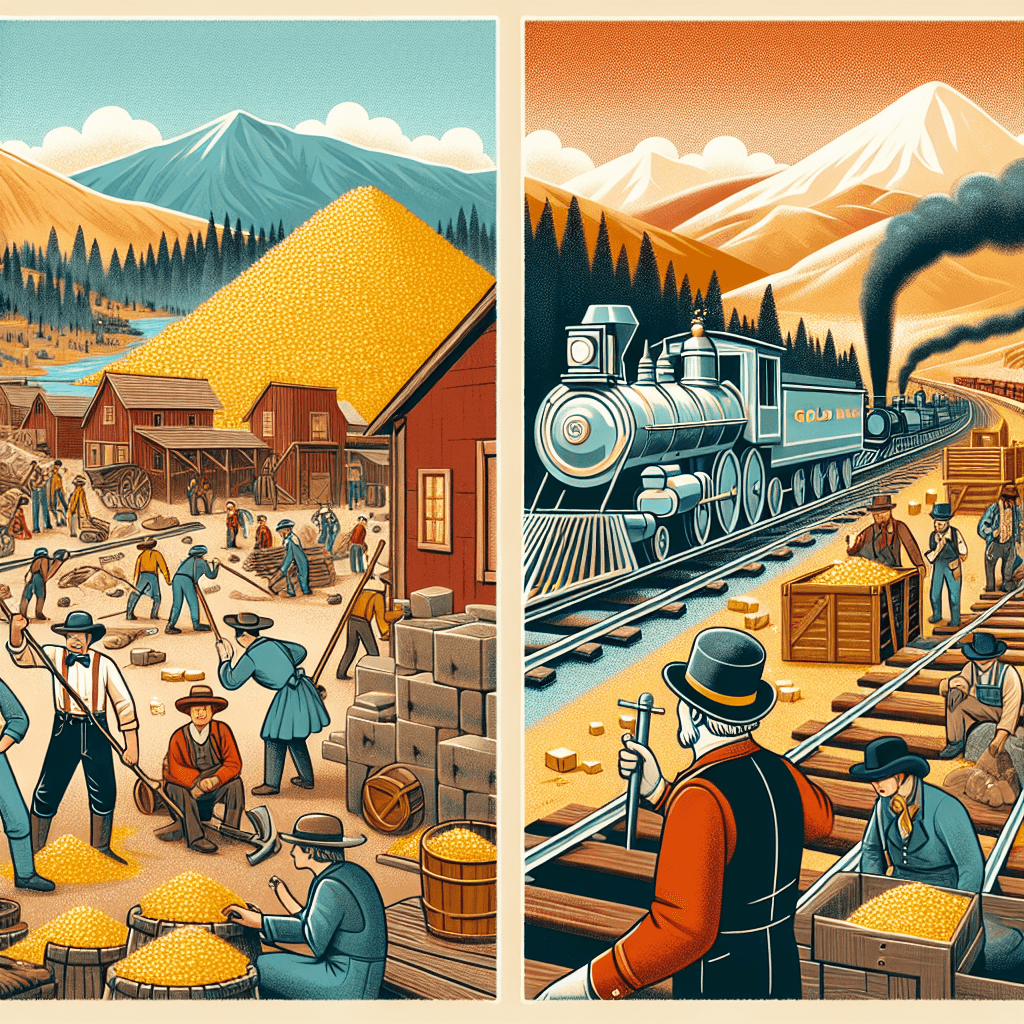
California's Gold Rush: Railroads and Communication Growth
Inquiry Framework
Question Framework
Driving Question
The overarching question that guides the entire project.How did the California Gold Rush and advancements in communication and railroads shape the diverse communities, economy, and environment of California, and what were the varying experiences of different groups during this transformative period?Essential Questions
Supporting questions that break down major concepts.- How did the Gold Rush transform California's population and communities?
- In what ways did advancements in communication technology, such as the telegraph, impact the development of California?
- How did the expansion of railroads affect the economy and connectivity of California during its growth period?
- What were the positive and negative consequences of California's rapid growth due to the Gold Rush and technological advancements?
- How did different groups of people (e.g., Native Americans, immigrants, miners) experience and contribute to the growth of California?
Standards & Learning Goals
Learning Goals
By the end of this project, students will be able to:- Students will be able to research and describe the impact of the California Gold Rush on the state's population and communities.
- Students will be able to explain how communication technologies like the telegraph influenced California's development.
- Students will be able to analyze the effects of railroad expansion on California's economy and connectivity.
- Students will be able to evaluate both the positive and negative consequences of California's rapid growth.
- Students will be able to compare and contrast the experiences of different groups (e.g., Native Americans, immigrants, miners) during California's growth period.
- Students will be able to construct well-organized informational writing pieces using evidence from research to support their claims.
- Students will be able to improve their informational writing skills such as introductions, supporting details, conclusion, and citing sources
Entry Events
Events that will be used to introduce the project to studentsCalifornia: Before and After
Present students with a series of 'before-and-after' photographs of California landscapes and communities drastically altered by the Gold Rush, telegraph, and railroads. Students discuss the visible changes, speculate on the causes, and consider the impact on the environment and different populations.Portfolio Activities
Portfolio Activities
These activities progressively build towards your learning goals, with each submission contributing to the student's final portfolio.California's Transformation: The Big Picture
Students will select one key aspect of California's growth (Gold Rush, telegraph, or railroads) to focus on. They will then create a detailed outline organizing their research findings into main ideas and supporting details.Steps
Here is some basic scaffolding to help students complete the activity.Final Product
What students will submit as the final product of the activityA structured outline with clear headings and subheadings, detailing the chosen aspect of California's growth.Alignment
How this activity aligns with the learning objectives & standardsCCSS.ELA-Literacy.W.4.2.a Introduce a topic clearly and group related information in paragraphs and sections; include formatting (e.g., headings), illustrations, and multimedia when useful to aiding comprehension.Digging Deeper: Unearthing the Details
Using the outline from Activity 1, students will expand each section with detailed information gathered from their research. They will focus on incorporating facts, definitions, and specific examples to support their main ideas.Steps
Here is some basic scaffolding to help students complete the activity.Final Product
What students will submit as the final product of the activityAn expanded outline filled with detailed information, facts, and examples related to the chosen topic.Alignment
How this activity aligns with the learning objectives & standardsCCSS.ELA-Literacy.W.4.2.b Develop the topic with facts, definitions, concrete details, quotations, or other information and examples related to the topic.Connecting the Dots: Crafting Coherent Paragraphs
Students will transform their detailed outline into a well-written informational paragraph. They will focus on using transition words and phrases to connect ideas and ensure smooth flow between sentences.Steps
Here is some basic scaffolding to help students complete the activity.Final Product
What students will submit as the final product of the activityA cohesive informational paragraph detailing the chosen aspect of California's growth, with clear transitions between ideas.Alignment
How this activity aligns with the learning objectives & standardsCCSS.ELA-Literacy.W.4.2.c Link ideas within categories of information using words and phrases (e.g., another, for example, also, because).Words Matter: Precision in Writing
Students will refine their informational paragraph by incorporating precise language and vocabulary specific to their chosen topic. They will focus on replacing general terms with more accurate and descriptive words.Steps
Here is some basic scaffolding to help students complete the activity.Final Product
What students will submit as the final product of the activityA refined informational paragraph with precise language and domain-specific vocabulary.Alignment
How this activity aligns with the learning objectives & standardsCCSS.ELA-Literacy.W.4.2.d Use precise language and domain-specific vocabulary to inform about or explain the topic.Rubric & Reflection
Portfolio Rubric
Grading criteria for assessing the overall project portfolioCalifornia's Transformation: Informational Writing Rubric
Outline Structure and Content
Focuses on the clarity of the central idea, the logical organization of information, and the depth of exploration of the chosen topic.Focus & Clarity
Clarity and Focus of Main Idea: How clearly does the outline present a central idea or argument related to the chosen aspect of California's growth?
Exemplary
4 PointsThe outline presents a sharply focused and compelling central idea that is thoroughly developed and insightful. Headings and subheadings clearly articulate the main argument. Demonstrates sophisticated understanding of the chosen aspect.
Proficient
3 PointsThe outline presents a clear central idea or argument that is well-developed and supported by relevant information. Headings and subheadings are logically organized and contribute to the overall coherence.
Developing
2 PointsThe outline presents a somewhat discernible central idea or argument, but it may lack clarity or depth. Headings and subheadings may not always align with the main idea, and some information may be loosely related.
Beginning
1 PointsThe outline lacks a clear central idea or argument, and the information appears disorganized and unfocused. Headings and subheadings are either missing or do not reflect the content of the outline. Demonstrates minimal understanding of the chosen aspect.
Organization
Organization and Structure: How effectively is the information organized within the outline, and how logical is the progression of ideas?
Exemplary
4 PointsThe outline exhibits a highly logical and coherent structure, with a seamless progression of ideas from introduction to conclusion. Headings and subheadings are meticulously crafted to guide the reader through the information.
Proficient
3 PointsThe outline is well-organized, with a logical flow of ideas. Headings and subheadings are appropriately used to structure the information and guide the reader.
Developing
2 PointsThe outline shows some organization, but the flow of ideas may be disjointed or unclear. Headings and subheadings may be inconsistently applied or lack specificity.
Beginning
1 PointsThe outline lacks a clear organizational structure, and the information appears randomly arranged. Headings and subheadings are either missing or do not contribute to the overall coherence.
Information Depth
Depth and Detail of Information: How thoroughly does the outline explore the chosen aspect of California's growth, and how detailed is the supporting information?
Exemplary
4 PointsThe outline delves deeply into the chosen aspect of California's growth, providing extensive and nuanced information that demonstrates a comprehensive understanding of the topic. Supporting details are exceptionally rich and insightful.
Proficient
3 PointsThe outline provides a thorough exploration of the chosen aspect of California's growth, with sufficient detail to support the main ideas. Supporting details are relevant and informative.
Developing
2 PointsThe outline touches on the chosen aspect of California's growth, but the information may be superficial or lacking in detail. Supporting details may be sparse or only tangentially related to the main ideas.
Beginning
1 PointsThe outline provides minimal information about the chosen aspect of California's growth, and the supporting details are either missing or irrelevant. Demonstrates a limited understanding of the topic.
Detailed Information and Evidence
Evaluates the relevance, accuracy, and depth of information included in the expanded outline, as well as the effective use of supporting evidence.Information Quality
Relevance and Accuracy of Information: How relevant and accurate is the information presented in the expanded outline to the chosen aspect of California's growth?
Exemplary
4 PointsAll information presented is meticulously accurate, highly relevant, and directly supports the central ideas with compelling evidence and insightful analysis. Demonstrates exceptional research skills.
Proficient
3 PointsThe information presented is accurate, relevant, and supports the central ideas of the outline. Sources are credible and appropriately cited.
Developing
2 PointsSome of the information presented may be irrelevant, inaccurate, or weakly connected to the central ideas of the outline. Sources may be questionable or improperly cited.
Beginning
1 PointsMuch of the information presented is irrelevant, inaccurate, or unsupported by evidence. Sources are missing or unreliable. Demonstrates poor research skills.
Supporting Evidence
Use of Facts, Definitions, and Examples: How effectively does the expanded outline incorporate facts, definitions, and examples to support the main ideas?
Exemplary
4 PointsThe expanded outline seamlessly integrates a rich array of compelling facts, precise definitions, and vivid examples that illuminate the main ideas and enhance the reader's understanding. Demonstrates sophisticated use of evidence.
Proficient
3 PointsThe expanded outline incorporates facts, definitions, and examples to support the main ideas and provide context for the reader. These elements are used appropriately and effectively.
Developing
2 PointsThe expanded outline includes some facts, definitions, or examples, but they may be insufficient, poorly integrated, or lacking in clarity. Their contribution to the overall understanding is limited.
Beginning
1 PointsThe expanded outline lacks facts, definitions, or examples to support the main ideas. The reader is left without concrete evidence or context to understand the topic fully. Demonstrates minimal use of evidence.
Elaboration & Depth
Expansion and Elaboration of Ideas: How well does the expanded outline build upon the initial outline, providing greater depth and detail to the chosen topic?
Exemplary
4 PointsThe expanded outline demonstrates exceptional elaboration and depth, building upon the initial outline to create a comprehensive and insightful exploration of the chosen topic. Ideas are developed with meticulous care and attention to detail.
Proficient
3 PointsThe expanded outline builds effectively upon the initial outline, providing greater depth and detail to the chosen topic. Ideas are well-developed and supported by relevant information.
Developing
2 PointsThe expanded outline shows some attempt to build upon the initial outline, but the depth and detail may be limited. Some ideas may be underdeveloped or lacking in support.
Beginning
1 PointsThe expanded outline fails to build upon the initial outline, providing little or no additional depth or detail to the chosen topic. Ideas remain superficial and unsupported. Demonstrates minimal elaboration.
Paragraph Coherence and Flow
Focuses on the clarity, coherence, and flow of the informational paragraph, with emphasis on the effective use of transition words and the contribution of each sentence to the overall understanding.Clarity & Coherence
Clarity and Coherence: How clearly and coherently is the information presented in the paragraph?
Exemplary
4 PointsThe paragraph is exceptionally clear, concise, and coherent, presenting information in a manner that is easily understood and highly engaging. Ideas flow seamlessly from one to the next, creating a compelling narrative.
Proficient
3 PointsThe paragraph presents information clearly and coherently, with a logical flow of ideas and well-structured sentences. The reader can easily follow the main points.
Developing
2 PointsThe paragraph is somewhat unclear or incoherent, with occasional lapses in logic or sentence structure. The reader may struggle to follow the main points at times.
Beginning
1 PointsThe paragraph is unclear, incoherent, and difficult to understand. Ideas are presented in a disjointed manner, and the reader is unable to follow the main points. Demonstrates poor writing skills.
Transitions
Use of Transition Words and Phrases: How effectively are transition words and phrases used to connect ideas and create a smooth flow?
Exemplary
4 PointsTransition words and phrases are used masterfully to create seamless connections between ideas, enhancing the flow and coherence of the paragraph. The transitions are natural, sophisticated, and contribute to the overall impact of the writing.
Proficient
3 PointsTransition words and phrases are used effectively to connect ideas and create a smooth flow within the paragraph. The transitions are clear and appropriate.
Developing
2 PointsTransition words and phrases are used inconsistently or inappropriately, resulting in a choppy or disjointed flow of ideas. The transitions may be unclear or ineffective.
Beginning
1 PointsTransition words and phrases are largely absent, resulting in a lack of connection between ideas and a disjointed flow of information. The paragraph reads as a series of disconnected sentences. Demonstrates poor use of transitions.
Sentence Contribution
Contribution of Sentences to Overall Understanding: How well do the sentences contribute to the reader's overall understanding of the chosen topic?
Exemplary
4 PointsEach sentence contributes significantly to the reader's understanding of the chosen topic, providing valuable insights and enhancing the overall coherence of the paragraph. The sentences work together harmoniously to create a powerful and compelling narrative.
Proficient
3 PointsEach sentence contributes meaningfully to the reader's understanding of the chosen topic, providing relevant information and supporting the main ideas of the paragraph.
Developing
2 PointsSome sentences may be irrelevant, redundant, or detract from the reader's understanding of the chosen topic. The sentences may not always work together cohesively.
Beginning
1 PointsMany sentences are irrelevant, confusing, or do not contribute to the reader's understanding of the chosen topic. The paragraph lacks focus and coherence. Demonstrates poor sentence construction.
Language and Vocabulary
Assesses the student's ability to use precise language and domain-specific vocabulary to effectively inform about or explain the chosen topic, while ensuring clarity and accuracy.Language Precision
Precision of Language: How precise and specific is the language used in the paragraph?
Exemplary
4 PointsThe paragraph demonstrates a masterful command of language, using precise and evocative words to create vivid imagery and enhance the reader's understanding. General terms are replaced with specific, descriptive language that adds depth and nuance to the writing.
Proficient
3 PointsThe paragraph uses precise language effectively to convey information clearly and accurately. General terms are replaced with more specific language where appropriate.
Developing
2 PointsThe paragraph contains some general or vague language that could be more precise. Opportunities to use more specific language are missed, and the writing lacks impact.
Beginning
1 PointsThe paragraph relies heavily on general and imprecise language, making it difficult for the reader to understand the intended meaning. The writing lacks clarity and specificity. Demonstrates poor vocabulary.
Vocabulary Usage
Use of Domain-Specific Vocabulary: How effectively is domain-specific vocabulary incorporated into the paragraph?
Exemplary
4 PointsDomain-specific vocabulary is seamlessly and appropriately integrated into the paragraph, demonstrating a deep understanding of the topic and enhancing the reader's comprehension. The vocabulary is used with precision and flair.
Proficient
3 PointsDomain-specific vocabulary is used effectively to inform about or explain the topic. The vocabulary is appropriate and enhances the reader's understanding.
Developing
2 PointsDomain-specific vocabulary is used sparingly or inappropriately, limiting its impact on the reader's understanding. The vocabulary may be misused or lack context.
Beginning
1 PointsDomain-specific vocabulary is largely absent from the paragraph, resulting in a lack of depth and sophistication. The writing lacks the specialized language needed to convey complex ideas effectively. Demonstrates poor vocabulary usage.
Information Accuracy
Clarity and Accuracy: How clear and accurate is the information presented in the paragraph?
Exemplary
4 PointsThe paragraph presents information with exceptional clarity and accuracy, leaving no room for ambiguity or misinterpretation. The writing is meticulously crafted to ensure that the reader gains a deep and comprehensive understanding of the topic.
Proficient
3 PointsThe paragraph presents information clearly and accurately, ensuring that the reader understands the main points without confusion.
Developing
2 PointsThe paragraph contains some inaccuracies or ambiguities that may confuse the reader or detract from their understanding. The writing could be clearer and more precise.
Beginning
1 PointsThe paragraph is riddled with inaccuracies, inconsistencies, or ambiguities, making it difficult for the reader to understand the information being presented. The writing lacks clarity and accuracy. Demonstrates poor writing skills.