
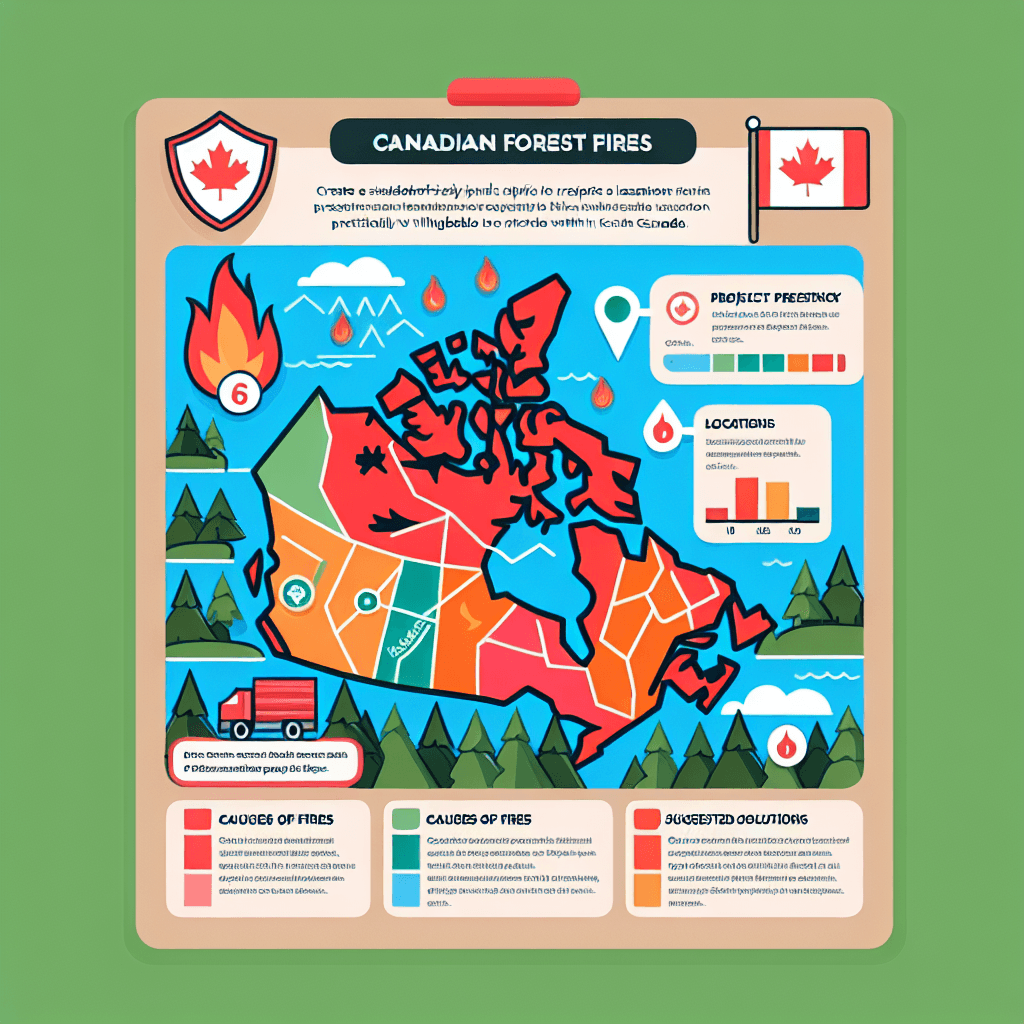
Canadian Forest Fires: Causes, Locations, and Solutions
Inquiry Framework
Question Framework
Driving Question
The overarching question that guides the entire project.How can we, as concerned citizens, understand, prepare for, and respond to the growing threat of Canadian forest fires to protect our communities and environment?Essential Questions
Supporting questions that break down major concepts.- What are the primary causes of forest fires in Canada?
- Where are the most common locations for forest fires in Canada?
- How do forest fires impact the environment and communities?
- What are the safety measures and evacuation procedures during a forest fire?
- What are the roles and responsibilities of different agencies in managing forest fires?
- How can individuals and communities contribute to forest fire prevention and preparedness?
Standards & Learning Goals
Learning Goals
By the end of this project, students will be able to:- Understand the causes of Canadian forest fires.
- Identify common locations of forest fires in Canada.
- Analyze the environmental and community impacts of forest fires.
- Learn safety measures and evacuation procedures during a forest fire.
- Understand the roles of agencies in managing forest fires.
- Explore ways individuals and communities can prevent and prepare for forest fires.
- Develop informed responses to the threat of Canadian forest fires.
- Learn about the growing threat of Canadian forest fires to protect our communities and environment
Entry Events
Events that will be used to introduce the project to studentsBreaking News: Wildfire Emergency!
A news report suddenly interrupts the class with breaking coverage of a rapidly spreading wildfire threatening a nearby community. Students are immediately tasked as 'junior reporters' to investigate the situation, understand the fire's origins, and report on potential solutions and safety measures.Emergency Response Simulation
The classroom is transformed into an 'emergency response center' simulation. Students receive urgent simulated messages, maps, and data about a growing forest fire and must work in teams to analyze the information, devise evacuation plans, allocate resources, and communicate effectively to 'save' the threatened area.Portfolio Activities
Portfolio Activities
These activities progressively build towards your learning goals, with each submission contributing to the student's final portfolio.Fire Starter Investigators: Uncovering the Causes
Students will research and identify the primary natural and human-caused factors contributing to forest fires in Canada. They will create a cause-and-effect chart to visually represent these factors.Steps
Here is some basic scaffolding to help students complete the activity.Final Product
What students will submit as the final product of the activityA detailed cause-and-effect chart explaining the causes of Canadian forest fires.Alignment
How this activity aligns with the learning objectives & standardsAddresses the learning goal: "Understand the causes of Canadian forest fires."Hotspot Detectives: Mapping the Danger Zones
Students will map the most common locations of Canadian forest fires using provided data or research. They will analyze geographical patterns and explain why certain regions are more susceptible.Steps
Here is some basic scaffolding to help students complete the activity.Final Product
What students will submit as the final product of the activityA map of Canada highlighting common forest fire locations, with a written analysis of geographical patterns.Alignment
How this activity aligns with the learning objectives & standardsAddresses the learning goal: "Identify common locations of forest fires in Canada."Impact Assessors: Examining the Devastation
Students will investigate the environmental and community impacts of forest fires, focusing on both short-term and long-term effects. They will create a presentation summarizing their findings.Steps
Here is some basic scaffolding to help students complete the activity.Final Product
What students will submit as the final product of the activityA presentation (e.g., slideshow, poster) detailing the environmental and community impacts of forest fires.Alignment
How this activity aligns with the learning objectives & standardsAddresses the learning goal: "Analyze the environmental and community impacts of forest fires."Safety Guardians: Creating an Emergency Guide
Students will learn about safety measures and evacuation procedures during a forest fire. They will design an emergency preparedness guide for families.Steps
Here is some basic scaffolding to help students complete the activity.Final Product
What students will submit as the final product of the activityAn emergency preparedness guide for families, including safety measures and evacuation procedures.Alignment
How this activity aligns with the learning objectives & standardsAddresses the learning goal: "Learn safety measures and evacuation procedures during a forest fire."Agency Architects: Mapping the Response Network
Students will research the roles and responsibilities of different agencies (e.g., firefighters, government organizations) in managing forest fires. They will create an organizational chart illustrating the roles and responsibilities.Steps
Here is some basic scaffolding to help students complete the activity.Final Product
What students will submit as the final product of the activityAn organizational chart illustrating the roles and responsibilities of different agencies in managing forest fires.Alignment
How this activity aligns with the learning objectives & standardsAddresses the learning goal: "Understand the roles of agencies in managing forest fires."Community Champions: Building a Fire-Resilient Future
Students will brainstorm and research ways individuals and communities can contribute to forest fire prevention and preparedness. They will develop a community action plan to promote fire safety.Steps
Here is some basic scaffolding to help students complete the activity.Final Product
What students will submit as the final product of the activityA community action plan to promote forest fire safety, including preventative measures and preparedness strategies.Alignment
How this activity aligns with the learning objectives & standardsAddresses the learning goal: "Explore ways individuals and communities can prevent and prepare for forest fires." and "Develop informed responses to the threat of Canadian forest fires." and "Learn about the growing threat of Canadian forest fires to protect our communities and environment"Rubric & Reflection
Portfolio Rubric
Grading criteria for assessing the overall project portfolioCanadian Forest Fires Portfolio Rubric
Understanding Causes
This category assesses the students' ability to identify and explain the causes of Canadian forest fires and visually represent these causes in a cause-and-effect chart. It focuses on accuracy, thoroughness, and clarity of presentation.Cause Identification
Accuracy and thoroughness of identifying causes of Canadian forest fires.
Exemplary
4 PointsDemonstrates comprehensive and accurate understanding of both natural and human-caused factors, providing detailed explanations and supporting evidence.
Proficient
3 PointsDemonstrates a thorough understanding of both natural and human-caused factors, providing clear explanations and relevant evidence.
Developing
2 PointsShows an emerging understanding of some natural and human-caused factors, but explanations may be incomplete or lack sufficient evidence.
Beginning
1 PointsShows a limited understanding of the causes of forest fires, with minimal explanation or supporting evidence.
Visual Representation
Clarity and effectiveness of the cause-and-effect chart in visually representing the relationships between causes and effects.
Exemplary
4 PointsThe cause-and-effect chart is exceptionally clear, visually appealing, and effectively illustrates the complex relationships between causes and effects with insightful connections.
Proficient
3 PointsThe cause-and-effect chart is clear, well-organized, and effectively illustrates the relationships between causes and effects.
Developing
2 PointsThe cause-and-effect chart is somewhat clear, but the organization may be confusing or the relationships between causes and effects are not always clear.
Beginning
1 PointsThe cause-and-effect chart is unclear, poorly organized, and fails to effectively illustrate the relationships between causes and effects.
Mapping Danger Zones
This category assesses the students' ability to map the locations of Canadian forest fires and analyze the geographical patterns. It focuses on the accuracy of the map and the depth of the written analysis.Geographical Accuracy
Accuracy of mapping forest fire locations and identifying geographical patterns.
Exemplary
4 PointsMap accurately plots fire locations with insightful analysis of geographical patterns and their underlying reasons, demonstrating a deep understanding of the region's susceptibility.
Proficient
3 PointsMap accurately plots fire locations with clear analysis of geographical patterns and potential reasons, demonstrating a good understanding of the region's susceptibility.
Developing
2 PointsMap contains some inaccuracies in plotting fire locations, and the analysis of geographical patterns is superficial or incomplete.
Beginning
1 PointsMap contains significant inaccuracies in plotting fire locations, and the analysis of geographical patterns is missing or incorrect.
Pattern Analysis
Depth and clarity of the written analysis explaining observed geographical patterns.
Exemplary
4 PointsWritten analysis is exceptionally insightful, providing a comprehensive explanation of the observed patterns with strong supporting evidence and well thought out conclusions.
Proficient
3 PointsWritten analysis is clear and thorough, providing a well-reasoned explanation of the observed patterns with relevant supporting evidence.
Developing
2 PointsWritten analysis is somewhat superficial, lacking depth or sufficient supporting evidence to explain the observed patterns.
Beginning
1 PointsWritten analysis is missing, unclear, or fails to provide a coherent explanation of the observed patterns.
Examining Devastation
This category assesses the students' ability to research and present the environmental and community impacts of forest fires. It focuses on the comprehensiveness of the research and the quality of the presentation.Impact Research
Comprehensiveness and accuracy of research on the environmental and community impacts of forest fires.
Exemplary
4 PointsResearch is exceptionally comprehensive and accurate, covering a wide range of environmental and community impacts with detailed supporting evidence.
Proficient
3 PointsResearch is thorough and accurate, covering key environmental and community impacts with relevant supporting evidence.
Developing
2 PointsResearch is somewhat limited, focusing on only a few environmental or community impacts with incomplete supporting evidence.
Beginning
1 PointsResearch is minimal or inaccurate, failing to adequately address the environmental and community impacts of forest fires.
Presentation Quality
Clarity, organization, and visual appeal of the presentation summarizing the impacts.
Exemplary
4 PointsPresentation is exceptionally clear, well-organized, visually appealing, and effectively communicates the complex impacts of forest fires with creative and engaging elements.
Proficient
3 PointsPresentation is clear, well-organized, visually appealing, and effectively communicates the key impacts of forest fires.
Developing
2 PointsPresentation is somewhat disorganized, lacking visual appeal, or fails to clearly communicate the impacts of forest fires.
Beginning
1 PointsPresentation is unclear, poorly organized, lacks visual appeal, and fails to effectively communicate the impacts of forest fires.
Creating Emergency Guide
This category assesses the students' ability to create an emergency preparedness guide for families. It focuses on the accuracy and completeness of the information and the clarity and visual appeal of the guide.Emergency Information
Accuracy and completeness of the safety measures and evacuation procedures included in the guide.
Exemplary
4 PointsThe guide includes exceptionally accurate and comprehensive safety measures and evacuation procedures, demonstrating a deep understanding of emergency preparedness.
Proficient
3 PointsThe guide includes accurate and complete safety measures and evacuation procedures, demonstrating a thorough understanding of emergency preparedness.
Developing
2 PointsThe guide includes some safety measures and evacuation procedures, but it may be incomplete or contain some inaccuracies.
Beginning
1 PointsThe guide includes minimal safety measures and evacuation procedures, and it may contain significant inaccuracies.
Guide Design
Clarity, conciseness, and visual appeal of the emergency preparedness guide for families.
Exemplary
4 PointsThe guide is exceptionally clear, concise, visually appealing, and easy to understand, making it highly effective for families in emergency situations.
Proficient
3 PointsThe guide is clear, concise, visually appealing, and easy to understand, making it effective for families in emergency situations.
Developing
2 PointsThe guide is somewhat unclear, disorganized, or lacking in visual appeal, making it less effective for families in emergency situations.
Beginning
1 PointsThe guide is unclear, poorly organized, lacks visual appeal, and is difficult to understand, making it ineffective for families in emergency situations.
Mapping Response Network
This category assesses the students' ability to research and illustrate the roles and responsibilities of different agencies in managing forest fires. It focuses on the accuracy of the information and the clarity of the organizational chart.Agency Identification
Accuracy in identifying key agencies and their roles in forest fire management.
Exemplary
4 PointsDemonstrates a comprehensive and accurate understanding of key agencies and their roles in forest fire management, providing detailed insights into their functions.
Proficient
3 PointsDemonstrates a thorough understanding of key agencies and their roles in forest fire management, providing clear and accurate descriptions of their functions.
Developing
2 PointsShows an emerging understanding of some agencies and their roles, but descriptions may be incomplete or contain some inaccuracies.
Beginning
1 PointsShows a limited understanding of the agencies involved in forest fire management, with minimal or inaccurate descriptions of their roles.
Chart Design
Effectiveness of the organizational chart in illustrating the relationships between agencies.
Exemplary
4 PointsThe organizational chart is exceptionally clear, visually appealing, and effectively illustrates the complex relationships between agencies with insightful connections.
Proficient
3 PointsThe organizational chart is clear, well-organized, and effectively illustrates the relationships between agencies.
Developing
2 PointsThe organizational chart is somewhat clear, but the organization may be confusing or the relationships between agencies are not always clear.
Beginning
1 PointsThe organizational chart is unclear, poorly organized, and fails to effectively illustrate the relationships between agencies.
Building Fire-Resilient Future
This category assesses the students' ability to develop a community action plan to promote forest fire safety. It focuses on the creativity and feasibility of the proposed measures and the persuasiveness of the action plan.Action Plan Creativity
Creativity and feasibility of the proposed preventative measures and preparedness strategies.
Exemplary
4 PointsAction plan demonstrates exceptional creativity and proposes highly feasible preventative measures and preparedness strategies with innovative solutions.
Proficient
3 PointsAction plan proposes creative and feasible preventative measures and preparedness strategies that are well-suited to the community.
Developing
2 PointsAction plan includes some preventative measures and preparedness strategies, but they may be impractical or lack creativity.
Beginning
1 PointsAction plan is missing or fails to propose viable preventative measures and preparedness strategies.
Advocacy Effectiveness
Clarity, detail, and persuasiveness of the action plan in advocating for its implementation.
Exemplary
4 PointsThe action plan is exceptionally clear, detailed, and persuasive, effectively advocating for its implementation with compelling arguments and a well-defined plan.
Proficient
3 PointsThe action plan is clear, detailed, and persuasive, effectively advocating for its implementation with strong arguments and a clear plan.
Developing
2 PointsThe action plan is somewhat unclear, lacking in detail, or fails to effectively advocate for its implementation.
Beginning
1 PointsThe action plan is unclear, poorly detailed, and fails to advocate for its implementation.