
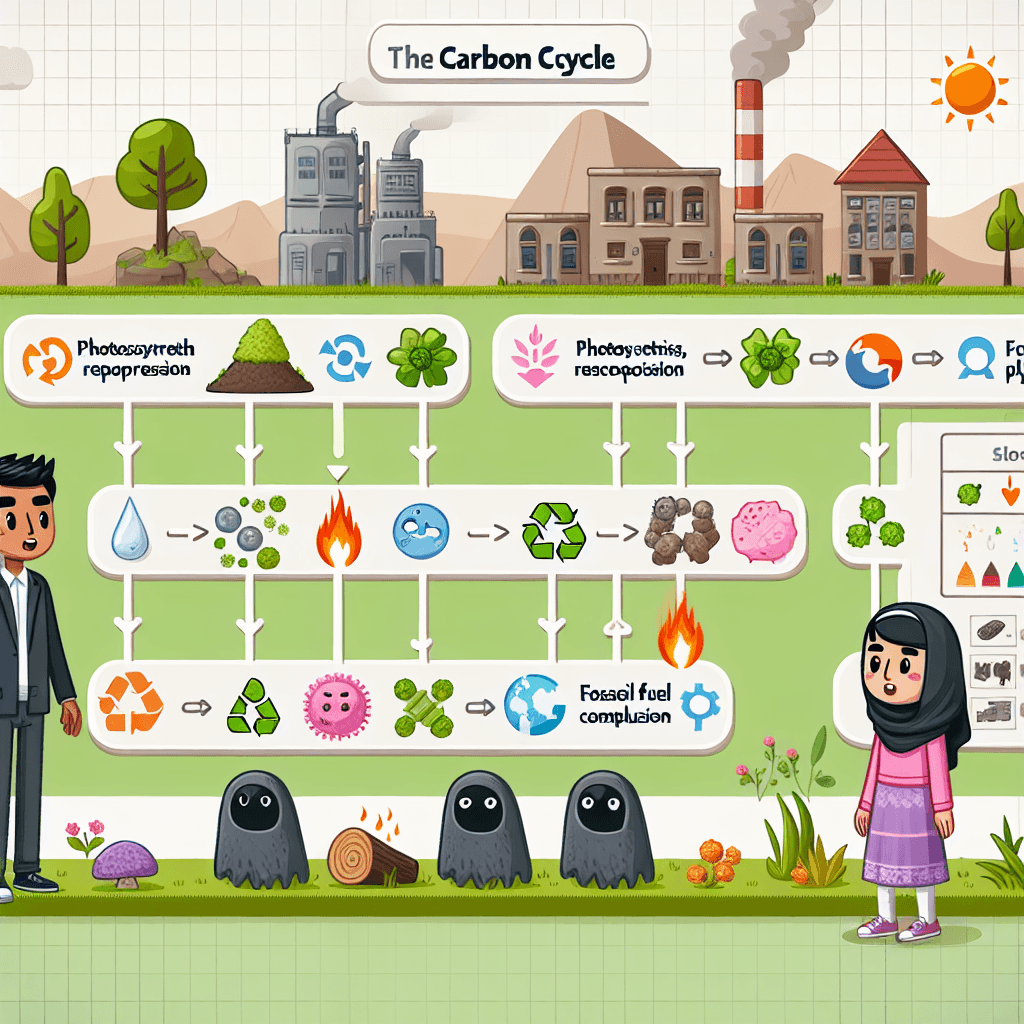
Carbon Cycle Video Game Design
Inquiry Framework
Question Framework
Driving Question
The overarching question that guides the entire project.How can we apply our understanding of the carbon cycle to design an engaging and accurate video game that simulates the movement of carbon through Earth's spheres and illustrates the impacts of human activities?Essential Questions
Supporting questions that break down major concepts.- How does carbon move through different spheres of Earth?
- What are the processes involved in the carbon cycle?
- How do human activities impact the carbon cycle?
- Why is the carbon cycle important for Earth's ecosystems?
- How can we model the carbon cycle in a video game?
Standards & Learning Goals
Learning Goals
By the end of this project, students will be able to:- Understand and explain the movement of carbon through the hydrosphere, atmosphere, geosphere, and biosphere.
- Analyze the impact of human activities on the carbon cycle.
- Develop a quantitative model to accurately represent the carbon cycle within a video game.
- Illustrate the importance of the carbon cycle to Earth's ecosystems through interactive gameplay elements.
- Utilize scientific concepts to engage an audience in a game format while maintaining accuracy in representing ecosystem processes.
Next Generation Science Standards
Entry Events
Events that will be used to introduce the project to studentsVirtual Reality Exploration
Students are introduced to the project through a virtual reality experience, simulating a journey through different components of Earth's carbon cycle, like traveling through the atmosphere, diving into the ocean, and venturing underground to a fossil fuel reservoir. This immersive introduction prompts them to question and explore how carbon moves and transforms in each environment.Portfolio Activities
Portfolio Activities
These activities progressively build towards your learning goals, with each submission contributing to the student's final portfolio.Carbon Cycle Basics Bootcamp
Students learn the foundational concepts of the carbon cycle across Earth's spheres. This activity will help them understand how carbon moves through the hydrosphere, atmosphere, geosphere, and biosphere.Steps
Here is some basic scaffolding to help students complete the activity.Final Product
What students will submit as the final product of the activityA collaborative infographic that illustrates the carbon cycle principles in each Earth sphere.Alignment
How this activity aligns with the learning objectives & standardsAligns with HS-ESS2-6 by building foundational knowledge about the carbon cycle necessary for quantitative modeling.Quantitative Model Creator
Students form collaborative teams to develop quantitative models of the carbon cycle that incorporate human impacts. They will use these models in their video game design.Steps
Here is some basic scaffolding to help students complete the activity.Final Product
What students will submit as the final product of the activityA detailed flowchart and quantitative model representing carbon cycle processes in one of Earth's spheres.Alignment
How this activity aligns with the learning objectives & standardsSupports HS-ESS2-6 by applying quantitative modeling to describe carbon cycle dynamics.Rubric & Reflection
Portfolio Rubric
Grading criteria for assessing the overall project portfolioCarbon Cycle Video Game Design Rubric
Scientific Understanding
Evaluation of the student's comprehension and application of carbon cycle concepts in Earth's spheres.Carbon Cycle Comprehension
Ability to understand and explain the cycling of carbon among the hydrosphere, atmosphere, geosphere, and biosphere.
Exemplary
4 PointsThoroughly explains and accurately details carbon movement through all spheres; integrates complex concepts effortlessly.
Proficient
3 PointsClearly explains carbon movement through main spheres with minor errors; applies concepts appropriately.
Developing
2 PointsPartially explains carbon movement; some inaccuracies or misconceptions present.
Beginning
1 PointsStruggles to explain carbon movement; demonstrates minimal understanding.
Human Impact Analysis
Evaluation of how well students analyze and integrate human impacts into their models of the carbon cycle.
Exemplary
4 PointsProvides a detailed, insightful analysis of human impacts on the carbon cycle, incorporating multiple scenarios effectively.
Proficient
3 PointsAnalyzes human impacts accurately but with less depth; incorporates typical scenarios effectively.
Developing
2 PointsDiscusses human impacts but lacks depth or contains inaccuracies.
Beginning
1 PointsDoes not clearly address human impacts or includes several misconceptions.
Creative Application
Assessment of student's creativity in applying scientific concepts within an interactive video game format.Innovative Game Design
Creativity and innovation in game mechanics and design that engage users while accurately simulating carbon cycle processes.
Exemplary
4 PointsDevelops highly creative and unique game mechanisms that authentically illustrate the carbon cycle, captivating the audience.
Proficient
3 PointsCreates effective game design elements that represent the carbon cycle accurately and engagingly.
Developing
2 PointsIncorporates basic game elements; minor inaccuracies or lack of engagement.
Beginning
1 PointsStruggles with game design, showing minimal creativity or inaccuracies in depicting carbon cycle.
Collaboration and Communication
Measure of student's ability to work effectively as part of a team and communicate their ideas clearly, both orally and in writing.Team Collaboration
Engagement and contribution to teamwork during the video game creation process.
Exemplary
4 PointsDemonstrates leadership and facilitates collaboration, consistently contributing valuable ideas.
Proficient
3 PointsActively participates and contributes useful ideas, collaborating well with team members.
Developing
2 PointsParticipates in teamwork with some contribution, may be inconsistent in efforts.
Beginning
1 PointsLimited participation in team activities, few contributions.
Communication Clarity
Quality and clarity of communication in presenting game design and scientific concepts.
Exemplary
4 PointsCommunicates ideas clearly and persuasively, with excellent use of scientific vocabulary and presentation skills.
Proficient
3 PointsCommunicates effectively with clear ideas and appropriate use of scientific terms.
Developing
2 PointsCommunication is basic; may lack clarity or use scientific terms inaccurately.
Beginning
1 PointsStruggles to communicate ideas clearly; lacks use of scientific language.