
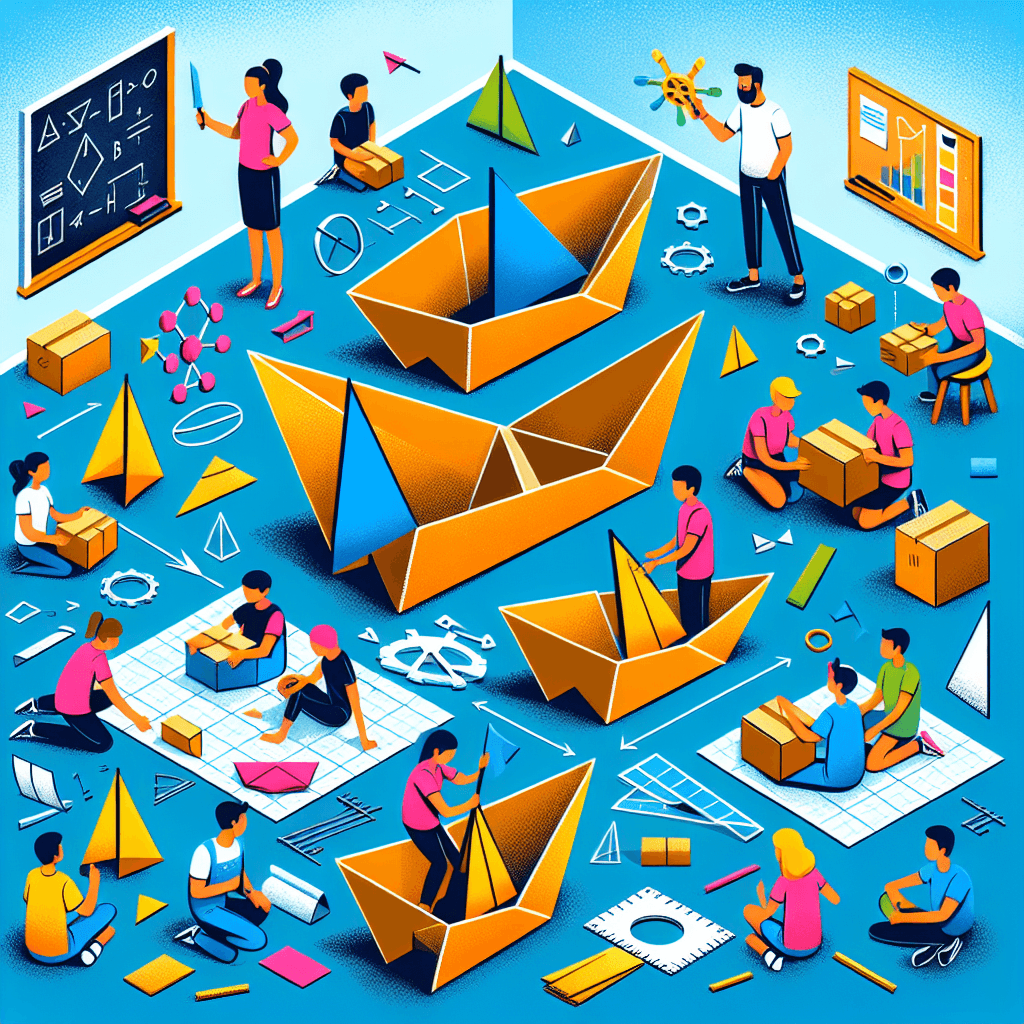
Cardboard Boat Engineering Challenge: Math and Geometry Exploration
Inquiry Framework
Question Framework
Driving Question
The overarching question that guides the entire project.How can we design and build a fully functional cardboard boat using only cardboard and duct tape by applying principles of buoyancy, surface area, volume, and geometry to ensure it not only floats but also maintains stability and performance?Essential Questions
Supporting questions that break down major concepts.- How do the principles of buoyancy determine whether a cardboard boat will float or sink?
- What role do surface area and volume calculations play in designing a cardboard boat?
- How can we apply geometric principles to optimize the shape and stability of a boat?
- In what ways do the material limitations (cardboard and duct tape) affect the design and functionality of the boat?
- How can mathematical modeling be used to predict the performance of the boat in water?
- What are the mathematical relationships between the 3D shapes used in constructing the boat and its overall stability and performance?
Standards & Learning Goals
Learning Goals
By the end of this project, students will be able to:- Apply geometric formulas to calculate surface area and volume of complex 3D shapes to ensure the cardboard boat is capable of buoyancy and stability.
- Understand and apply the principles of buoyancy and how they affect the design and construction of watercraft.
- Design a structurally sound boat using only restricted materials, making use of creative problem-solving skills and mathematical principles.
- Evaluate the performance of a constructed boat using mathematical and physical reasoning to refine its design.
- Use mathematical modeling to predict and enhance the boat's performance, focusing on stability, buoyancy, and structural integrity.
Common Core Standards
Next Generation Science Standards
Entry Events
Events that will be used to introduce the project to studentsThe Great Cardboard Regatta
Students are invited to witness a thrilling race where boats made solely of cardboard and duct tape compete to stay afloat while carrying a person across a pond. This spectacular event will kickstart the project, with a focus on understanding buoyancy, surface area, volume, and designing 3D shapes to create an unsinkable vessel. Students will be both spectators and future participants, fostering a competitive and inquiry-based learning atmosphere from the start.Portfolio Activities
Portfolio Activities
These activities progressively build towards your learning goals, with each submission contributing to the student's final portfolio.Buoyancy and Stability Workshop
Students will dive into the principles of buoyancy and stability by performing hands-on experiments that reinforce how these concepts apply to boat building.Steps
Here is some basic scaffolding to help students complete the activity.Final Product
What students will submit as the final product of the activityA lab report discussing the relationship between buoyancy and stability observed in experiments.Alignment
How this activity aligns with the learning objectives & standardsHS-PS2-1; Understanding motion and force principles that affect buoyancy and stability.Surface Area and Volume Calculations
This activity teaches students how to accurately calculate the surface area and volume of their 3D boat models, which are essential in predicting buoyancy.Steps
Here is some basic scaffolding to help students complete the activity.Final Product
What students will submit as the final product of the activityA mathematics worksheet containing calculated surface area and volume values with step-by-step solutions.Alignment
How this activity aligns with the learning objectives & standardsHSG.GMD.A.1; HSG.GMD.A.3; Surface area and volume are critical for designing buoyant structures.Geometric Design Challenge
Engage students in a challenge to design a cardboard boat prototype using just geometric shapes, applying knowledge of their properties and constraints.Steps
Here is some basic scaffolding to help students complete the activity.Final Product
What students will submit as the final product of the activityPaper scale models of cardboard boats showcasing creative uses of geometric principles.Alignment
How this activity aligns with the learning objectives & standardsHSG.MG.A.1; HSG.MG.A.3; Using geometric shapes and methods to solve design problems.Mathematical Modeling and Prediction
Utilize mathematical modeling software to simulate boat performance, enhancing students' understanding of real-world geometry applications in design and construction.Steps
Here is some basic scaffolding to help students complete the activity.Final Product
What students will submit as the final product of the activityA computer simulation report detailing predicted performance and any redesigns made for optimal buoyancy and stability.Alignment
How this activity aligns with the learning objectives & standardsHS-PS2-1; Applying mathematical reasoning to predict physics outcomes in design scenarios.3D Shapes Exploration
Students explore different 3D shapes to understand their properties, focusing on those that can be used to build a boat. They'll experiment with how these shapes affect surface area, volume, and subsequently buoyancy.Steps
Here is some basic scaffolding to help students complete the activity.Final Product
What students will submit as the final product of the activityA set of 3D shape models made from cardboard representing potential boat components.Alignment
How this activity aligns with the learning objectives & standardsHSG.GMD.A.1; Understand 3D shape properties and how they relate to volume and surface area.Rubric & Reflection
Portfolio Rubric
Grading criteria for assessing the overall project portfolioCardboard Boat Building Project Rubric
Understanding of Mathematical Concepts
Assesses students' grasp of surface area, volume, and geometric design principles essential for a buoyant and stable cardboard boat.Application of Surface Area and Volume Calculations
Measurement of the student's ability to accurately calculate and apply surface area and volume to boat design.
Exemplary
4 PointsConsistently applies accurate calculations with clear understanding, benefiting the overall design and functionality of the boat.
Proficient
3 PointsApplies calculations accurately with a good understanding, contributing to the boat's design and performance.
Developing
2 PointsShows partial accuracy in calculations, with occasional misunderstandings affecting design outcomes.
Beginning
1 PointsStruggles with accuracy in calculations, significantly impacting the design and understanding of function.
Geometric Design Implementation
Evaluates the effective use of geometric shapes in the design and construction of a boat.
Exemplary
4 PointsDemonstrates exceptional use of geometric principles, resulting in an innovative and structurally sound design.
Proficient
3 PointsEffectively uses geometric principles, creating a stable and functional design.
Developing
2 PointsUses geometric principles but with limited effectiveness, resulting in a design that needs improvement.
Beginning
1 PointsStruggles to implement geometric principles effectively, leading to a flawed design.
Application of Physics in Design
Focuses on students' understanding and application of buoyancy and motion principles within their boat design.Understanding of Buoyancy
Measures how well students can apply the principle of buoyancy to ensure the boat floats and supports weight.
Exemplary
4 PointsApplies buoyancy principles expertly, ensuring the boat is highly buoyant and stable.
Proficient
3 PointsApplies buoyancy principles effectively, resulting in a boat that floats reliably.
Developing
2 PointsShows some understanding of buoyancy principles, but with inconsistencies affecting stability.
Beginning
1 PointsStruggles with buoyancy principles, leading to a design that fails to stay afloat.
Integration of Stability and Balance
Evaluates the students' ability to balance elements within the design to maintain the boat's stability in water.
Exemplary
4 PointsExhibits outstanding balance and stability, with innovative solutions for handling weight distribution.
Proficient
3 PointsMaintains adequate balance and stability, allowing the boat to perform well under normal conditions.
Developing
2 PointsShows basic stability, but lacks consistent balancing, affecting performance.
Beginning
1 PointsStruggles with maintaining balance, resulting in instability and poor performance.
Innovative Problem Solving
Assesses creative approaches and problem-solving skills in responding to constraints of materials and design challenges.Creative Use of Materials
Measures students' creativity and innovation in using only cardboard and duct tape to meet design goals.
Exemplary
4 PointsDemonstrates high creativity in material use, overcoming design constraints with innovative solutions.
Proficient
3 PointsUses materials creatively, successfully addressing most design challenges.
Developing
2 PointsShows some creativity, but limited effectiveness in addressing design constraints.
Beginning
1 PointsStruggles with creative material use, resulting in inadequate solutions to design constraints.
Collaboration and Communication
Evaluates teamwork, communication, and peer collaboration throughout the project phase.Team Collaboration
Assesses effectiveness in collaborating and communicating within teams during the boat construction project.
Exemplary
4 PointsLeads in collaboration, facilitating communication and consistently contributing to team success.
Proficient
3 PointsParticipates actively in collaboration, communicating effectively, and supporting team goals.
Developing
2 PointsInvolved in collaboration, but may lack consistency in communication or contribution.
Beginning
1 PointsRequires improvement in team collaboration and communication, struggling to contribute effectively.