
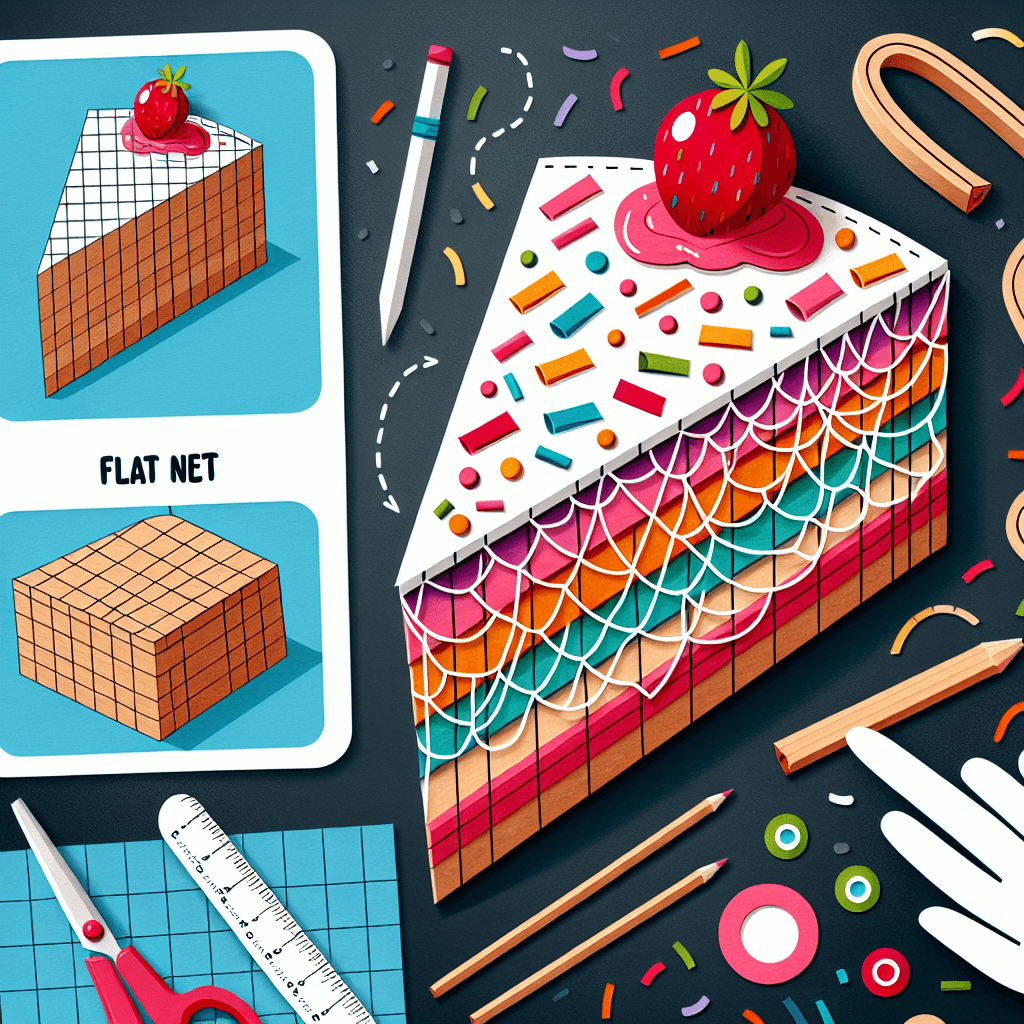
Cardboard Cake Slice Net Creation & Decoration
Inquiry Framework
Question Framework
Driving Question
The overarching question that guides the entire project.How can students use mathematical concepts and design principles to transform a two-dimensional net into a three-dimensional artistic cake slice that is both functional and visually appealing?Essential Questions
Supporting questions that break down major concepts.- How can the design of an object affect its functionality and aesthetics?
- What are the steps involved in transforming a two-dimensional shape into a three-dimensional model?
- How do colors, shapes, and textures influence visual perception in art?
- What techniques and materials can be used to construct durable and visually appealing art objects?
- How can mathematical concepts be applied creatively in art projects?
Standards & Learning Goals
Learning Goals
By the end of this project, students will be able to:- Students will understand and apply the concepts of two-dimensional nets and three-dimensional shapes in a practical, artistic context.
- Students will explore and utilize artistic materials and design principles to create a visually appealing and functional art piece.
- Students will develop problem-solving skills by transforming a two-dimensional net into a three-dimensional structure.
- Students will learn to measure, cut, and assemble materials accurately, highlighting the intersection of mathematics and art.
- Students will appreciate the role of color, texture, and form in visual perception and artistic expression.
National Core Arts Standards
Common Core Standards
Entry Events
Events that will be used to introduce the project to studentsBaking Challenge Announcement
Transform your love for cakes into art! Imagine entering a bakery where your next task is to design the most eye-catching slice of cake using cardboard. Explore cake design history, then bring your creativity to life by constructing and decorating a life-sized cake piece with fine details and personal flair.Portfolio Activities
Portfolio Activities
These activities progressively build towards your learning goals, with each submission contributing to the student's final portfolio.Design Your Slice Net
Students will begin their project by designing the net of their cake slice using graph paper. This activity encourages students to visualize and sketch a precise 2D net that can be folded into a 3D object.Steps
Here is some basic scaffolding to help students complete the activity.Final Product
What students will submit as the final product of the activityA detailed and precise 2D net of a cake slice on graph paper.Alignment
How this activity aligns with the learning objectives & standardsAligns with CCSS.MATH.CONTENT.5.G.A.2 and CCSS.MATH.CONTENT.5.MD.C.4 as it involves graphing points and measuring accurately to represent a real-world object.Cut & Construct: From Net to Slice
In this activity, students will cut out their net and assemble it into a 3D structure. This hands-on activity helps students understand the transition from a 2D net to a 3D model, emphasizing accuracy and craft skills.Steps
Here is some basic scaffolding to help students complete the activity.Final Product
What students will submit as the final product of the activityA 3D cardboard model of a cake slice, accurately transformed from a 2D net.Alignment
How this activity aligns with the learning objectives & standardsAligns with CCSS.MATH.CONTENT.5.MD.C.4 for measuring accurately and understanding volume and VA:Cr1.1.5 for creative assembly of materials.Decorate Your Creation
Students will use artistic techniques to decorate their cake slice, applying colors and textures to enhance its aesthetic appeal. This phase emphasizes artistic creativity and presentation skills.Steps
Here is some basic scaffolding to help students complete the activity.Final Product
What students will submit as the final product of the activityA beautifully decorated cake slice with rich textures and colors.Alignment
How this activity aligns with the learning objectives & standardsAligns with VA:Pr5.1.5 as it involves artistic presentation and recognizing how decoration affects personal and viewer response.Rubric & Reflection
Portfolio Rubric
Grading criteria for assessing the overall project portfolio3D Artistic Cake Slice Project Rubric
Design and Planning
Ability to create a precise and functional 2D net for the 3D model, demonstrating understanding of geometric shapes and measurements.Net Construction
The precision and accuracy of the 2D net design using graph paper.
Exemplary
4 PointsThe net is meticulously designed, with all components fitting together perfectly when assembled.
Proficient
3 PointsThe net is accurately designed with minor adjustments needed, and most components fit well.
Developing
2 PointsThe net has several inaccuracies in dimensions or alignments requiring significant adjustments during assembly.
Beginning
1 PointsThe net is incomplete or largely inaccurate, with parts that do not fit together.
Measurement and Scaling
Application of appropriate scales and measurements in the design and construction of the net.
Exemplary
4 PointsAll measurements are exact, and the scale is consistently applied throughout the design.
Proficient
3 PointsMeasurements are generally accurate with occasional minor errors in scaling.
Developing
2 PointsSeveral measurements are incorrect, affecting the overall design scale and assembly.
Beginning
1 PointsMeasurements are mostly incorrect, leading to significant scaling issues.
Construction Skills
Skill and precision in cutting and assembling the cardboard net into a 3D model.Assembly Precision
Alignment and assembly of cardboard pieces to form a stable 3D cake slice.
Exemplary
4 PointsConstruction is highly precise, all edges align perfectly, creating a stable and neat 3D model.
Proficient
3 PointsThe assembly is mostly precise with minor alignment issues affecting the final shape minimally.
Developing
2 PointsSeveral alignment issues lead to a wobbly or unstable 3D model.
Beginning
1 PointsMajor alignment problems, rendering the model unstable and incomplete.
Artistic Presentation
The creative decoration and presentation of the cake slice focusing on aesthetics and design principles.Creativity and Aesthetics
Innovation and visual appeal in the decoration of the cake slice, including use of color, texture, and design principles.
Exemplary
4 PointsThe decoration is exceptionally creative and aesthetically pleasing, with well-integrated colors and textures.
Proficient
3 PointsDecoration is creative and appealing, with effective use of colors and textures.
Developing
2 PointsDecoration shows basic creativity with inconsistent integration of design elements.
Beginning
1 PointsThe decoration is minimal with little evidence of thoughtful design or color usage.