
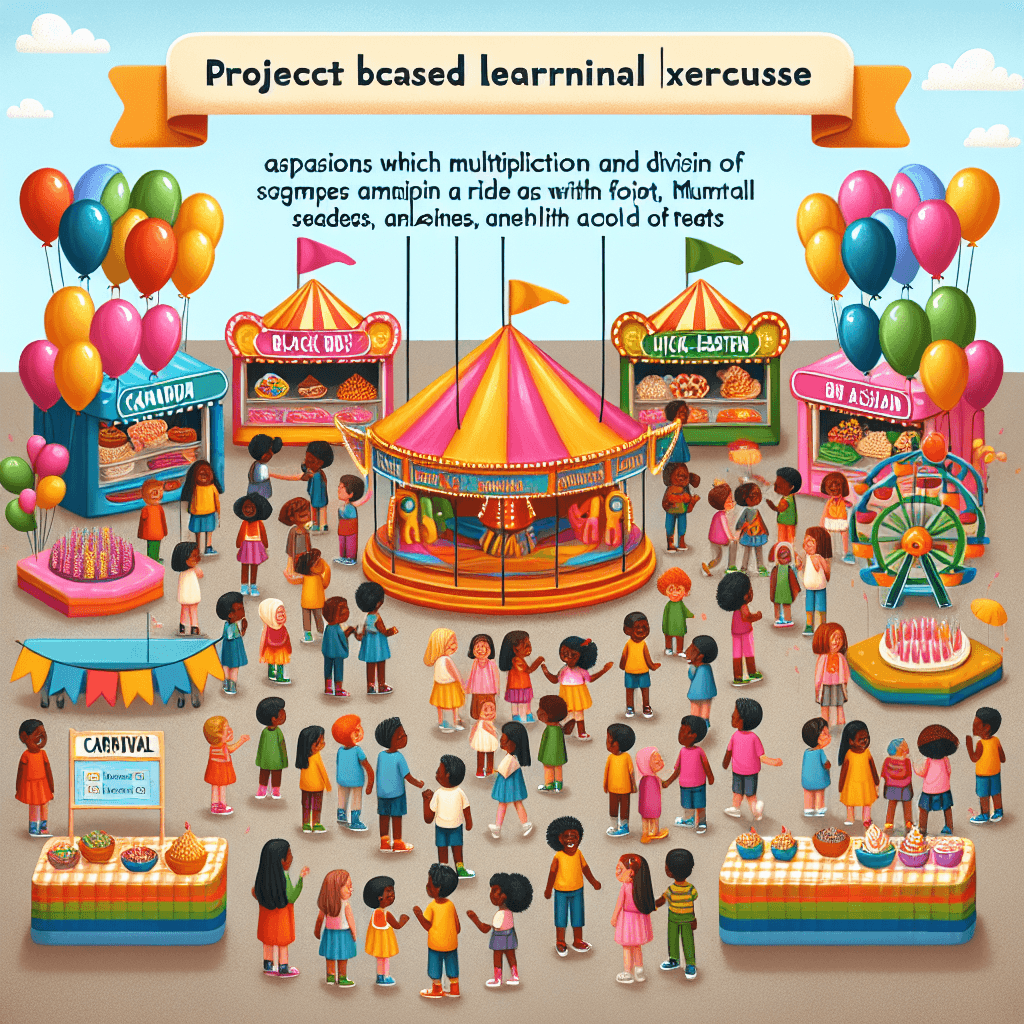
Carnival Planners: A Multiplication and Division Project
Inquiry Framework
Question Framework
Driving Question
The overarching question that guides the entire project.How can we use multiplication and division to plan a school carnival that is both fun and fair for everyone involved?Essential Questions
Supporting questions that break down major concepts.- How can multiplication help us plan for the carnival games and prizes?
- How can division help us make sure everyone has a chance to help?
- How can we use math to make sure the carnival is fun and fair for everyone?
Standards & Learning Goals
Learning Goals
By the end of this project, students will be able to:- Use multiplication to calculate costs/revenue for the carnival.
- Use division to share tasks and resources fairly.
- Apply math skills to ensure the carnival is fun and fair.
Entry Events
Events that will be used to introduce the project to studentsMystery of the Missing Carnival Tickets
The class arrives to find the carnival tickets are 'missing'! A frantic note from the principal says the carnival can't happen without them. Students must solve multiplication and division problems (clues) to find the hidden tickets and save the carnival.Portfolio Activities
Portfolio Activities
These activities progressively build towards your learning goals, with each submission contributing to the student's final portfolio.Carnival Blueprint: Multiplication Station
Students begin by brainstorming carnival game ideas and estimating the costs and potential revenue for each. This activity focuses on applying multiplication to real-world carnival planning.Steps
Here is some basic scaffolding to help students complete the activity.Final Product
What students will submit as the final product of the activityA detailed blueprint of each carnival game, including cost and potential revenue calculations using multiplication.Alignment
How this activity aligns with the learning objectives & standardsLearning Goal: Use multiplication to calculate costs/revenue for the carnival. Standard: MultiplicationDivision of Labor: Fair Share Task Assignment
Students explore how division can be used to fairly assign tasks and resources for the carnival. They learn to divide responsibilities equally among team members, ensuring everyone has a chance to contribute.Steps
Here is some basic scaffolding to help students complete the activity.Final Product
What students will submit as the final product of the activityA task assignment chart demonstrating how division ensures fair distribution of responsibilities.Alignment
How this activity aligns with the learning objectives & standardsLearning Goal: Use division to share tasks and resources fairly. Standard: DivisionFun and Fair Analysis: Ensuring Carnival Enjoyment
Students analyze different aspects of the carnival to ensure it is fun and fair for everyone. They will use their math skills to evaluate game fairness, ticket pricing, and prize distribution, making recommendations for improvements.Steps
Here is some basic scaffolding to help students complete the activity.Final Product
What students will submit as the final product of the activityA report with recommendations on how to improve the carnival's fairness and enjoyment, using mathematical analysis to support their suggestions.Alignment
How this activity aligns with the learning objectives & standardsLearning Goal: Apply math skills to ensure the carnival is fun and fair. Standard: Multiplication and DivisionRubric & Reflection
Portfolio Rubric
Grading criteria for assessing the overall project portfolioCarnival Planning Portfolio Rubric
Multiplication: Carnival Blueprint
Evaluates the student's ability to use multiplication to calculate costs and potential revenue for carnival games.Cost Calculation Accuracy
Accuracy in calculating the total costs for each carnival game using multiplication.
Exemplary
4 PointsCalculations are accurate, and all costs are accounted for with clear explanations.
Proficient
3 PointsCalculations are mostly accurate, with minor errors or omissions. Explanations are present.
Developing
2 PointsCalculations contain significant errors, and some costs are missing. Explanations are incomplete.
Beginning
1 PointsCalculations are largely inaccurate, and many costs are not accounted for. No explanations are provided.
Revenue Estimation
Realism and justification of revenue estimates for each game based on multiplication.
Exemplary
4 PointsProvides realistic revenue estimates with clear justification based on the number of tickets and price per ticket.
Proficient
3 PointsProvides revenue estimates with reasonable justification but may have minor inconsistencies.
Developing
2 PointsProvides revenue estimates but lacks sufficient justification or demonstrates inconsistencies.
Beginning
1 PointsProvides unrealistic revenue estimates with no justification.
Blueprint Clarity
Clarity and organization of the game blueprints, including detailed cost and revenue information.
Exemplary
4 PointsBlueprint is exceptionally clear, well-organized, and includes all necessary cost and revenue details. Easy to understand and implement.
Proficient
3 PointsBlueprint is clear, well-organized, and includes most of the necessary cost and revenue details.
Developing
2 PointsBlueprint is somewhat disorganized, and some cost or revenue details are missing.
Beginning
1 PointsBlueprint is unclear, disorganized, and lacks essential cost and revenue details.
Division: Fair Share Task Assignment
Evaluates the student's ability to use division to fairly assign tasks and resources for the carnival.Task Identification
Completeness in identifying all tasks needed to run the carnival.
Exemplary
4 PointsIdentifies all necessary tasks to run the carnival efficiently.
Proficient
3 PointsIdentifies most of the necessary tasks, with only minor omissions.
Developing
2 PointsIdentifies some of the necessary tasks, but several key tasks are missing.
Beginning
1 PointsIdentifies very few of the necessary tasks.
Fair Task Assignment
Effectiveness of using division to assign tasks fairly among students.
Exemplary
4 PointsUses division effectively to ensure tasks are assigned fairly and equally, maximizing student involvement.
Proficient
3 PointsUses division to assign tasks, with minor imbalances in workload distribution.
Developing
2 PointsAttempts to use division, but the task assignments are uneven and unfair.
Beginning
1 PointsDoes not use division effectively, and task assignments are highly unequal.
Task Assignment Chart
Clarity and organization of the task assignment chart.
Exemplary
4 PointsTask assignment chart is exceptionally clear, well-organized, and easy to understand, showing each student's role and responsibilities.
Proficient
3 PointsTask assignment chart is clear and organized, showing most student roles and responsibilities.
Developing
2 PointsTask assignment chart is somewhat disorganized, and some student roles or responsibilities are unclear.
Beginning
1 PointsTask assignment chart is unclear, disorganized, and difficult to understand.
Fun and Fair Analysis: Carnival Enjoyment
Evaluates the student's analysis of the carnival's fairness and enjoyment, using math to propose improvements.Fairness Evaluation
Thoroughness in evaluating the fairness of games, ticket pricing, and prize distribution.
Exemplary
4 PointsProvides a comprehensive evaluation of game fairness, ticket pricing, and prize distribution, identifying potential inequities.
Proficient
3 PointsEvaluates game fairness, ticket pricing, and prize distribution, with some consideration of potential inequities.
Developing
2 PointsEvaluates some aspects of fairness but misses key areas of potential inequity.
Beginning
1 PointsProvides a superficial evaluation of fairness with little or no consideration of potential inequities.
Mathematical Justification
Use of math to support recommendations for improving fairness and enjoyment.
Exemplary
4 PointsUses math effectively to justify all recommendations for improving fairness and enjoyment, showing clear calculations and reasoning.
Proficient
3 PointsUses math to justify most recommendations for improving fairness and enjoyment, with minor gaps in reasoning.
Developing
2 PointsAttempts to use math, but the justification for recommendations is weak or unclear.
Beginning
1 PointsProvides recommendations without any mathematical justification.
Recommendation Quality
Practicality and potential impact of recommendations on improving the carnival's fairness and enjoyment.
Exemplary
4 PointsProvides highly practical and impactful recommendations that significantly improve the carnival's fairness and enjoyment. Demonstrates innovation and deep understanding.
Proficient
3 PointsProvides practical recommendations that improve the carnival's fairness and enjoyment.
Developing
2 PointsProvides recommendations that have limited impact on the carnival's fairness and enjoyment.
Beginning
1 PointsProvides impractical or irrelevant recommendations.