
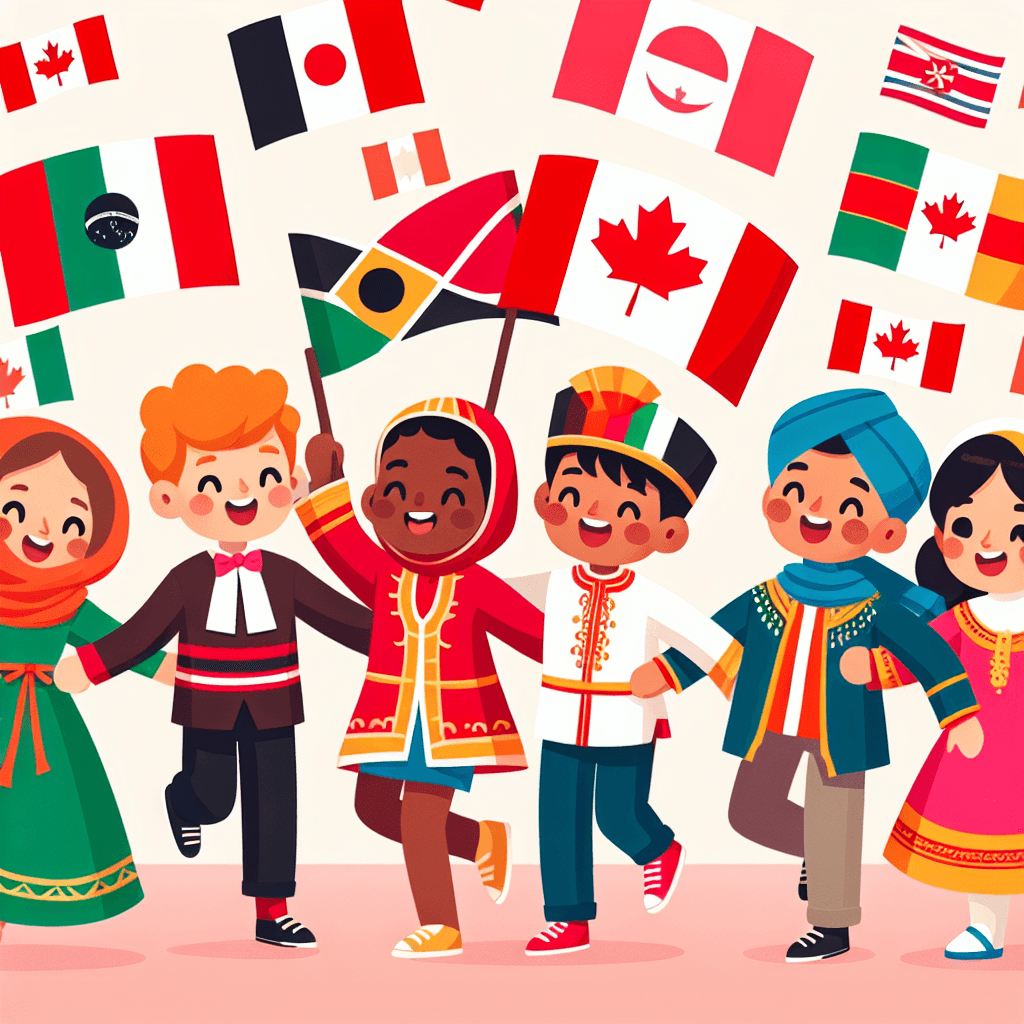
Celebrating Canada's Cultural Diversity Day
Inquiry Framework
Question Framework
Driving Question
The overarching question that guides the entire project.How can we create a Cultural Celebration Day event that showcases the diverse cultures of Canada and teaches us about their unique traditions and celebrations?Essential Questions
Supporting questions that break down major concepts.- What makes Canada a diverse country?
- What are some different cultures found in Canada?
- How do people from different cultures celebrate their traditions and beliefs?
- Why is it important to learn about and celebrate different cultures?
Standards & Learning Goals
Learning Goals
By the end of this project, students will be able to:- Students will identify and describe at least five different cultures found within Canada.
- Students will be able to explain the importance of cultural diversity and why it is important to celebrate different traditions.
- Students will participate in creating a class event that showcases diverse cultural traditions, enhancing their understanding through hands-on learning.
- Students will work collaboratively to design informative displays and presentations about various Canadian cultures.
- Students will develop appreciation and respect for cultural diversity by engaging with peers from different backgrounds.
Canadian Social Studies Standards
Common Core Standards
Next Generation Science Standards
Entry Events
Events that will be used to introduce the project to studentsCultural Treasure Hunt
Set up a classroom treasure hunt with items from various Canadian cultures hidden around. Provide clues that lead to each item, encouraging students to inquire about the item's cultural significance.Portfolio Activities
Portfolio Activities
These activities progressively build towards your learning goals, with each submission contributing to the student's final portfolio.Cultural Conversation Circles
Facilitate a discussion session where students share their insights and learnings about different Canadian cultures, enhancing communication skills and appreciation for diversity.Steps
Here is some basic scaffolding to help students complete the activity.Final Product
What students will submit as the final product of the activityA collective list of cultural insights enhanced by individual contributions during circle time.Alignment
How this activity aligns with the learning objectives & standardsCCSS.ELA-LITERACY.SL.1.1 (Collaborative conversations) and SOC.1.1 (Recognize diversity).Creative Culture Collage
Students will create collages using pictures, labels, and drawings to represent what they have learned about different Canadian cultures. This activity synthesizes their knowledge visually.Steps
Here is some basic scaffolding to help students complete the activity.Final Product
What students will submit as the final product of the activityA personal creative collage representing various Canadian cultures, displayed in the classroom.Alignment
How this activity aligns with the learning objectives & standardsSOC.1.1 (Recognize diversity) and NGSS.D2.Geo.7.K-2 (Explain movement of ideas).Tradition Troupe Presentations
In small groups, students will research a specific Canadian culture. They will prepare a short presentation or skit depicting a tradition, story, or celebration from that culture, promoting teamwork and deeper understanding.Steps
Here is some basic scaffolding to help students complete the activity.Final Product
What students will submit as the final product of the activityGroup presentations or skits that bring to life cultural traditions and celebrations from across Canada.Alignment
How this activity aligns with the learning objectives & standardsSOC.1.1 (Recognize diversity), CCSS.ELA-LITERACY.SL.1.1 (Collaborative conversations), and CCSS.ELA-LITERACY.RI.1.7 (Using illustrations and details).Rubric & Reflection
Portfolio Rubric
Grading criteria for assessing the overall project portfolioCultural Celebration Day Assessment Rubric
Understanding and Application of Cultural Diversity
This category assesses the extent to which students recognize, understand, and apply knowledge about the diversity of Canadian cultures.Cultural Recognition and Explanation
Evaluates student's ability to identify and explain various Canadian cultures and their significance.
Exemplary
4 PointsProvides a comprehensive and detailed explanation of at least five different Canadian cultures, including nuanced insights into traditions and celebrations.
Proficient
3 PointsIdentifies and explains at least five Canadian cultures, highlighting key traditions and celebrations.
Developing
2 PointsIdentifies a few Canadian cultures with basic explanations of their traditions and celebrations.
Beginning
1 PointsStruggles to identify Canadian cultures and provide adequate explanations of their traditions and celebrations.
Importance of Cultural Diversity
Assesses the student's ability to articulate why cultural diversity is important and deserves celebration.
Exemplary
4 PointsArticulates a sophisticated understanding of the importance of cultural diversity with detailed examples.
Proficient
3 PointsClearly explains the importance of cultural diversity using relevant examples.
Developing
2 PointsProvides a basic explanation of the importance of cultural diversity with limited examples.
Beginning
1 PointsStruggles to explain the importance of cultural diversity and lacks examples.
Collaborative Engagement
This category assesses how effectively students participate in and contribute to collaborative conversations and group activities.Participation in Discussions and Activities
Evaluates the student's level of engagement and contribution during class discussions and group tasks.
Exemplary
4 PointsActively participates, offering constructive ideas and questions, and shows leadership in group settings.
Proficient
3 PointsParticipates consistently, contributes relevant ideas and questions during group activities.
Developing
2 PointsParticipates sporadically, occasionally contributing ideas or questions in group settings.
Beginning
1 PointsRarely participates and offers limited ideas or questions in group contexts.
Creative Expression and Product Design
This category evaluates the student's ability to creatively express cultural knowledge and design informative presentations.Quality and Creativity of Cultural Products
Assesses the creativity and quality of student-produced collages and presentations.
Exemplary
4 PointsProduces highly creative and detailed cultural products that effectively convey diverse cultural elements.
Proficient
3 PointsProduces well-designed and creative cultural products that highlight key cultural elements.
Developing
2 PointsProduces cultural products that contain basic cultural elements but lack detailed creativity.
Beginning
1 PointsProduces cultural products with minimal cultural elements and creativity.
Beginning
1 PointsRarely participates and offers limited ideas or questions in group contexts.
Presentation Skills
Evaluates how clearly and effectively the student presents information about their assigned culture.
Exemplary
4 PointsDelivers an engaging, well-organized presentation that effectively communicates cultural information with strong articulation.
Proficient
3 PointsPresents information clearly and with satisfactory organization and articulation.
Developing
2 PointsPresents information with basic clarity but struggles with organization and articulation.
Beginning
1 PointsStruggles to present information clearly, with minimal organization and articulation.