
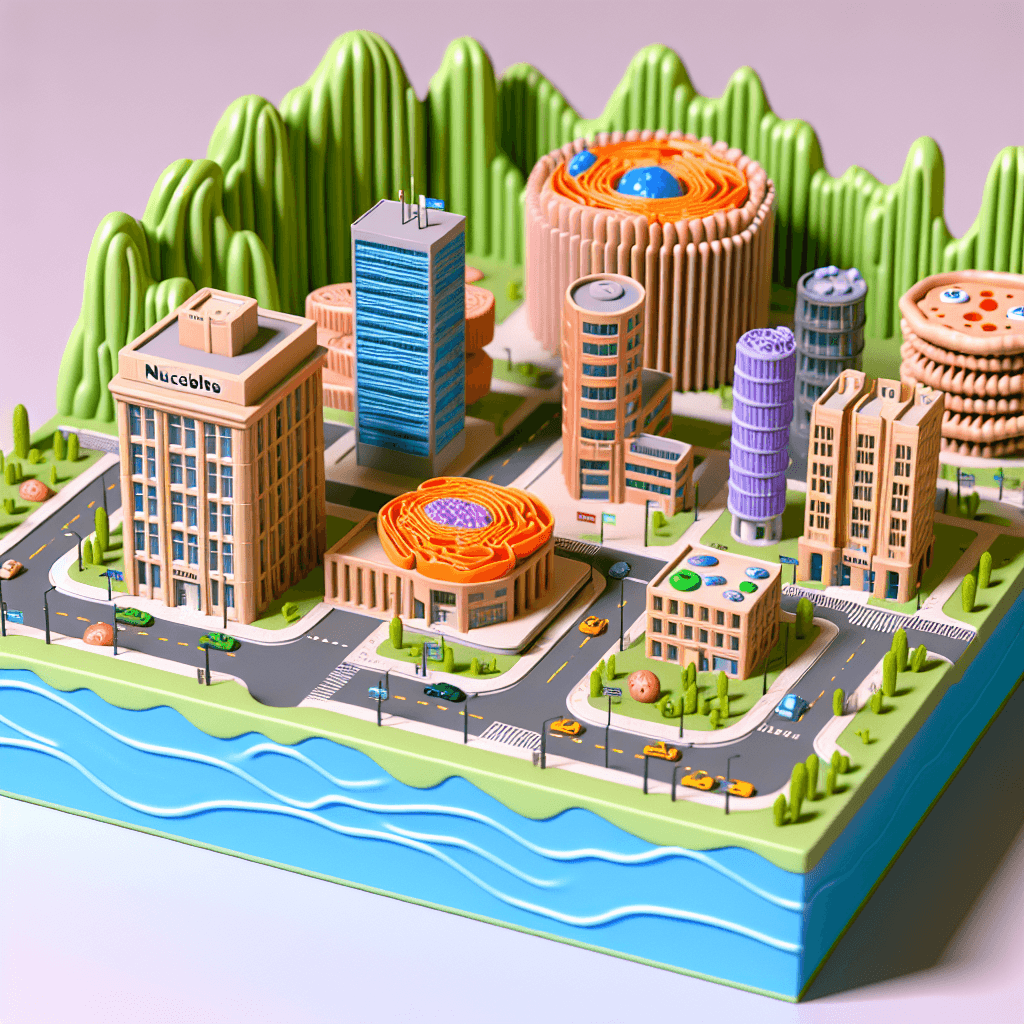
Cell City: 3D Organelle Models
Inquiry Framework
Question Framework
Driving Question
The overarching question that guides the entire project.How can we design a 3D city model that effectively represents the structures and functions of a cell's organelles and demonstrates the interdependencies between them, highlighting the differences between plant and animal cells?Essential Questions
Supporting questions that break down major concepts.- How do the different parts of a cell work together to keep it alive?
- What is the main function of each organelle within a cell?
- How are plant and animal cells similar and different in terms of their organelles?
- Can you create an analogy to a city to help explain how a cell functions?
- How does the structure of an organelle relate to its function in the cell?
Standards & Learning Goals
Learning Goals
By the end of this project, students will be able to:- Students will be able to identify and describe the function of major cell organelles (nucleus, mitochondria, ribosomes, endoplasmic reticulum, Golgi apparatus, lysosomes, vacuoles, cell membrane, cell wall, chloroplasts).
- Students will be able to compare and contrast plant and animal cells, explaining the unique functions of specific organelles.
- Students will be able to create an analogy between a cell and a city, demonstrating the interconnectedness of cellular components.
- Students will be able to design and construct a 3D model of a plant or animal cell, accurately labeling and representing the organelles.
Teacher Provided Standard
Entry Events
Events that will be used to introduce the project to studentsMysterious Box Challenge
Present students with a mysterious box containing various everyday objects (e.g., a battery, a control panel, a storage container). Challenge them to figure out how these objects relate to the different parts of a cell and their functions. This sparks curiosity and encourages systems thinking.Portfolio Activities
Portfolio Activities
These activities progressively build towards your learning goals, with each submission contributing to the student's final portfolio.Organelle Trading Cards
Students will research and create informational trading cards for each organelle, detailing its structure and function.Steps
Here is some basic scaffolding to help students complete the activity.Final Product
What students will submit as the final product of the activityA set of trading cards, one for each organelle, with accurate information and visuals.Alignment
How this activity aligns with the learning objectives & standardsStudents will be able to identify and describe the function of major cell organelles (nucleus, mitochondria, ribosomes, endoplasmic reticulum, Golgi apparatus, lysosomes, vacuoles, cell membrane, cell wall, chloroplasts).Cell City Comparison
Students will work in pairs to create a Venn diagram comparing and contrasting plant and animal cells. They will use their organelle trading cards as a reference.Steps
Here is some basic scaffolding to help students complete the activity.Final Product
What students will submit as the final product of the activityA Venn diagram visually representing the similarities and differences between plant and animal cells.Alignment
How this activity aligns with the learning objectives & standardsStudents will be able to compare and contrast plant and animal cells, explaining the unique functions of specific organelles.City Analogy
Students will brainstorm and create analogies between cell organelles and parts of a city. This activity helps them understand the interconnectedness of cellular components.Steps
Here is some basic scaffolding to help students complete the activity.Final Product
What students will submit as the final product of the activityA written explanation of the chosen city analogy, explaining how each organelle corresponds to a part of the city and why.Alignment
How this activity aligns with the learning objectives & standardsStudents will be able to create an analogy between a cell and a city, demonstrating the interconnectedness of cellular components.3D Cell Model Construction
Students will design and build a 3D model of either a plant or animal cell using various materials. They will label each organelle and provide a brief description of its function.Steps
Here is some basic scaffolding to help students complete the activity.Final Product
What students will submit as the final product of the activityA 3D cell model with accurately labeled organelles and descriptions of their functions.Alignment
How this activity aligns with the learning objectives & standardsStudents will be able to design and construct a 3D model of a plant or animal cell, accurately labeling and representing the organelles.Rubric & Reflection
Portfolio Rubric
Grading criteria for assessing the overall project portfolioCell City Project Rubric
Understanding of Cell Organelles
Assesses the ability to identify and accurately describe the function of cell organelles.Identification of Organelles
Identifies major organelles in plant and animal cells.
Exemplary
4 PointsAccurately identifies all major organelles in both plant and animal cells.
Proficient
3 PointsIdentifies most major organelles in both plant and animal cells.
Developing
2 PointsIdentifies some major organelles, but with inaccuracies.
Beginning
1 PointsStruggles to identify major organelles.
Description of Organelles
Provides accurate and detailed descriptions of organelle functions.
Exemplary
4 PointsProvides detailed and accurate descriptions for all organelle functions.
Proficient
3 PointsProvides accurate descriptions for most organelle functions.
Developing
2 PointsProvides basic descriptions with some inaccuracies.
Beginning
1 PointsProvides incomplete or inaccurate descriptions.
Analogical Thinking
Evaluates the creativity and accuracy of analogies made between the cell and a city.Relevance of City Analogy
Creates accurate analogies between organelles and city components.
Exemplary
4 PointsAll analogies are clear and accurately reflect organelle functions.
Proficient
3 PointsMost analogies are clear and accurately reflect organelle functions.
Developing
2 PointsSome analogies are unclear or inaccurately reflect functions.
Beginning
1 PointsAnalogies are unclear or mostly inaccurate.
Construction and Presentation
Assesses the quality of the 3D model and its presentation.Accuracy of Model
Constructs a 3D model that accurately represents the cell and its organelles.
Exemplary
4 PointsModel is highly accurate with all organelles properly represented and placed.
Proficient
3 PointsModel is mostly accurate with most organelles properly represented and placed.
Developing
2 PointsModel has several inaccuracies or missing organelles.
Beginning
1 PointsModel is largely inaccurate or incomplete.
Presentation and Labeling
Effectively labels organelles and explains model construction.
Exemplary
4 PointsAll organelles are clearly labeled with concise, accurate explanations.
Proficient
3 PointsMost organelles are clearly labeled with accurate explanations.
Developing
2 PointsLabels are unclear or explanations are inaccurate or incomplete.
Beginning
1 PointsLabels are mostly missing or incorrect.